
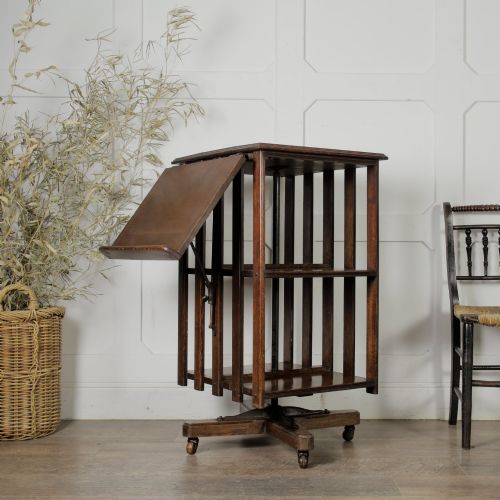
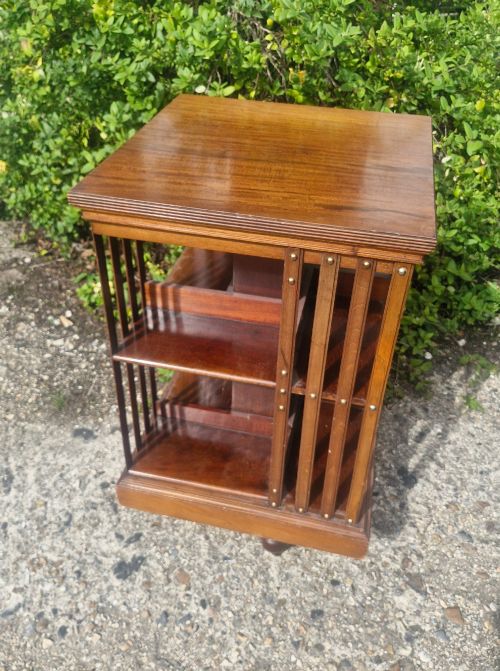
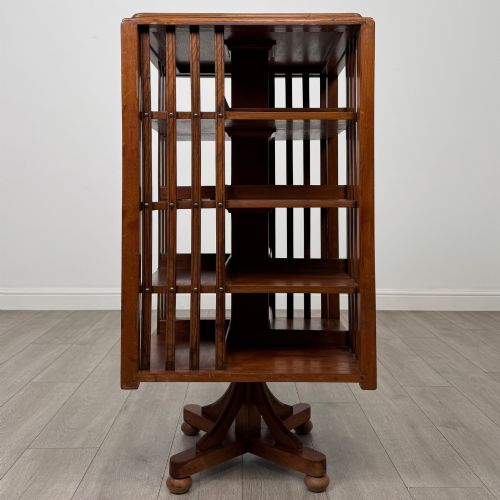
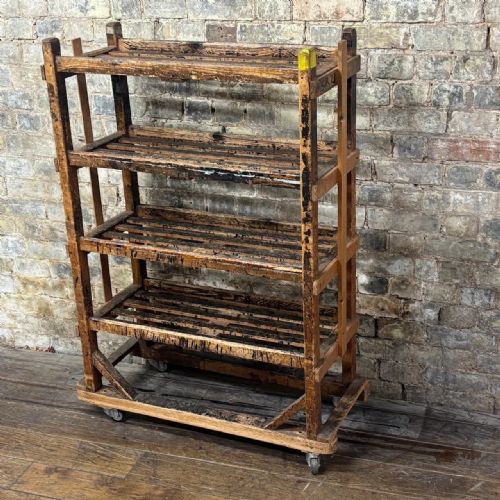
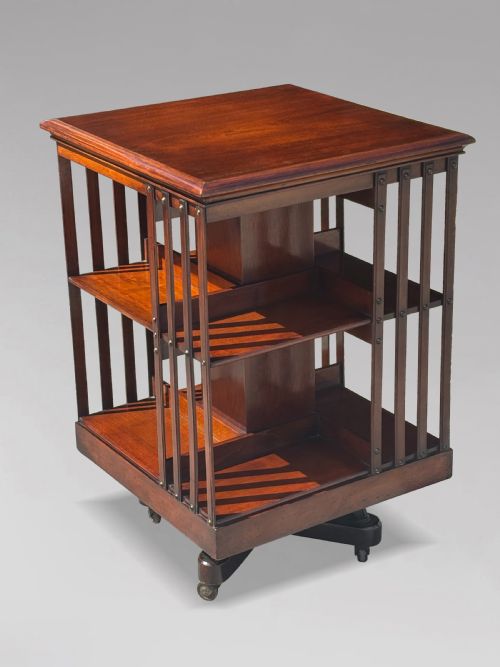
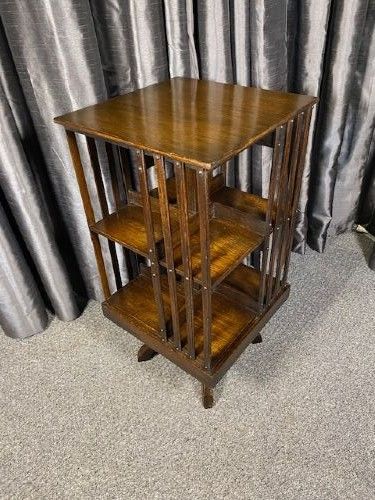
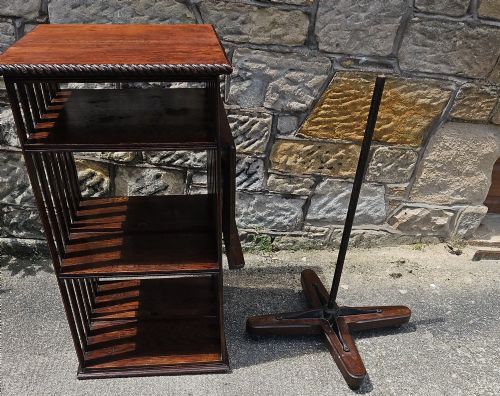


Antique Slatted Bookcase
These revolving bookcases and storage pieces are sturdy additions to a study, bringing practical timber construction and smooth rotation to your collection.
Antique Slatted Bookcase
The timber framework typically incorporates vertical slats around the circumference, allowing a clear view of the book spines from any angle in the room. Alongside revolving bookcases, related storage forms such as larder cupboards and bakers racks occasionally appear within this category.
Originating predominantly from British workshops of the Victorian and Edwardian eras, these pieces combine functional utility with compact proportions well suited to traditional interiors.
How they were made
Cabinet makers relied primarily on solid mahogany and oak to construct the main bodies of these pieces, selecting timber for its strength and grain figure. Brass and cast iron mechanisms were integrated beneath the shelves to enable smooth rotation without sticking.
The slatted walls were assembled using precise joinery, securing individual wooden laths evenly around the revolving drum to withstand the weight of heavy books.
The current selection spans the Edwardian era and the nineteenth century, built primarily from mahogany and oak.
What varies in quality
The refinement of the internal revolving mechanism dictates the mechanical success of the piece, with superior examples turning silently and evenly on ball-bearing castors. Timber selection also divides the standard range from the exceptional, particularly where figured mahogany or quarter-sawn oak is utilised.
Proportion and structural crispness define the visual hierarchy, where tighter slat spacing and well-defined mouldings separate standard workshop output from finer cabinet work.
Heals
The Antique Slatted Bookcase Glossary
- Revolving bookcase
- A tabletop or floor-standing bookcase mounted on a hidden central pivot allowing it to spin freely. This design provides immediate access to multiple shelves of books from a single seated position.
- Quarter-sawn oak
- Timber cut radially from the growth rings to produce a distinct flecked grain pattern. This method yields boards that are less prone to warping over time.
- Slats
- Narrow strips of wood arranged vertically or horizontally to form an open barrier. In these bookcases, they create light partitions around the revolving tiers.
- Edwardian
- The period of British history spanning the reign of King Edward VII from nineteen hundred to nineteen ten. Furniture from this era often retains lighter proportions than its Victorian predecessor.
Antique Slatted Bookcase: Frequently Asked Questions
How do I lubricate a stiff revolving bookcase?
Access the central mechanism underneath the base by gently tilting the structure if the design permits safely. Apply a small amount of light machine oil to the pivot bearing.
Avoid using heavy greases that attract dust and lint over time. Turn the bookcase several times to distribute the oil evenly across the moving parts.
Can these bookcases hold heavy hardback books?
Solid oak and mahogany construction provides ample strength for standard library volumes and hardback novels. The revolving tiers are engineered to bear considerable weight when balanced properly.
Distribute heavier volumes on the lower shelves to maintain stability during rotation. Avoid overloading the upper tiers to prevent strain on the central pivot.
How do I distinguish Edwardian from Victorian models?
Edwardian examples generally exhibit lighter timber tones and simpler architectural lines compared to earlier nineteenth-century pieces. Late Victorian items often feature darker mahogany finishes and heavier mouldings. Nail construction, timber preparation, and secondary woods inside the carcass further clarify the manufacturing period.
Where should I place a revolving bookcase in a room?
These pieces function best near armchairs, desks, or in corners where access from multiple angles is practical. Ensure adequate clearance around the entire circumference so the revolving tiers spin without striking walls or furniture.
Keep timber pieces away from direct heat sources and strong sunlight to prevent the wood from drying out or fading.