
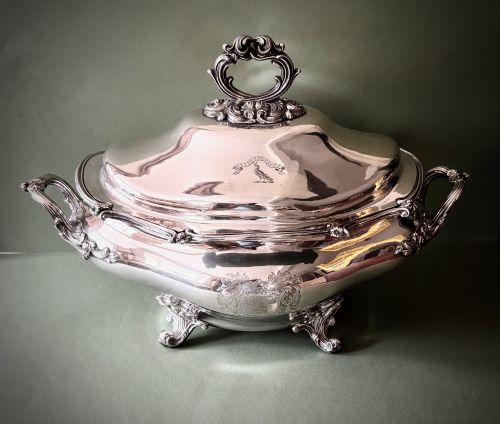
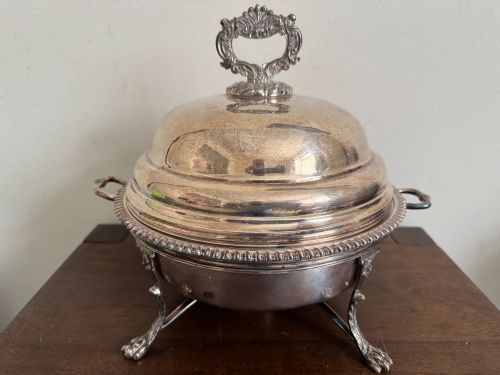


Antique Silvered Vegetable Dish
An antique silvered vegetable dish brings heavy metal covers and warming bases to the dining table.
Antique Silvered Vegetable Dish
An antique silvered vegetable dish serves as a covered vessel for dining table presentation, appearing in forms such as entree dishes, sauce tureens, and asparagus dishes. These serveware pieces originate across periods from the Georgian era through to Art Deco, encompassing Regency, Victorian, and Edwardian designs.
The most common examples encountered here are silver plated entree dishes from the Edwardian period and the nineteenth century, frequently shaped as rectangular or oval lidded vessels. Alongside these sit Old Sheffield Plate tureens and sterling silver supper dishes complete with lampstands.
Makers stamp or mark many of these metal serving vessels, linking individual pieces to silversmiths and electroplating firms based in Britain and France. Their utility spans large dining gatherings, keeping food warm before carving or service.
Distinctions in Quality
Quality rests upon the weight of the metal, the crispness of cast borders and handles, and the integrity of the underlying base metal beneath the silver plating. Heavier gauge vessels retain heat better and resist distortion from daily use and polishing.
Design complexity also separates standard utility pieces from exceptional items, seen in crested lids, original warming stands, and matched pairs by notable makers. The retention of the original silver layer without excessive base metal telegraphing through indicates superior preservation.
Listings feature serving pieces spanning the Georgian, Victorian, Edwardian, and Art Deco eras, constructed from sterling silver, Old Sheffield Plate, and silver plate.
Mappin and Webb·William Grundy·Hamilton and Inches·Edward and John Barnard·Walker and Hall·Elkington·Matthew Linwood·William Hutton and Sons·Cresswick·Christofle / Gallia
The Antique Silvered Vegetable Dish Glossary
- Old Sheffield Plate
- A composite material made by fusing a sheet of silver to a copper ingot before rolling into sheets. This technique predates modern electroplating.
- Entree Dish
- A shallow lidded vessel designed for serving portions of vegetables or meat at the dining table. They often feature removable handles for versatile stacking.
- Tureen
- A deep, bowl-shaped serving vessel with a cover, used historically for soups, sauces, or vegetables. Handles typically project from the sides for lifting.
- EPNS
- Electroplated Nickel Silver, a common base metal composition coated with a thin layer of silver through an electrolytic process. It became widespread during the Victorian era.
- Lampstand
- A metal frame equipped with a burner underneath to keep a food dish warm during long meals. These accompany select Georgian and nineteenth-century supper dishes.
Antique Silvered Vegetable Dish: Frequently Asked Questions
What is the difference between an entree dish and a tureen?
An entree dish is typically shallow and rectangular or oval, designed for solid foods like vegetables or meats, and often includes a reversible lid that doubles as a second dish. A tureen is deeper and bowl-shaped, built primarily for liquids such as soups or gravies.
Both items served similar functions at formal dining tables, but their physical profiles reflect the specific food types they were manufactured to hold during the Georgian and Victorian periods.
How do I care for silver plated tableware?
Silver plated items require gentle cleaning with non-abrasive silver polishes to prevent wearing through the thin silver layer to the underlying copper or nickel. Hand washing with mild soap and drying immediately preserves the finish.
Storage in tarnish-resistant cloths or bags helps maintain the bright appearance of the metal when the dishes are not in active use on the dining table.
How can I tell Old Sheffield Plate from electroplate?
Old Sheffield Plate often reveals a thin line of copper showing along the cut edges or wear spots where the fused silver layer has worn away through centuries of polishing. Electroplated nickel silver reveals a greyish or yellowish nickel base metal when the silver wears off.
Examining the weight, manufacture date clues, and edge characteristics helps distinguish the older fused technique from later nineteenth-century electrodeposition methods.
Can these antique dishes still be used for serving food?
These pieces function well for serving dry foods and warm vegetables, provided the plating remains intact and clean. Many owners use them for holiday dinners or modern entertaining.
Acidic foods should not be left in silver plated dishes for extended periods, and users must avoid abrasive scrubbers that damage the historic surface.