



Antique Silver Table Forks
Antique silver table forks are substantial Georgian dining implements that bring period heft and genuine craftsmanship to any formal table setting.
What antique silver table forks are
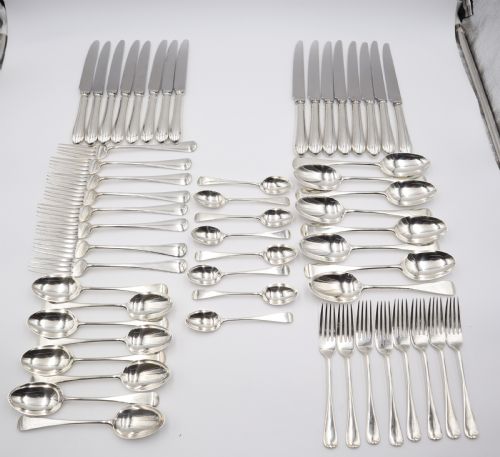
Antique silver table forks are formal dining utensils originating from the Georgian era, built for heavy daily service at the dining table. These pieces generally date from the mid-eighteenth century, representing a time when silver flatware was entirely hand-wrought by skilled silversmiths.
The versions most commonly met on this page include sterling silver examples executed in the Hanoverian pattern and the later Fiddle pattern. They display the characteristic weight and balance of eighteenth-century tableware, quite distinct from modern stamped steel alternatives.
How they were made
These forks are fashioned from sterling silver, forged by hand from heavy gauge metal to withstand the rigours of period dining. The tines are individually shaped and filed, while the stems feature distinct Hanoverian ridges or Fiddle shoulders.
Makers struck their hallmarks directly into the reverse of the stem, recording the sterling standard, the assay office, and the date letter for the year of production.
Listings for antique silver table forks span the Georgian period and utilise solid sterling silver materials.
What varies in quality
Quality in these forks depends largely on the preservation of the original weight and the crispness of the hallmarks struck into the metal. Excessive polishing over the centuries wears down the sharp definition of the tines and softens the engraved crests or initials.
The thickness of the stem at the junction where the handle meets the tines indicates superior manufacture, as lighter pieces suffer from bending under pressure. Surviving makers' marks that remain deep and legible add significantly to the integrity of the piece.
The Antique Silver Table Forks Glossary
- Hanoverian pattern
- An early style of flatware featuring a upturned rounded end with a central ridge down the front of the handle. It dominated British dining tables through much of the eighteenth century.
- Fiddle pattern
- A nineteenth-century flatware design characterised by a shoulder on the handle resembling the body of a violin. It succeeded the Hanoverian style in popularity.
- Sterling silver
- An alloy consisting of ninety-two point five percent silver and seven point five percent other metals, usually copper, to provide durability. British pieces carry the lion passant mark to confirm this standard.
- Hallmark
- An official stamp applied by an assay office to guarantee the purity of the precious metal. It typically includes the maker's mark, standard mark, assay office mark, and date letter.
Frequently Asked Questions
How do I clean antique silver table forks?
Wash them gently in warm soapy water using a soft cloth, avoiding abrasive dips or harsh scrubbing brushes.
Dry them immediately with a clean cotton tea towel to prevent water spots and preserve the natural patina.
Can I use antique silver forks every day?
These forks were originally made for daily dining and possess a robust sterling silver construction suited to regular handling.
Hand wash them after every meal and store them in a lined case to protect the soft metal from scratching.
What is the difference between Hanoverian and Fiddle patterns?
Hanoverian forks feature a distinct upturned terminal with a central spine down the stem, popular during the Georgian period.
Fiddle forks display a widened shoulder near the end of the handle, a shape that became widespread in the following century.
How do I read the hallmarks on old silver?
Look for the series of small stamped symbols usually found on the reverse side of the handle stem.
These marks identify the specific assay office, the silver standard, and the exact year the fork was tested and entered into trade.