
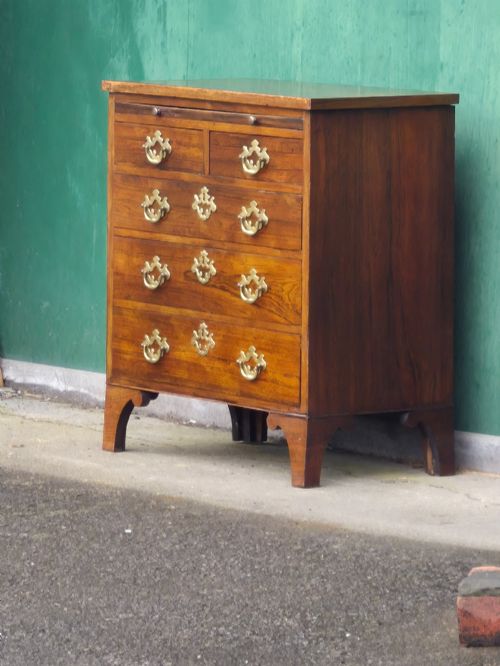


Antique Rosewood Commode
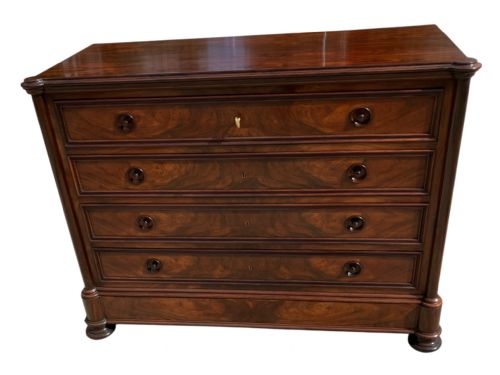
An antique rosewood commode brings warmth and grand proportion to a room, offering deep drawers and a striking timber surface.
Antique Rosewood Commode
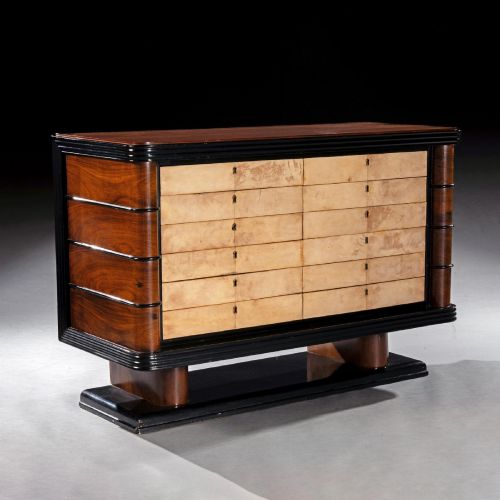
When you search for an antique rosewood commode, you encounter substantial storage furniture primarily originating from French workshops alongside English and Swedish examples. These pieces span periods from the eighteenth century through the nineteenth century, with later revivals appearing into the twentieth century.
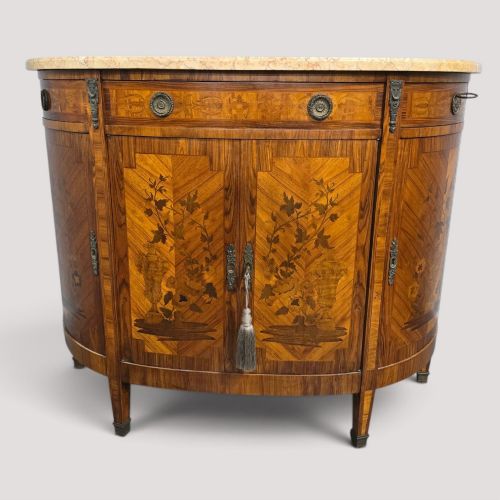
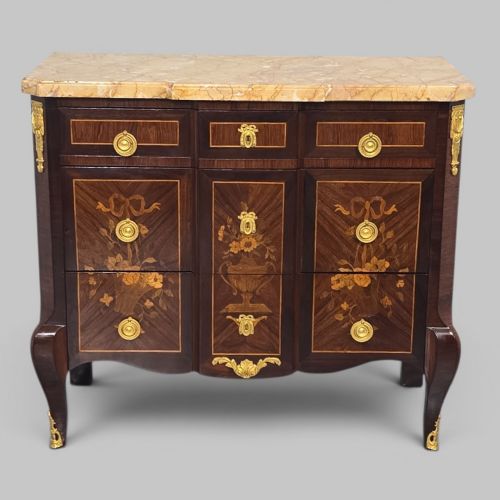
The most common form on this page is the French chest of drawers, often featuring shaped serpentine fronts and fitted marble tops. Alongside full-sized chests, smaller variations such as bedside tables, side cabinets, and miniature furniture emerge within the selection.
Stylistically, pieces draw heavily upon Louis XV and Louis XVI designs, displaying transitional curves or neoclassical lines. Makers frequently employed rich veneers, resulting in varied geometric or floral patterns across the drawer fronts and sides.
Materials and construction
Cabinet makers utilised dense tropical rosewood alongside contrasting timbers like kingwood, walnut, tulipwood, and satinwood to create complex marquetry patterns. These choice veneers were laid over sturdier secondary woods, forming rich visual fields across the body of the chest.
Heavy use of marble provided durable, cool-to-the-touch tops for many of the French and Swedish models. Artisans also integrated cast or chased ormolu, gilt bronze, and brass mounts to accent the corners, handles, and apron feet.
Joinery involved traditional hand-cut dovetailing for the drawer carcases, ensuring structural longevity. The integration of bronze and brass hardware required precise chiselling to fit flush against the curved timber surfaces.
Judging the range
The standard of execution in the marquetry separates the exceptional piece from the ordinary. Finer examples display meticulous control of grain direction and timber colour, creating intricate floral or pictorial scenes that align seamlessly across drawer divides.
The quality of the mount work tells its own story. Crisp, heavily chased ormolu and well-weighted bronze hardware indicate superior workshop production compared to lighter, softly cast brass fittings.
Preservation of the original marble top and the depth of the timber's patina heavily influence the standing of a commode. Untouched surfaces retain a soft sheen that reflects the age of the piece far better than heavily stripped and revarnished examples.
Mercier Frères
The Antique Rosewood Commode Glossary
- Marquetry
- The art of forming decorative patterns by fitting together small pieces of veneer. Artisans selected various coloured woods to create pictorial or geometric designs.
- Ormolu
- Gilt bronze mounts applied to furniture for decoration. This technique involved coating a bronze base with a finely ground gold-mercury amalgam.
- Serpentine
- A furniture front or top shaped with a central convex curve flanked by two concave curves. It requires advanced woodworking skill to veneer accurately.
- Bombe
- A swollen or bulging out shape typical of eighteenth-century case furniture. This curved profile demands exceptional mastery from the cabinet maker.
- Demi-lune
- Half-moon shaped furniture designed to sit flat against a wall. These smaller tables and cabinets often served as decorative side pieces.
Antique Rosewood Commode: Frequently Asked Questions
Where should I place a commode?
These statement pieces anchor a hallway, living room, or master bedroom very effectively.
Their generous surface areas also provide ideal spots for lamps, mirrors, or decorative objects.
How do I clean the marble top?
Wipe the surface regularly with a soft, damp cloth using plain warm water.
Avoid acidic cleaning products or abrasive pads, which will etch and dull the polished stone.
Are these drawers suitable for daily use?
Most eighteenth and nineteenth-century carcases remain sturdy enough to hold clothing or linens.
However, one should handle older drawer runners with care to preserve the original timber.
How do I distinguish Louis XV from Louis XVI style?
Louis XV pieces embrace sweeping curves, asymmetrical lines, and rich rococo mounts.
Louis XVI furniture shifts towards stricter symmetry, straight tapered legs, and neoclassical restraint.