


Antique Playing Table
These antique playing table examples are fold-over card tables, games tables, and silver playing card boxes designed for domestic entertainment.
Antique Playing Table
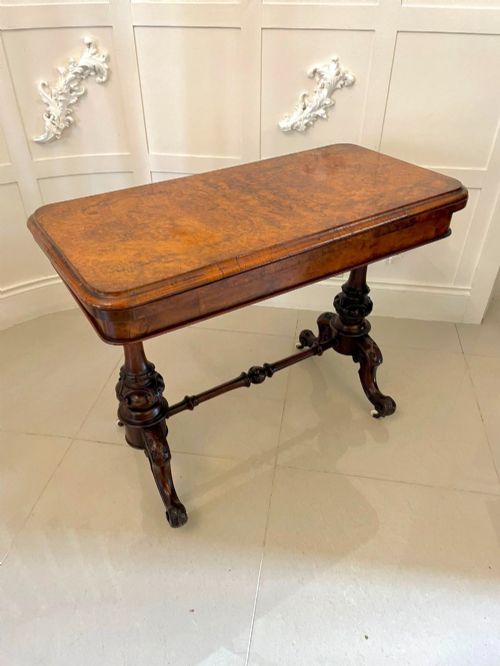
An antique playing table serves domestic card games and social gatherings, appearing most frequently in the form of fold-over card tables and games tables from the Victorian, Edwardian, and nineteenth-century periods. These pieces frequently double as console or side tables when closed, adapting easily to modern domestic interiors.
The selection ranges from burr walnut and mahogany card tables to Edwardian sterling silver playing card boxes and occasional table variants. English and continental workshops produced these items across the eighteenth, nineteenth, and twentieth centuries to suit card games, chess, and bridge.
Buyers encounter distinct regional styles such as Queen Anne style, Regency, and Arts and Crafts, alongside specialised accessories like cribbage boxes and menu holders. The core offering remains the timber fold-over table designed for cards, supported by related games boxes and occasional items.
How they were made
Cabinetmakers constructed these tables primarily in mahogany, walnut, and burr walnut, frequently applying intricate inlay and serpentine shaping to the timber surfaces. Timber selection governed both structural integrity and the decorative visual impact of the closed top.
Interiors typically feature specialised playing surfaces lined in baize or leather, providing a tactile counterpoint to the polished wood exterior. Metal elements appear in brass hinges and locks, while silver and enamel feature in smaller boxes and card caskets.
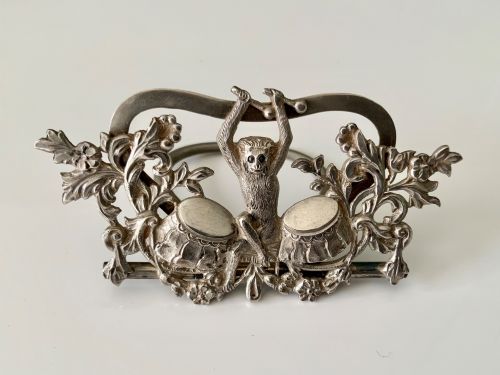
Among the card tables sit musical cherubs cast in bronze and a monkey playing drums on a silver menu holder.
What varies in quality
Quality rests upon the selection of timber veneers, such as figured burr walnut or rich mahogany, and the precision of the fold-over mechanism. Superior examples display seamless integration when closed and stable, well-fitted hinges that operate smoothly.
The intricacy of surface inlay and the execution of carved details distinguish finer workshop output from simpler production. Condition of the internal baize or leather playing surface also influences the standing of an individual piece.
The Antique Playing Table Glossary
- Fold-over card table
- A table with a hinged top that opens to double its surface area, revealing a playing space. This design allows the furniture to function as a compact console when not in use.
- Baize
- A coarse woolen fabric used to line the playing surfaces of card and games tables. It provides a soft, durable texture that prevents cards from sliding during play.
- Burr walnut
- A prized timber veneer obtained from the Burls of walnut trees, noted for its swirling, highly figured grain patterns. It was widely favored by nineteenth-century cabinetmakers for high-end tables.
- Serpentine shaped
- A curved edge profile featuring a central convex sweep flanked by concave curves. This contour adds fluidity and visual movement to table tops and aprons.
Antique Playing Table: Frequently Asked Questions
How do I use an antique playing table today?
These tables function well as console or side tables in living spaces when the top remains folded shut. Opening the surface allows them to serve as impromptu dining spots, desk space, or surfaces for actual card games.
Their dual nature makes them practical for smaller rooms where multi-purpose furniture adds flexibility. Placing them away from direct sunlight protects the timber veneers and internal baize from fading.
What periods do these tables come from?
The listings span the nineteenth and twentieth centuries, encompassing Victorian, Edwardian, Regency, and William IV eras. Victorian and Edwardian examples appear most frequently in walnut and mahogany.
Earlier pieces often display Regency or William IV styling, while later twentieth-century iterations include specialised silver and enamel boxes. Each period utilises distinct timber treatments and hardware styles.
How do I maintain the baize playing surface?
Keep the internal baize clean by gentle brushing or vacuuming with a soft attachment to remove dust. Avoid using liquid cleaners on the fabric, as moisture can damage the underlying timber framework.
When the table is not in use for games, keeping it closed shields the playing surface from light and accidental spills. Professional restoration is available if the fabric requires complete replacement.
Are all these tables made of wood?
While the primary furniture forms utilise timbers like mahogany, walnut, and rosewood, the broader category includes silver playing card boxes and metal decorative objects. Some pieces incorporate brass fittings, leather inserts, and enamel.
Material variety reflects the specific object type, ranging from heavy timber card tables to small tabletop game accessories and silver caskets.