
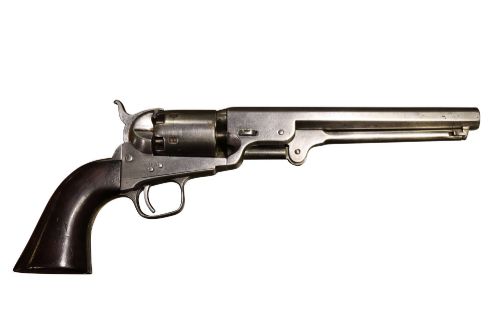

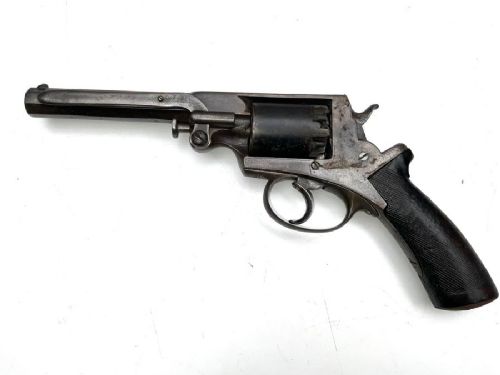


Antique Percussion Revolver
An antique percussion revolver offers a tangible piece of nineteenth-century military and civilian history, prized by collectors for its mechanical ingenuity.
Antique Percussion Revolver
When you search for an antique percussion revolver, you are looking at nineteenth-century firearms that utilise the percussion cap ignition system. These pieces span periods from the Regency era through the American Civil War, reflecting significant technological shifts in personal defence and military equipment.
The versions you are most likely to meet on this page include iconic American models such as the Colt Model 1851 Navy and Model 1860 Army, alongside British designs like the Beaumont-Adams and various pepperbox pistols. They appear in both cased sets with accessories and as individual arms.
How they were made
Makers constructed these firearms primarily from steel and iron for the barrels, frames, and internal mechanisms, ensuring durability under high pressures. Brass often appeared in trigger guards and backstraps, providing a contrasting metallic finish.
Stocks and grips commonly featured shaped walnut, mahogany, or oak, frequently finished with checkered patterns for secure handling. Fitted presentation boxes often lined their interiors with velvet to protect the polished metal and accompanying accessories.
Even early nineteenth-century duellists appreciated a well-lined velvet box for keeping their tiny powder flasks from rolling about.
What varies in quality
The clarity of factory stampings, proof marks, and maker signatures distinguishes standard production arms from superior examples. Crisp metal engraving and matching serial numbers across components elevate the standing of a piece significantly.
The integrity and preservation of the timber grips, alongside the completeness of any original fitted case and accessory kit, dictate the overall calibre of the item. Mechanical crispness in the revolving and firing action remains a primary indicator of superior preservation.
Colt·Deane Adams and Deane·J.R. Cooper·John Manton
The Antique Percussion Revolver Glossary
- Percussion cap
- A small metal cup containing fulminate of mercury placed on the nipple of a firearm to ignite the powder charge when struck by the hammer. This innovation replaced flintlock mechanisms in the nineteenth century.
- Pepperbox pistol
- A multi-barrelled firearm in which the barrels revolve around a central axis upon cocking or pulling the trigger. J.R. Cooper patented notable versions of this design.
- Matching numbers
- Serial numbers stamped on multiple components of a firearm to indicate they left the factory as a unified set. Collectors value this originality highly.
- Calibre
- The internal diameter of the firearm barrel, determining the size of the ammunition used. Common sizes in these listings include thirty-six and forty-four.
- Transitional revolver
- A firearm bridging the design gap between pepperbox pistols and solid-frame revolving pistols. These early nineteenth-century arms often feature rotating barrels or cylinders with separate hammers.
Antique Percussion Revolver: Frequently Asked Questions
What is a percussion revolver?
A percussion revolver is a nineteenth-century hand firearm that uses a percussion cap and hammer system to ignite gunpowder within rotating cylinder chambers.
These firearms superseded earlier flintlock designs, offering multiple shots without reloading after each discharge.
How do I identify a Civil War era revolver?
Civil War era revolvers typically date from the 1850s and 1860s, featuring specific military markings such as U.S. martial issues. Model designations like the Colt 1860 Army directly align with this conflict period.
Examinations of serial numbers often help narrow down the exact year of production during the nineteenth century.
What are pepperbox pistols?
Pepperbox pistols are multi-barrelled firearms where the entire block of barrels rotates around a central axis. They preceded standard cylinder revolvers in the early nineteenth century.
Maker patents, such as those by J.R. Cooper, governed the mechanical rotation of these distinct multi-shot arms.
How were these revolvers stored?
Many fine revolvers were housed in fitted wooden boxes lined with velvet to cushion the firearm. These presentation cases kept the pistol secure alongside essential accessories.
Accessories typically included bullet moulds, powder flasks, and cleaning rods stored neatly in dedicated compartments.