



Antique Orientalist Seating
Antique orientalist seating brings rich woodwork, intricate bone inlay, and evocative Moorish or Syrian designs straight into a room.
Antique Orientalist Seating
When buyers search for antique orientalist seating, they encounter distinctive forms including armchairs, corner chairs, settees, and hall benches. These pieces often draw on Moorish Revival, Syrian Ottoman, Levantine, and Anglo-Moorish styles originating across the late nineteenth and early twentieth centuries.
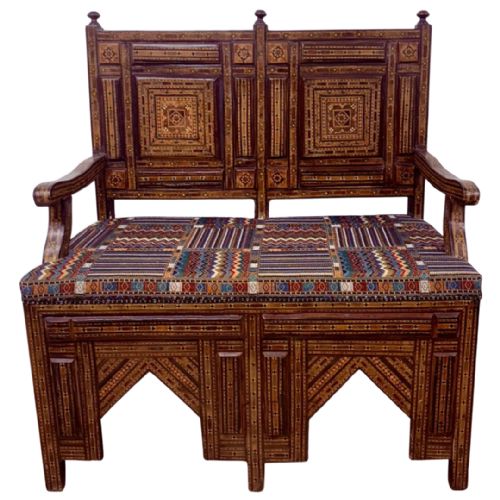
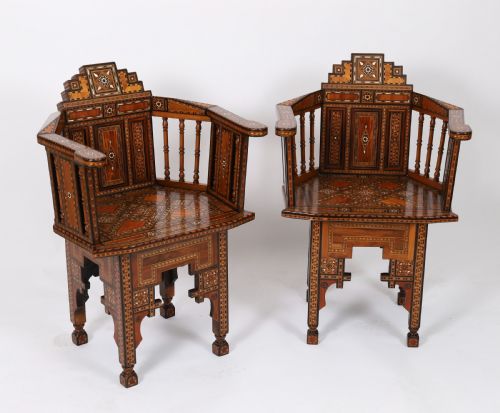
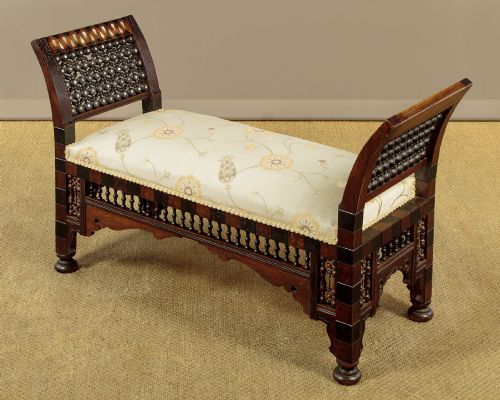
The most common examples on this page are heavily inlaid wooden chairs and benches featuring geometric parquetry, bone inlay, and carved mashrabiya panels. Makers and workshops from this era utilised dense hardwoods, walnut, and elaborate surface decoration to evoke distant trade routes and exotic aesthetics.
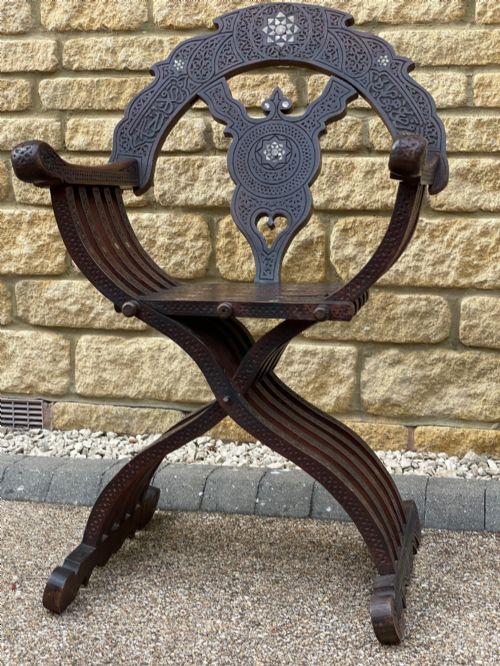
Alongside traditional wooden armchairs and settees, the selection incorporates folding chairs and conversation seats influenced by Andalusian and Islamic traditions. Each item reflects European fascination with eastern craftsmanship during the nineteenth and twentieth centuries.
Materials and construction methods
Craftsmen built these forms using solid walnut and assorted hardwoods as a structural foundation for intricate decorative schemes. Joinery was often paired with detailed surface carving to support complex geometric patterns.
Decoration relied heavily on contrasting materials, embedding mother-of-pearl, bone, and brass wire directly into the wooden frames. Parquetry techniques allowed artisans to arrange tiny wooden tiles into elaborate mosaics across backrests and seats.
Upholstered elements incorporated heavy textiles such as velvet to complement the dark, highly decorated woodwork. Specialised joinery also produced folding frames that required precise alignment of hinged wooden segments.
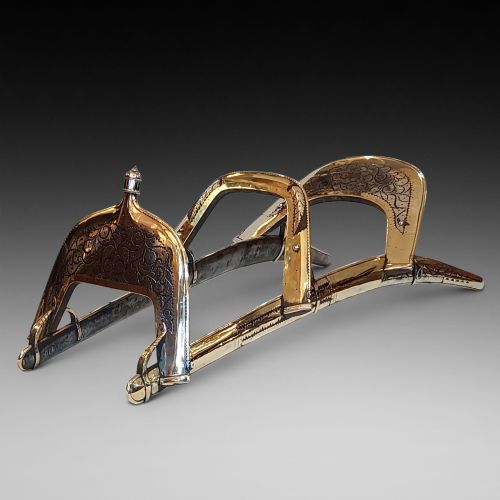
A ceremonial camel saddle sits ready to offer your living room an unexpected dash of nineteenth-century desert expedition style.
Assessing craftsmanship and execution
Quality separates pieces by the precision of the inlay work and the depth of the wood carving. Superior examples display tightly fitted mother-of-pearl and bone fragments with minimal filler, whereas lesser pieces show wider gaps and simpler stamped patterns.
The architectural complexity of the woodwork defines the upper tier of these items. Pieces incorporating intricate mashrabiya lattice panels and sophisticated parquetry demonstrate a higher level of workshop skill than plain panelled alternatives.
Structural integrity and the selection of timber dictate longevity. Dense walnut frames with stable joints hold their decorative elements far better than softer woods prone to shrinkage and the loss of inlaid tesserae.
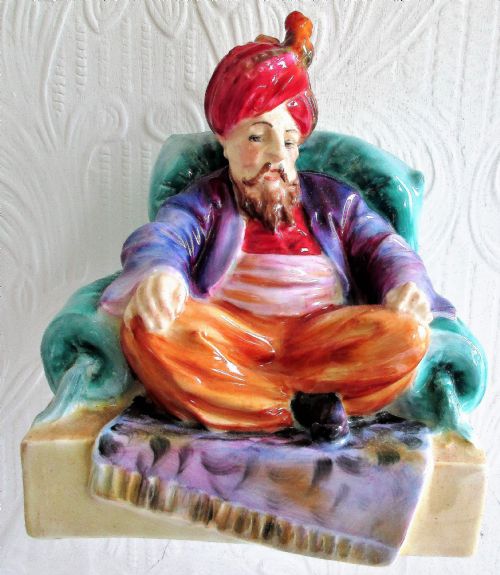
Franz Bergman·Liberty and Co·Royal Doulton·Goldscheider
The Antique Orientalist Seating Glossary
- Parquetry
- A mosaic of geometric wooden tiles arranged to form decorative patterns on flat surfaces. This technique forms the primary visual interest on many Levantine and Syrian chairs.
- Mashrabiya
- An architectural lattice screen of turned wooden bobbins assembled into intricate geometric grilles. It frequently appears on the backs and panels of Moorish revival seating.
- Moorish Revival
- An architectural and decorative style popular in the nineteenth century that reinterpreted Islamic design elements from Spain and North Africa. It heavily influenced western furniture production.
- Mother-of-Pearl
- The iridescent inner layer of mollusc shells used extensively for inlay work. Artisans cut it into thin plates to create shimmering floral or geometric motifs against dark wood.
- Anglo-Moorish
- A hybrid design style combining traditional Islamic woodwork techniques with Victorian furniture forms. British firms produced these pieces to satisfy domestic demand for exotic domestic interiors.
Antique Orientalist Seating: Frequently Asked Questions
How do I care for inlaid wood?
Keep inlaid chairs away from direct heat sources and dramatic humidity shifts to prevent the wood from expanding and loosening the mother-of-pearl or bone elements. Use a soft, dry cloth for dusting and avoid liquid polishes that can seep beneath delicate inlays.
Apply a microcrystalline wax sparingly if the timber appears dry, buffing gently with a clean cloth. Regular, gentle maintenance preserves both the finish of the hardwood and the stability of the decorative tesserae.
Are these chairs comfortable for daily use?
Many orientalist armchairs and settees were designed as statement furniture with upright wooden backs and firm seats rather than deep lounging comfort. Adding subtle, period-appropriate cushions can improve daily usability without obscuring the intricate woodwork.
Consider where the chair will sit in your home to balance daily comfort with the visual impact of the carved panels and inlaid surfaces. Lighter occasional chairs function well in low-traffic reading corners or entrance halls.
How do I identify Moorish revival styles?
Look for signature design motifs including horseshoe arches, dense geometric parquetry, and turned spindle work reminiscent of Middle Eastern architecture. The presence of bone inlay and mother-of-pearl detailing strongly points toward these specific revival movements.
Examine the construction methods and timber choices, as nineteenth-century European and Syrian workshops combined native hardwoods with traditional eastern decorative geometry. Comparing the joinery helps distinguish purpose-built revival pieces from later reproductions.
Can I mix these pieces with modern decor?
These heavily patterned and inlaid seats act as strong focal points that anchor minimalist or contemporary interior schemes. Pairing a Syrian armchair with plain walls and simple furniture allows the intricate carving and mother-of-pearl details to stand out.
Introduce neutral textiles nearby to balance the visual weight of dark walnut and complex parquetry. This approach lets the historic craftsmanship command attention without overwhelming the room.