




Antique Onyx Clock
An antique onyx clock brings mineral weight and polished presence to a room, anchoring a mantelpiece with enduring materials.
Antique Onyx Clock
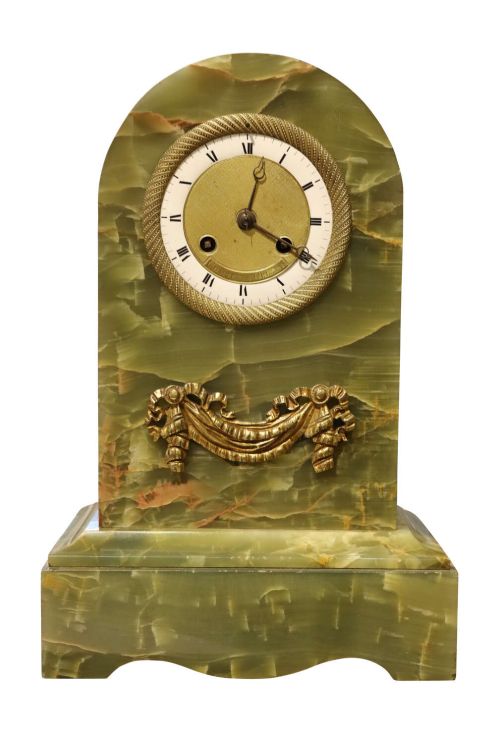
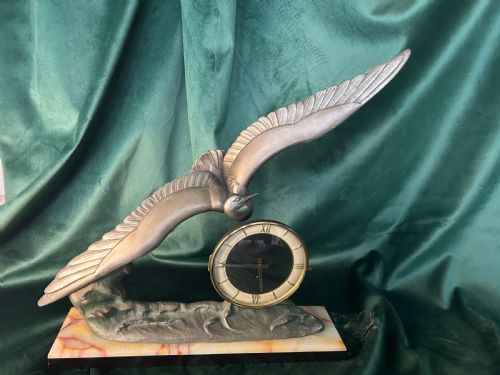
An antique onyx clock stands as a substantial decorative object for a mantelpiece or desk, frequently appearing alongside matching garnitures or barometer sets. These pieces range from severe geometric Art Deco designs to ornate Victorian and Louis XVI revival forms, reflecting shifting tastes across the nineteenth and twentieth centuries.
Buyers most commonly encounter French and English examples constructed from banded natural stone paired with metallic mounts, enamel dials and glass covers. The form serves simultaneously as a precise timekeeper and a dominant sculptural element within a domestic interior.
Materials and Construction
Craftsmen shaped solid blocks of onyx and marble into architectural cases, often combining green varieties with contrasting brass, gilt bronze or ormolu mounts. Spelter figures, bronze sculptures or champleve enamel panels frequently decorated the front and sides of the stone housing.
Clockmakers fitted precision mechanical movements behind glazed brass bezels and enamel dials, while sculptors such as Auguste Moreau, Michel Decoux and Ferdinand Priess contributed cast metal figures to mount upon the stone bases.
Listings feature both nineteenth-century Victorian designs and twentieth-century Art Deco interpretations, utilising green onyx, marble, spelter and gilt bronze.
Distinctions in Quality
Quality rests upon the depth and grain of the onyx itself, the crispness of the cast bronze or ormolu mounts, and the integration of sculptural elements. Pieces bearing the signatures of established makers or sculptors command greater attention.
The complexity of the set also dictates distinction, as complete three-piece garnitures involving matching side pieces, barometers or bronze figures represent a higher order of original manufacture than solitary timepieces.
Charles a Orleans·Elliott·Auguste Moreau·Michel Decoux·Ferdinand Priess·Garrards·Louis Japy·H F Moreau·Japy Freres·Samuel Marti
The Antique Onyx Clock Glossary
- Onyx
- A banded variety of chalcedony quartz valued for its translucent layers and rich colour variations, appearing frequently in green tones on these clock cases.
- Garniture
- A set of decorative objects designed to be displayed together, typically comprising a central clock flanked by two matching side pieces such as vases or urns.
- Ormolu
- Gilded bronze achieved through a mercury amalgamation process, applied to metallic mounts and decorative accents on nineteenth-century clock cases.
- Spelter
- A zinc alloy used as a cost-effective alternative to bronze for casting sculptural figures, frequently finished with a bronze-coloured patina.
- Champleve
- An enamelling technique where troughs are dug into a metal surface, filled with vitreous enamel powder, and fired to create colourful patterns.
Antique Onyx Clock: Frequently Asked Questions
How do I wind an antique onyx clock?
Most mechanical examples require a matching winding key inserted into specific holes on the enamel dial to tension the spring-driven movement.
Care must be taken not to over-wind the mechanism, ensuring the clock maintains accurate time without damaging the internal gears.
What is a clock garniture set?
A garniture set consists of a central mantel clock accompanied by two matching ornamental side pieces, such as urns or candelabra, designed for symmetrical display.
These sets were popular in grand nineteenth and early twentieth-century interiors to create a unified decorative scheme across a fireplace.
How do I tell Victorian from Art Deco clocks?
Victorian models typically display heavy classical revival styling, ornate gilt bronze mounts, and sculptural figures depicting historical or mythological themes.
Art Deco pieces favour streamlined geometric silhouettes, polished green onyx surfaces, and clean modernist dial designs characteristic of the interwar period.
Where should I place an onyx clock?
These heavy stone objects require a sturdy, level surface such as a wooden mantelpiece, heavy sideboard or dedicated desk.
Positioning them away from direct sunlight and damp environments protects the delicate enamel dials and the polished mineral finish.