
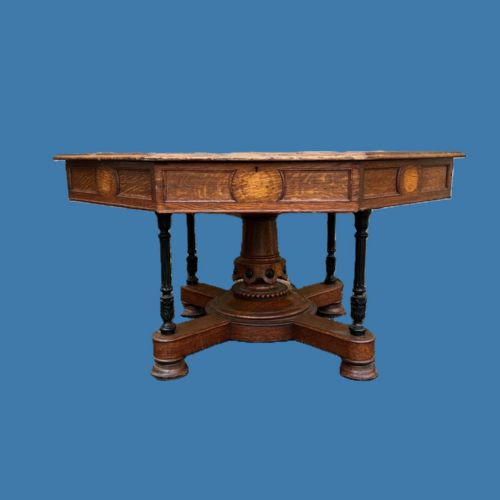


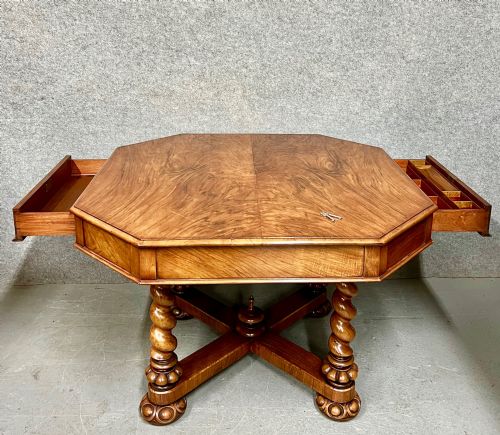


Antique Octagonal Writing Table
An antique octagonal writing table offers a generous multi-sided workspace rooted in Victorian and Georgian craftsmanship, designed to anchor a room.
Antique Octagonal Writing Table
An antique octagonal writing table brings an eight-sided geometry to domestic and professional interiors, differing from standard rectangular desks by allowing access from multiple angles. The pieces found here span the Georgian era through the Victorian period, Edwardian times, and into the early twentieth century.
Forms vary from library tables and centre tables to drum tables and occasional desks. Most examples rely on substantial timbers like oak, walnut, and mahogany, frequently paired with inset leather working surfaces.
Makers and designers of the nineteenth century utilised these shapes to create imposing library pieces alongside smaller occasional furniture. The presence of styles such as Victorian Gothic Revival and Reformed Gothic demonstrates the versatility of the octagonal format across different decades.
How they were made
Construction relies upon dense hardwoods including mahogany, walnut, and oak, chosen for their structural strength and capacity to support heavy book collections or writing materials. Ebonised wood also appears as an alternative finish.
Working surfaces typically incorporate tooled Moroccan leather or standard leather insets, secured to the timber top. Brass fittings, such as locks marked George Rex, provide functional security on period examples.
Listings feature oak, walnut, mahogany, and ebonised wood across Victorian, Edwardian, and Georgian periods.
What varies in quality
The distinction between standard workshop production and superior cabinet-making rests in the selection of timber grain and the precision of the eight-sided joinery. Finer pieces maintain structural integrity without excessive timber shrinkage across the multiple mitred joints.
The retention of original tooled leather inserts and period hardware elevates a piece above those fitted with later replacements. Maker attribution, such as documented work by James Shoolbred and Co, further distinguishes exceptional examples.
James Shoolbred & Co London
The Antique Octagonal Writing Table Glossary
- Library Table
- A large freestanding table designed for the storage and consultation of books, often featuring drawers beneath the top. These pieces were traditionally placed in the centre of a room rather than against a wall.
- Drum Table
- A circular or octagonal library table with a deep frieze containing drawers, resembling the shape of a drum. They frequently incorporate a rotating mechanism or stationary pedestal base.
- Centre Table
- A freestanding piece finished on all sides for placement in the middle of an apartment or study. They serve decorative and functional purposes without a fixed orientation.
- Reformed Gothic
- A nineteenth-century design movement focusing on structural truth, flat carved ornament, and medieval-inspired forms. This style rejects heavy Victorian ornamentation in favour of architectural clarity.
- Moroccan Leather
- A goatskin leather tanned with sumac, known for its fine grain and durability. It provides a smooth, resilient writing surface when inset into table tops.
Antique Octagonal Writing Table: Frequently Asked Questions
Where did these tables sit?
These tables traditionally stood in the middle of libraries, studies, or large reception rooms rather than against walls. Their eight-sided format allowed multiple users to sit around the perimeter.
Because they were finished on all sides, they functioned as independent room dividers and primary workspace hubs in large nineteenth-century homes.
How do I care for leather inserts?
Leather surfaces require minimal moisture and gentle cleaning to prevent the material from drying out or cracking over time. Avoid placing direct heat sources nearby.
Applying specialised leather balms periodically helps maintain the suppleness of the original tooled Moroccan leather without damaging the surrounding timber.
Were these used for writing?
Many examples served as primary writing desks, library tables, or partner desks depending on the scale and internal drawer configuration. The generous top surface accommodated ledgers, correspondence, and reference volumes.
Deep frieze drawers provided storage for inkwells, quills, and stationery out of sight.
How do I identify a Victorian Gothic piece?
Victorian Gothic and Reformed Gothic examples display architectural motifs, chamfered edges, and geometric carving influenced by medieval ecclesiastical design. The timber is frequently dark oak or walnut.
These pieces contrast with smoother Georgian designs through their emphasis on structural lines and structural honesty.