


Antique Map Globe
An antique map globe brings centuries of cartography and design into a room, offering a tangible record of changing borders and geographical knowledge.
Antique Map Globe
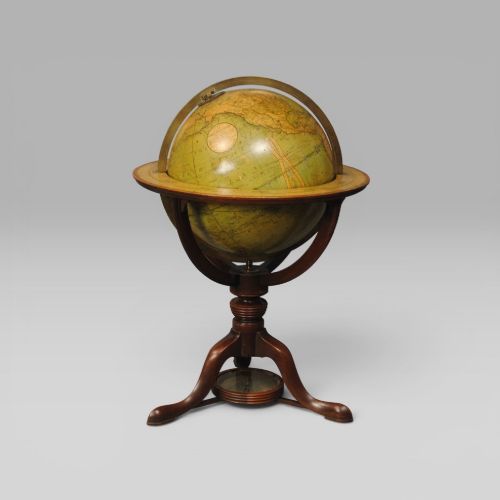
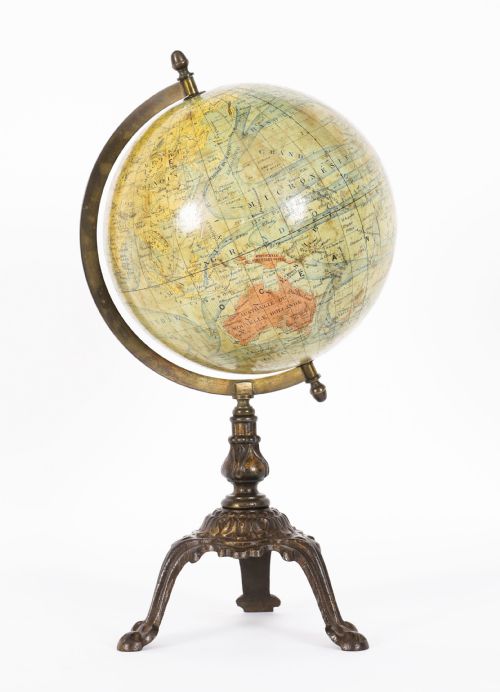
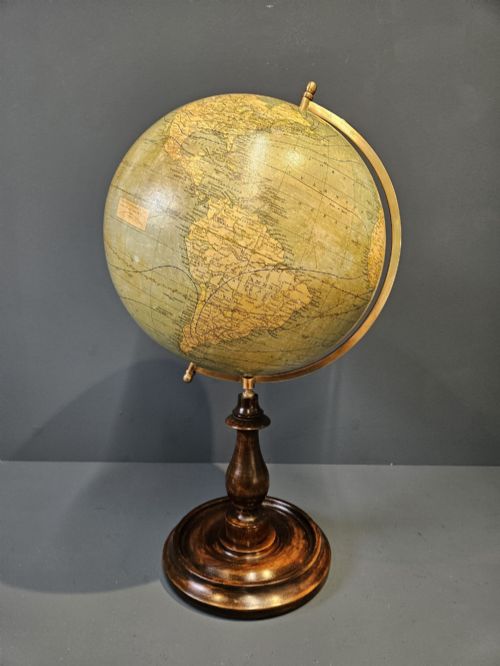
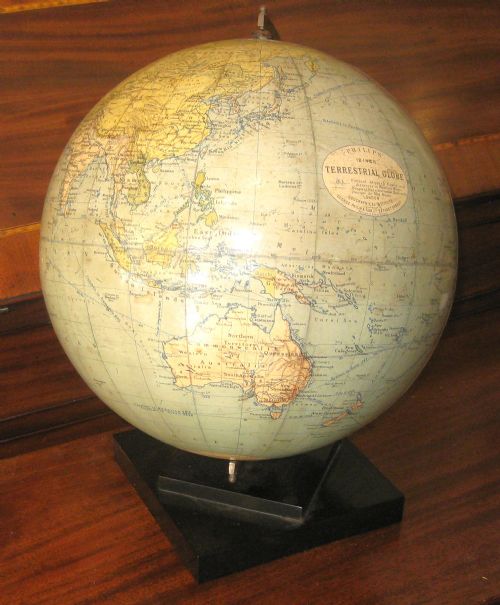
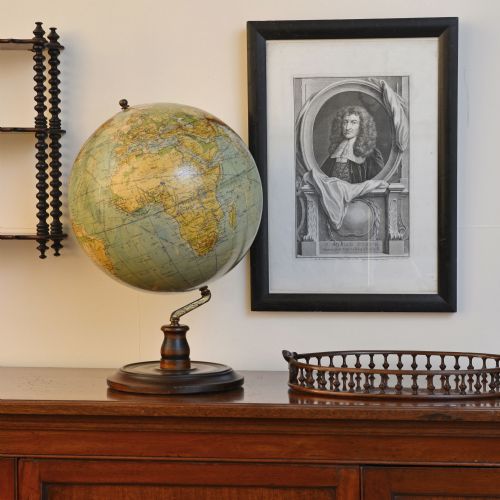
When you search for an antique map globe, you encounter scientific instruments and decorative objects dating from the Victorian era through the mid-twentieth century. The selection ranges from miniature desk globes to floor-standing models produced by notable geographical publishers.
Most examples found here are terrestrial globes that show the world as understood during specific decades, though celestial variants and specialised physical globes also appear. These pieces serve as both historical documents and striking interior ornaments.
Distinctions in quality and execution
Quality rests in the precision of the cartographic printing, the accuracy of the gores' alignment at the seams, and the legibility of the geographical text. Finer examples retain vibrant hand-colouring and crisp typography rather than faded or heavily rubbed details.
The integrity of the physical sphere and the craftsmanship of the supporting stand also determine standard and superior grades. Solid turned wood bases, heavy cast metal tiers, and intact brass meridians elevate the overall construction.
Listings feature globes spanning the Victorian period through the mid-twentieth century, utilising materials such as mahogany, brass, cast iron, and paper mache.
George Philips and Son Ltd·Geographia·Lebegue and Cie·Hughes and Son·Carl Adami·Raths
The Antique Map Globe Glossary
- Gore
- A wedge-shaped printed paper segment that is pasted onto the spherical surface of a globe. Multiple gores are required to cover the round sphere without creasing.
- Terrestrial globe
- A scale model of the Earth representing landmasses, oceans, political boundaries, and shipping routes. These instruments reflect the geographical knowledge of their specific publication year.
- Celestial globe
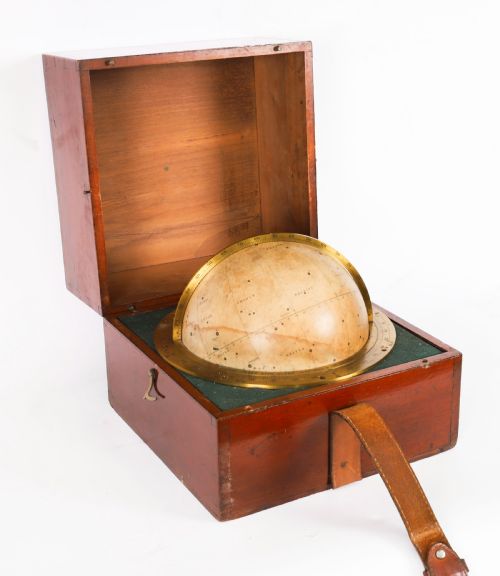
- A sphere mapping the stars, constellations, and astronomical coordinates as viewed from Earth. They are typically mounted on a brass ring representing the celestial horizon.
- Meridian ring
- A graduated metal ring that encircles the globe and holds it at an angle corresponding to the Earth's axial tilt. It allows the sphere to rotate along a fixed axis.
- Paper mache
- A composite material made from paper pulp or layers of paper bound with glue, used to form lightweight and durable globe spheres before modern plastics.
Antique Map Globe: Frequently Asked Questions
How do I determine the date of a globe?
Dates are often printed directly in the cartouche alongside the publisher's name and location. If a date is absent, examining the political borders shown on the map provides a reliable estimated timeframe.
Changes in national boundaries, colonial possessions, and capital cities help narrow down the decade of production. Comparing the geography to known historical maps confirms the era.
What is the difference between desk and floor models?
Desk globes are compact instruments designed to sit on tables, shelves, or desks, typically measuring between four and twelve inches in diameter. They offer easy portability and close study.
Floor-standing models feature dedicated wooden or metal stands that elevate the globe to a comfortable viewing height for standing observers. These pieces function primarily as substantial furniture and room focal points.
How should I clean paper globe gores?
Paper gores require dry maintenance to avoid lifting or staining the fragile historical printed surface. Dusting gently with a soft, dry cloth or a clean brush removes surface particles safely.
Water and liquid cleaning agents must be kept away from the paper surface entirely. Moisture dissolves old adhesives and causes the paper to warp or separate from the underlying plaster sphere.
Why do some globes include celestial charts?
Celestial spheres were historically used for astronomical education, navigation, and astrology rather than terrestrial geography. They allowed scholars and mariners to calculate star positions and track constellations.
These pieces were frequently produced as companion pieces to terrestrial globes or housed in portable cases for field use. They represent the broader scientific interests of nineteenth and early twentieth-century cartography.