



Antique Mantel Clock Candelabra
When seeking an antique mantel clock candelabra, you find matching sets comprising a central timepiece flanked by matching candelabras or urns designed for symmetry.

Antique Mantel Clock Candelabra
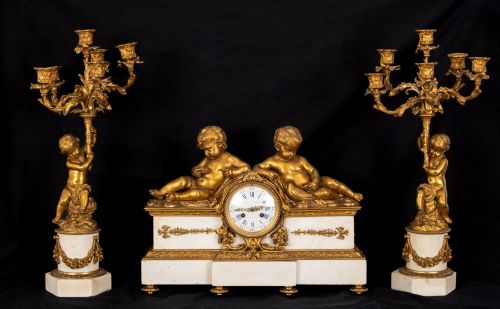
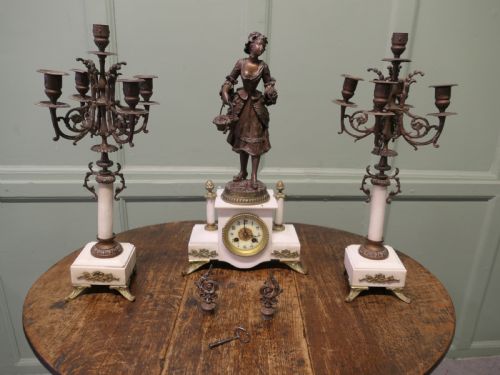
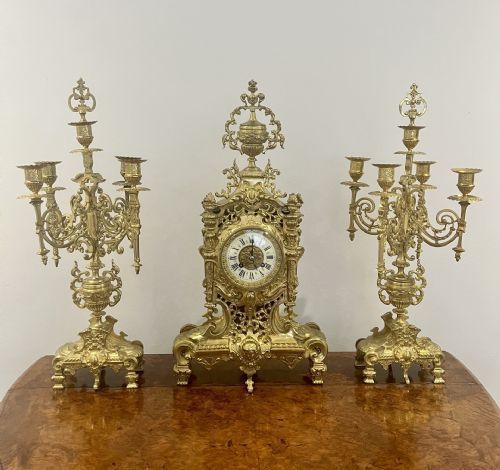
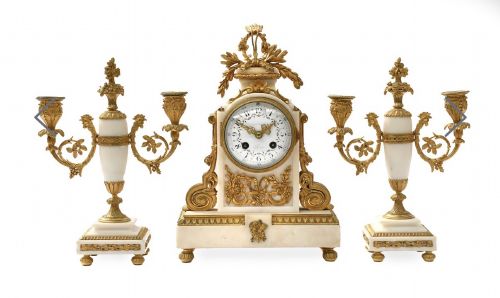
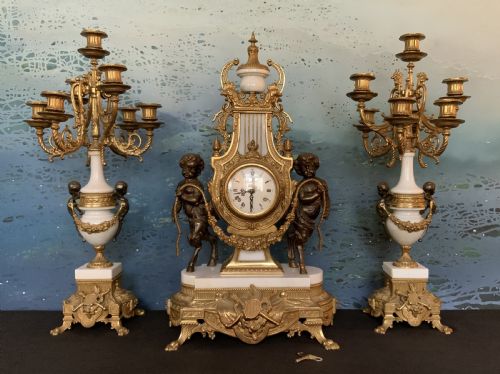
An antique mantel clock candelabra setup forms a complete garniture set, usually featuring a central clock accompanied by a pair of matching candelabras. These arrangements originate predominantly from the nineteenth century, reflecting French tastes spanning Louis XVI Revival, Empire, and Rococo styles.
The configurations on this page include three-piece sets involving marble, bronze, and ormolu, often incorporating cherubs, porcelain panels, and detailed side pieces designed for decorative symmetry on a mantelpiece.
Most examples hail from French makers and workshops of the Victorian era, utilising grand classical motifs such as urns, floral garlands, and mythological figures to create a unified domestic display.
How they were made
Gilt bronze and ormolu form the primary decorative metalwork, cast into elaborate scrolls, foliage, and figures before receiving a fine gold wash. White and black marble, alongside onyx, provide the heavy architectural foundations for the clock bodies and matching bases.
Porcelain elements, including panels styled after Sevres or produced at Meissen, add painted colour and delicate contrast to the metallic mounts. Enamel dials indicate the hours, driven by eight-day clock movements housed within the central stone or metal chassis.
Several sets include vigilant bronze cherubs holding up ten-light candelabras while apparently unfazed by the weight.
What varies in quality
Complete survival of the original matching candelabras alongside the clock elevates a set, especially when movements, dials, and side pieces share a unified design vocabulary and maker signature.
Henry Dasson·H Luppens Paris·Raingo Fres Paris
The Antique Mantel Clock Candelabra Glossary
- Garniture
- A set of matching decorative objects designed to be displayed together on a mantelpiece, typically comprising a clock and two side pieces such as candelabras or urns.
- Ormolu
- Finely ground high-carat gold applied to a bronze base using a mercury amalgamation technique, common in nineteenth-century French metalwork.
- Candelabra
- A branched candlestick holder designed to hold multiple tapers, frequently manufactured as the matching side ornaments in a clock set.
- Louis XVI Style
- A neoclassical design movement characterised by straight lines, symmetry, classical urns, and Roman architectural motifs that influenced many nineteenth-century clock sets.
- Sevres Style
- Decorative porcelain painted with characteristic bleu de roi glazes and floral panels, mimicking the aesthetic of the famous French royal manufactory.
Antique Mantel Clock Candelabra: Frequently Asked Questions
What is a clock garniture?
A clock garniture is a matched decorative set designed for a fireplace mantel, consisting of a central clock flanked by matching ornaments such as candelabras or vases.
These sets create a balanced, symmetrical display that was popular in nineteenth-century formal interiors.
How do I identify Louis XVI style?
Louis XVI style pieces feature straight lines, classical architectural proportions, and restrained ornamentation like ribbons, swags, and acanthus leaves.
This aesthetic contrasts with the more asymmetrical and curving lines of earlier Rococo designs.
Are these clocks eight-day movements?
Many nineteenth-century French clock sets utilise eight-day mechanical movements that require winding via a key once a week.
They generally strike on the hour and half-hour using a bell or a gong.
How should I clean ormolu mounts?
Ormolu mounts benefit from gentle dusting with a soft brush to prevent accumulation of dirt in the chased recesses.
Harsh chemical polishes should be avoided because they can strip away the historic gilt surface.