



Antique London Firearm
An antique london firearm delivers mechanical precision and historic weight, offering collectors a tangible link to eighteenth and nineteenth century craftsmanship.
Antique London Firearm
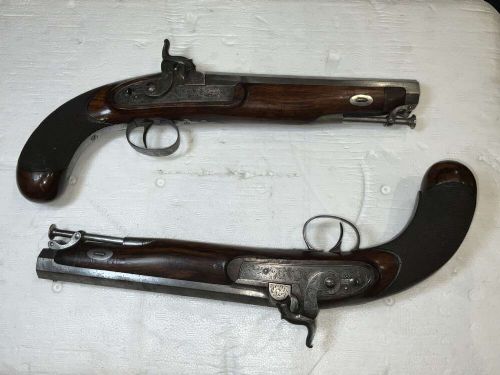
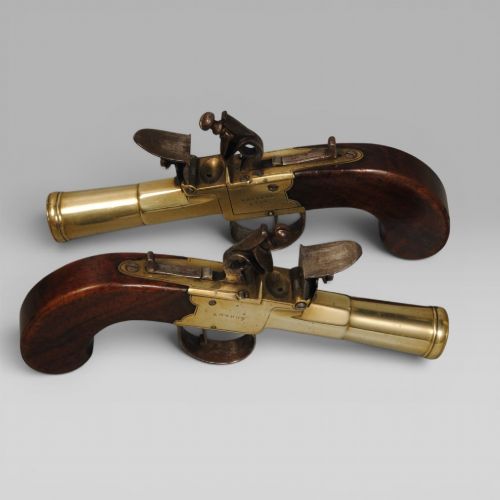
When you search for an antique london firearm, you encounter historical pieces produced by makers working within the capital during the Georgian, Regency, and Victorian eras. These items span various functional categories, including pocket pistols, duelling pistols, blunderbuss pairs, and transitional revolvers.
The version you are most likely to meet on this page is the eighteenth-century flintlock pocket or holster pistol, often bearing the signature of a notable London gunsmith alongside official proof marks. Such pieces represent the primary domestic and military sidearms of their day.
The material composition of these items generally involves steel mechanisms fitted into wooden stocks, frequently accompanied by fitted cases lined in velvet or baize. The physical forms reflect the evolution from early Queen Anne turn-off barrels to later percussion cap systems.
How they were made
Makers constructed these arms using forged steel for barrels and lockplates, combining them with stocks shaped from dense timbers such as walnut, mahogany, and other hardwoods. Brass furniture often reinforced trigger guards and butt caps.
Surface decoration required specialised techniques, including silver wire inlay embedded into the wooden grips and engraved detailing on metal components. Proof marks were stamped following official inspection to verify barrel strength.
Antique London Firearm Retail Price Guide 2026
Typical asking prices for london firearm among the pieces listed under this phrase on Sellingantiques today, from the lower quarter to the upper quarter. They describe what is for sale here now, not the wider market.
Some pistols wear delicate silver wire like fine embroidery.
What varies in quality
The distinction between tiers rests upon the execution of the mechanism, the crispness of metal engraving, and the integration of fine details like silver wire inlay. Master gunsmiths achieved superior mechanical smoothness and structural balance.
Condition and completeness also define the standing of a piece, particularly when items retain their original fitted hardwood cases with intact interior linings of velvet or baize, rather than being assembled from disparate elements.
Harrison of London·T. Potts·Twigg·Joseph Egg·James Barber·Thomas Henshaw·H.W. Mortimer & Son·I Parr·John Rimes·John Manton·Dutton
The Antique London Firearm Glossary
- Flintlock
- An ignition mechanism utilising a piece of flint struck against a steel frizzen to generate sparks for gunpowder ignition. This system dominated firearms production throughout the eighteenth century.
- Percussion cap
- A later ignition method employing a small explosive primer placed on a nipple, struck by the hammer to fire the charge. This technology superseded the flintlock during the nineteenth century.
- Boxlock
- A firearm design where the breech and action are forged as a single unified metal frame rather than having a separate lockplate screwed to the stock. It offered greater mechanical reliability.
- Turn-off barrel
- A barrel designed to unscrew from the breech for easier muzzle loading with a pre-patched ball. This feature appears frequently on eighteenth-century pocket pistols.
- Proof marks
- Official stamps applied to barrels and actions after testing with gunpowder charges to guarantee structural integrity. London authorities stamped specific marks denoting local testing.
Antique London Firearm: Frequently Asked Questions
What periods do these pieces cover?
The inventory encompasses items spanning the eighteenth and nineteenth centuries, including Georgian and Victorian eras.
Specific production dates extend from the early 1700s through the transition to percussion systems in the mid-nineteenth century.
Which wood types appear on the stocks?
Stocks utilise dense hardwoods, with walnut and mahogany being the primary timbers selected for strength and grain pattern.
Secondary materials sometimes include specialised hardwood varieties tailored to specific pistol forms.
What is a Queen Anne style pistol?
Queen Anne style firearms feature a distinct turn-off barrel and a breech forged as a single piece with the trigger plate.
This configuration became popular for pocket defence during the eighteenth century due to its compact construction.
Do these items include storage cases?
Certain pieces are preserved within fitted wooden cases designed specifically to hold the firearm and its associated accessories.
These interior compartments are typically lined with protective velvet or baize fabrics.