



Antique Line Bracelet
An antique line bracelet is a continuous flexible chain of matched gemstones, prized for a wrist line of uninterrupted sparkle.
Antique Line Bracelet
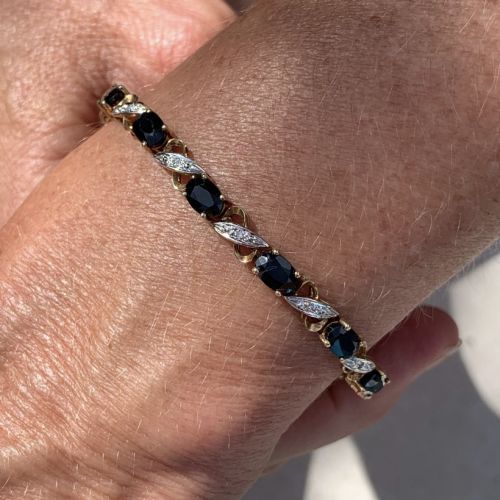
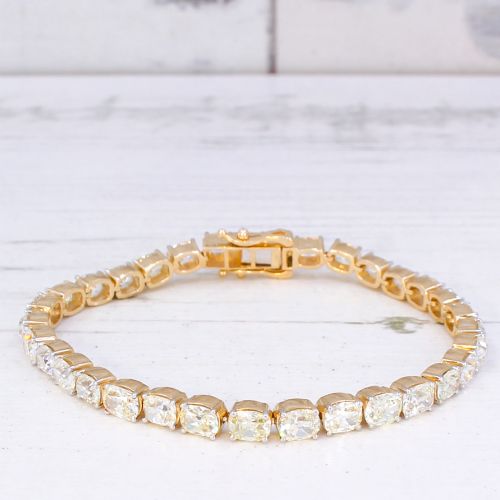
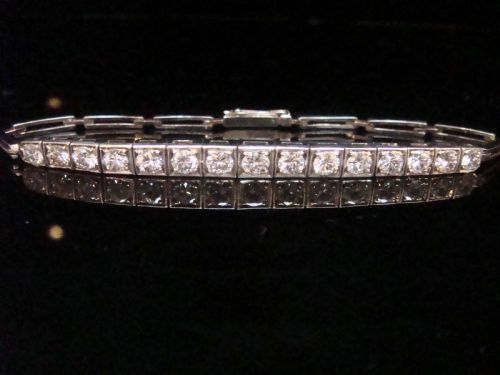
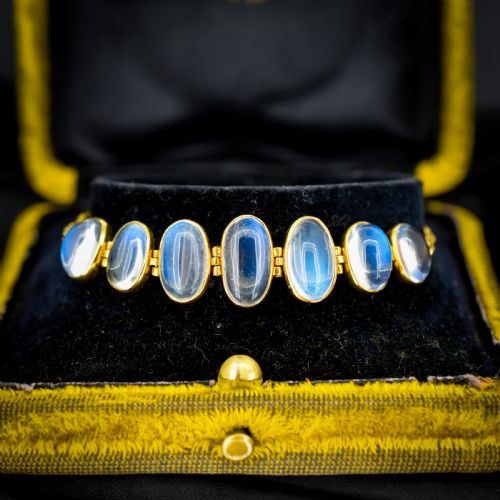
When you search for an antique line bracelet, you look at articulated rows of gemstones set sequentially around the wrist. The pieces gathered here span from the Victorian and Edwardian eras through the Art Deco period and into the mid-twentieth century. Most examples you meet on this page pair diamonds with platinum or yellow gold, following classic geometric or symmetrical designs.
Earlier nineteenth-century versions often use silver-topped gold alongside old mine cut stones or moonstones, whilst twentieth-century pieces lean heavily into platinum and white gold. Art Deco examples dominate the selection with calibrated emeralds, sapphires, and rubies alternating with brilliant cut diamonds. You also encounter pearl and zircon variants originating from French and British workshops.
Materials and construction
Makers constructed these bracelets using platinum and various purities of gold, including 18ct, 15ct, 9ct, and 8ct, occasionally employing silver for early settings. Stones were secured using collet settings, bezel mounts, or intricate millegrain edges that required precise hand-tooling by skilled bench jewellers.
The flexibility of each piece depends on discrete hinged or linked joints hidden between stone mounts. Gemstones such as diamonds, sapphires, emeralds, and pearls were hand-selected and graduated or matched uniformly to follow the linear path of the band.
The periods represented span the Victorian era, Edwardian period, Art Nouveau, 1940s Retro, Art Deco, and mid-twentieth century.
Distinctions in quality
The standard of an antique line bracelet rests on the uniformity and matching of its stones, alongside the precision of the articulation. Finer examples maintain smooth flexibility without slack in the links, ensuring the bracelet sits flat against the wrist.
The integrity of the metalwork also divides the range, particularly the crispness of millegrain decoration and the security of the box clasp and safety chain. Original stones set without later replacements command greater interest from collectors.
The Antique Line Bracelet Glossary
- Old mine cut
- An early diamond cut characterised by a cushion shape, high crown, and large culet facet. These stones display a softer candlelit sparkle compared to modern brilliant cuts.
- Millegrain
- A decorative technique featuring a row of tiny raised metal beads along the edge of a setting. This method softens the transition between metal and stone in Edwardian and Art Deco pieces.
- Collet set
- A method where a gemstone is encircled by a narrow band of metal that holds it in place. This technique secures the stone whilst exposing its side profile.
- Art Deco
- A design style spanning the 1920s and 1930s defined by geometric symmetry, streamlined shapes, and strong contrasts. Platinum paired with diamonds and calibrated sapphires or emeralds typifies this period.
- Graduated
- A layout where stones increase in size toward the centre of the bracelet. This design creates a balanced focal point on the wrist.
Antique Line Bracelet: Frequently Asked Questions
How do I wear an antique line bracelet daily?
These flexible bracelets suit everyday wear provided you check the security of the clasp and safety chain regularly. Avoid wearing them during heavy manual tasks to protect the settings from impact.
Store the bracelet flat in a dedicated jewellery box to prevent the links from twisting or tangling when not on your wrist.
What is the difference between Edwardian and Art Deco bracelets?
Edwardian bracelets feature lacy, garland-style motifs in platinum and yellow gold, often incorporating pearls or softer pastel gemstones. They emphasise delicate openwork and feminine curves.
Art Deco bracelets shift toward bold geometric patterns, platinum settings, and high-contrast combinations of diamonds with emeralds, rubies, or sapphires.
How are these bracelets secured on the wrist?
Most antique line bracelets utilise an integrated box clasp that clicks firmly into place when closed. A secondary safety chain or figure-eight latch provides extra security against accidental loss.
Jewellers can inspect the spring mechanism inside the box clasp to ensure it retains adequate tension over time.
Can links be removed to resize a line bracelet?
Resizing depends on the repeating pattern of the stones and the construction of the individual links. A specialist jeweller can usually alter the length by removing identical repeating sections.
Retaining any removed sections is recommended to preserve the complete history and original length of the piece.