





Antique Levelling Instrument
An antique levelling instrument is a brass and mahogany tool of precision, built to measure ground and sight lines with a heavy, honest weight.
Antique Levelling Instrument
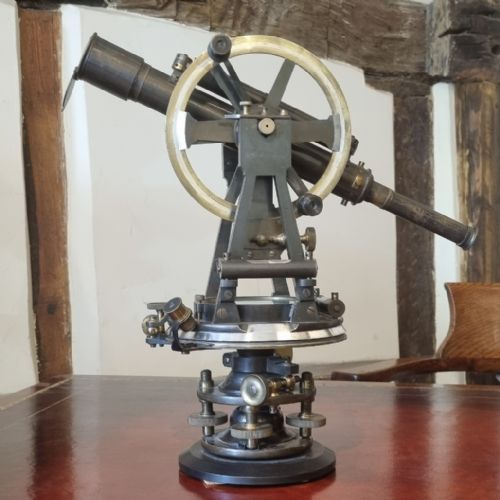
When you search for an antique levelling instrument, you enter a world of brass, glass, and seasoned mahogany built for precise surveying and measurement. These mechanical objects include theodolites, drainage levels, transit instruments, and architects' levels alongside related clinometers and pressure gauges.
The versions you are most likely to meet on this page hail from the nineteenth century, the Edwardian era, and the Georgian period. Many retain their fitted wooden transit cases, bearing the signatures of prominent London and Edinburgh makers on silvered metal dials.
Materials and construction
Makers constructed these instruments primarily from polished brass, cast bronze, and heavy steel, paired with optical glass for the sighting lenses. Dials and compass cards were executed in silvered metal with fine engraved graduations.
Housings and fitted carrying cases were turned from dense hardwoods such as mahogany and boxwood, designed to protect delicate internal bubbles and needles during transport across rugged terrain.
Distinctions in quality
Quality rests in the crispness of the engraved divisions on the silvered metal and the smoothness of the brass rack and pinion movements. Finer examples display signed plates from established makers, indicating higher standards of optical and mechanical calibration.
The integrity of the original mahogany case and the survival of subsidiary parts like folding sights and compass needles elevate an example. Utility grade items show simpler industrial finishes without the refined signing found on workshop flagships.
W S Jones·L Casella and Co·Cooke Troughton and Simms·Latimer Clark·Negretti and Zambra·Elliott Bros of London·Alexander Adie of Edinburgh·W H Harling·W F Stanley
The Antique Levelling Instrument Glossary
- Theodolite
- An instrument for measuring horizontal and vertical angles on a rotating base. It typically sits on a sturdy tripod and includes telescopic sights.
- Clinometer
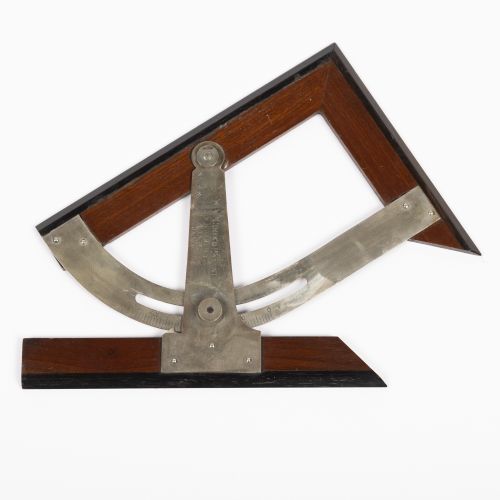
- A tool used for measuring angles of slope, elevation, or depression of an object with respect to gravity. These often incorporate folding rules or boxwood bodies.
- Transit instrument
- A telescope mounted on an axis perpendicular to its sighting line, used for observing celestial or terrestrial horizontal planes. Latimer Clark held a notable patent for a portable variant.
- Silvered metal
- A base metal treated to present a silver surface, commonly utilised for the dials and compass circles where crisp black lettering stands out clearly.
Antique Levelling Instrument: Frequently Asked Questions
What is an antique levelling instrument?
These are mechanical surveying tools built to determine relative heights and establish horizontal lines across land and architecture. They rely on spirit levels, telescopes, and graduated dials to achieve precision.
Craftsmen housed them in polished brass and fitted mahogany boxes to withstand field conditions while maintaining delicate internal calibration.
How do you date them?
Dating relies on maker signatures, style of lettering, and materials such as early mahogany versus later industrial metals. Patents named on the plates also provide a firm earliest possible year of manufacture.
Stylistic shifts from Georgian heaviness to Victorian scientific refinement offer clear visual clues for the decade of origin.
Are they still accurate today?
While many retain their mechanical movement and bubble vials, optical and internal calibration can drift over the centuries. They are collected primarily as historic scientific objects rather than for modern surveying work.
Collectors appreciate the intricate gear assemblies and optical clarity rather than active field utility.
How should I display one?
These pieces suit desks, libraries, and studies where their polished brass and dark wood tones can be examined up close. Pairing the instrument with its fitted mahogany case creates an engaging display.
Keep them away from direct heat sources to protect the wooden cases and the delicate lacquered brass finishes.