



Antique Leather Folding Screen
An antique leather folding screen brings texture, colour and substantial division to a room, offering both decorative splendour and practical partition.
Antique Leather Folding Screen
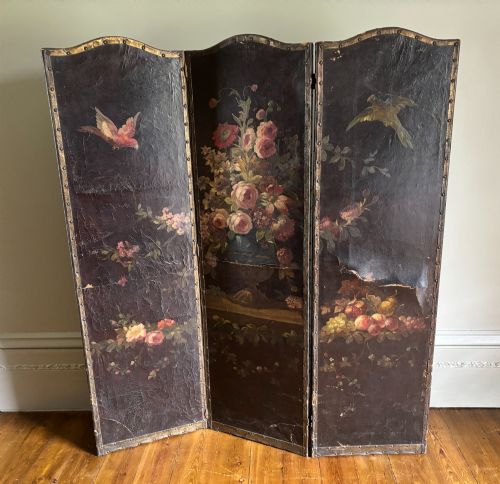
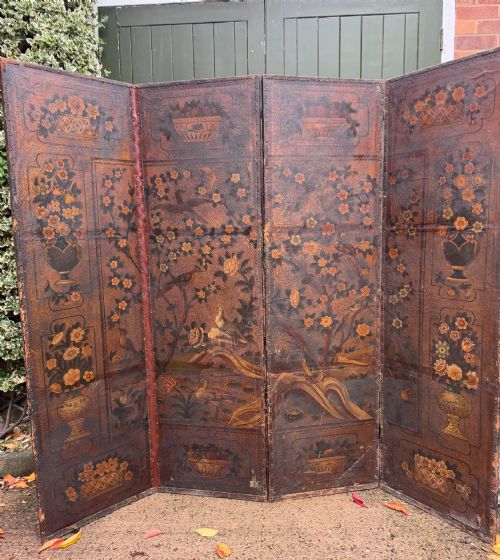
An antique leather folding screen functions primarily as a room divider, utilising multiple hinged panels to section off spaces within a domestic interior. These pieces emerge in styles spanning the eighteenth and nineteenth centuries, including Continental Baroque, Chinoiserie, and Victorian Rococo Revival.
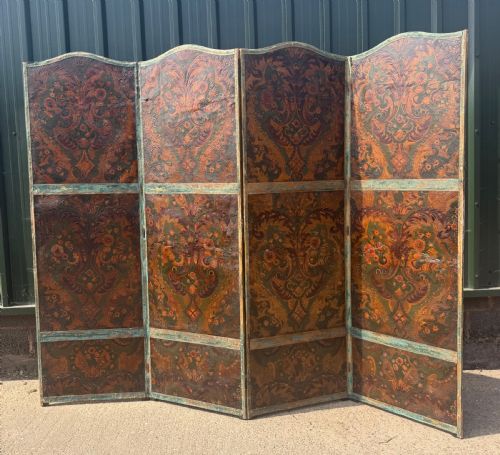
The buyer encounters predominantly four-fold and three-fold examples on this page, originating from periods such as the eighteenth century and the late nineteenth century. Forms range from tall, country-house canvases to intricate European room dividers.
Makers and artisans of these screens employed diverse regional approaches, from eighteenth-century Spanish and Dutch formats to French Chateau aesthetics. Each configuration provides a distinct architectural presence within a room.
How they were made
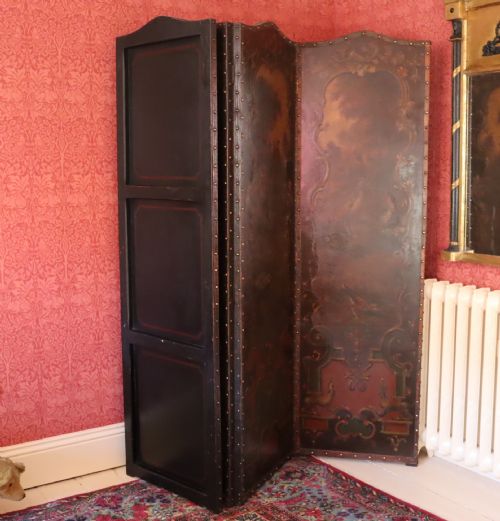
Craftsmen built these screens using wood and timber frames to support panels of leather, canvas, and brass hinges. The underlying structure required sturdy joinery to sustain the weight of the folding panels.
Surfaces were frequently finished with oil paint, paint, and gold leaf, achieving rich polychrome decoration. Techniques such as gilt embossing and hand-painting defined the elaborate aesthetic seen in Dutch tooled leather and Chinoiserie designs.
Antique Leather Folding Screen Retail Price Guide 2026
Typical asking prices for leather folding screen among the pieces listed under this phrase on Sellingantiques today, from the lower quarter to the upper quarter. They describe what is for sale here now, not the wider market.
Some nineteenth-century examples wear their country-house provenance proudly, disguised as Dutch tooled leather.
What varies in quality
The refinement of the hand-painted details and the complexity of the gilt embossing set the standard for these screens. Earlier eighteenth-century examples often display intricate pictorial depth compared to later Victorian interpretations.
The integrity of the leather panels and the sophistication of the polychrome decoration dictate the visual impact of the piece. Superior examples maintain crisp articulation in their decorative motifs across every fold.
The Antique Leather Folding Screen Glossary
- Folding screen
- A piece of furniture consisting of two or more panels that are hinged together, used to divide a room or provide privacy.
- Cordoban
- Pertaining to decorated leather originating from the Spanish city of Córdoba, known for rich tooling and embossing.
- Chinoiserie
- A European artistic style reflecting Chinese motifs and techniques, frequently applied to screens and lacquerwork.
- Polychrome
- Decorated in a variety of colours, particularly relating to the painted surfaces of these screens.
- Gilt embossed
- Stamped or raised designs on leather or other surfaces that have been highlighted with gold leaf or metallic powder.
Antique Leather Folding Screen: Frequently Asked Questions
How are antique leather folding screens constructed?
These screens consist of multiple hinged panels made from wood or timber frames supporting leather or canvas. Brass hinges join the sections together to allow flexible movement.
Artisans then decorated these surfaces using oil paint, paint, and gold leaf, often incorporating hand-painted scenes or gilt embossing.
What styles do these screens appear in?
The listings reveal various historical aesthetics, including Continental Baroque, Chinoiserie, and Victorian Rococo Revival. Eighteenth-century Spanish and Dutch influences also appear alongside French Chateau designs.
These diverse styles reflect the preferences of different periods, spanning from the seventeen-fifties through the nineteenth century.
How many folds do these screens usually have?
The pieces recorded here typically feature either three or four folds. These multiple panels create a wide barrier suitable for dividing larger rooms.
Each fold is hinged to the next, allowing the screen to be angled or flattened against a wall as needed.
What materials are used on the panels?
Leather and canvas form the primary body of the panels, stretched across wooden timber frameworks. Brass hardware secures the structural hinges.
The decorative layers rely on oil paint, applied pigments, and gold leaf to create the finished surface.