





Antique Kurdish Rug Bag
An antique kurdish rug bag brings the tactile geometry of tribal weaving straight into a modern interior.
Antique Kurdish Rug Bag
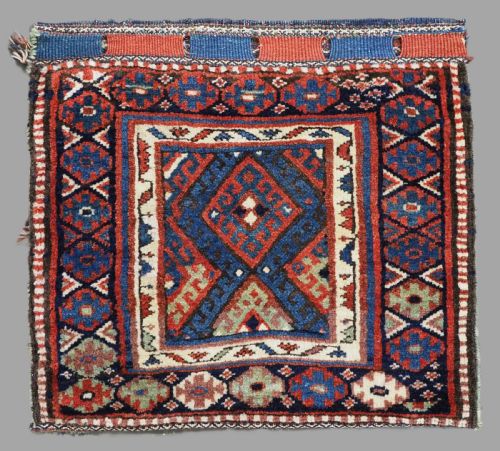
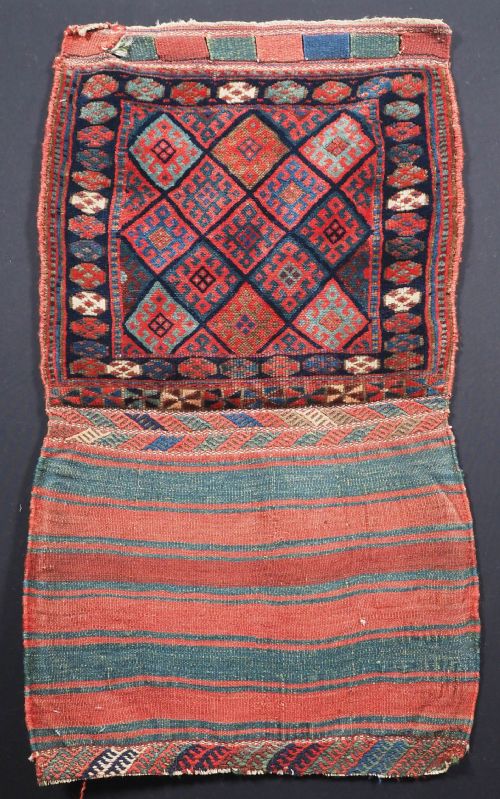
An antique kurdish rug bag is a portable woven container made by tribal groups for nomadic life, taking the form of saddlebags, wheat sacks, and smaller chantehs. These textiles appear primarily from the late nineteenth and early twentieth centuries, spanning decades such as the 1880s, 1890s, and 1900s through to the 1920s.
Buyers on this page most frequently encounter complete bags featuring plain weave backs, alongside separated bag faces and adapted cushions or pillows. The regional origins reach across West Persia and the Char Mahal Valley, taking shape through Kurdish, Jaf, Bidjar, and Bakhtiari Lor tribal traditions.
The functional purpose of these pieces was purely utilitarian, serving to transport personal belongings, household goods, or grain across rugged terrain. Today, collectors value them for their dense geometric patterns and the authenticity of their nomadic craftsmanship.
How they were made
The structure relies fundamentally on wool, frequently hand-spun to create varied texture and natural irregularity within the pile and flatweave sections. Goat hair is commonly utilised for durable selvedges and structural reinforcement, enduring the friction of daily nomadic transit.
Foundation threads often incorporate cotton alongside wool, supporting the intricate pile work and flatweave backs. Artisans employed traditional tribal techniques that combined knotted pile for decorative faces with plain weave backs for lightweight flexibility.
Antique Kurdish Rug Bag Retail Price Guide 2026
Typical asking prices for kurdish rug bag among the pieces listed under this phrase on Sellingantiques today, from the lower quarter to the upper quarter. They describe what is for sale here now, not the wider market.
Nomadic weavers packed these portable pockets with everything from dried wheat to personal heirlooms.
What varies in quality
The distinction between a standard piece and a superior one rests in the crispness of the tribal design and the handling of the wool. Hand-spun wool yields a depth of handle and a richness of touch that lesser, more uniform yarns simply fail to deliver.
Completeness alters the character of the object, as surviving examples retaining their original plain weave backs hold greater integrity than isolated bag faces. The fineness of the knotting and the vitality of the palette determine whether a piece rises above ordinary domestic utility.
The Antique Kurdish Rug Bag Glossary
- Chanteh
- A small tribal bag or vanity pouch used by nomads for carrying personal items. These pieces often feature highly concentrated geometric designs.
- Juval
- A large storage bag traditionally used inside a tent for bedding or household possessions. They represent some of the larger format weaving produced by tribal groups.
- Tasheh
- A specific type of wheat sack utilised for agricultural storage and transport. These functional pieces display robust construction designed to handle heavy dry goods.
- Plain weave
- A simple unpiled textile structure where warp and weft threads cross alternately. This technique forms the sturdy backs of many storage bags.
- Saddlebagface
- The decorative front panel of a paired riding bag, preserved after the rear sections deteriorated or were cut away. It showcases the primary artistic output of the weaver.
Antique Kurdish Rug Bag: Frequently Asked Questions
How were these bags originally used?
Nomadic families packed these textiles with personal belongings, provisions, and bedding during seasonal migrations. Their sturdy construction allowed them to be slung over pack animals or stored securely within tents.
Over decades of use, many paired bags were separated into individual faces or adapted into smaller cushions once their original transport function ended.
How do I live with a tribal bag?
These textiles adapt easily to contemporary spaces as small decorative wall hangings, table accents, or restructured cushion covers. Their compact dimensions make them suitable for adding texture to chairs or benches without overwhelming a room.
Placing them away from direct, strong sunlight preserves the natural wool fibres and the integrity of the original hand-spun materials.
How can I tell the periods apart?
Dating relies on observing structural characteristics, wool preparation, and the specific palette typical of late nineteenth and early twentieth-century tribal weaving. Pieces from the 1880s frequently exhibit distinct hand-spinning irregularities and specific regional colour choices.
Later works moving toward the 1920s show subtle shifts in proportion and yarn processing, reflecting changing conditions within tribal communities.