
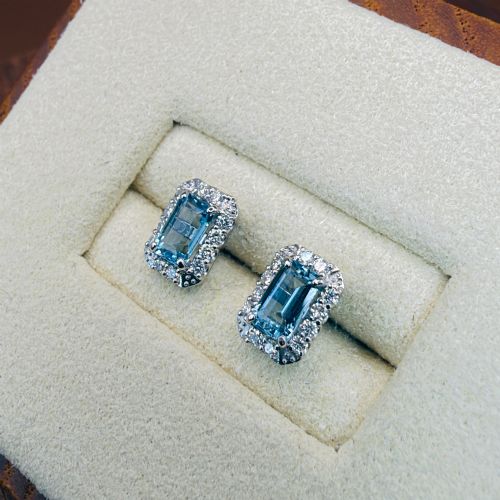
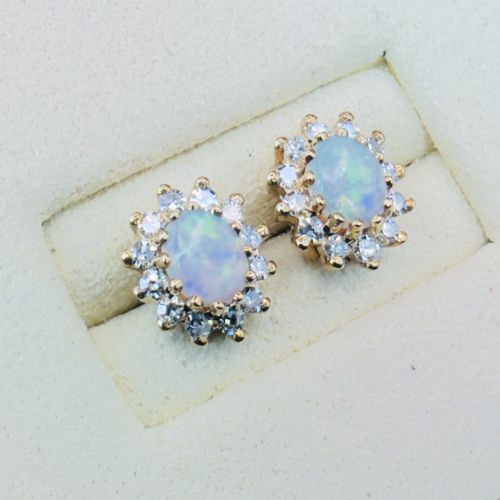


Antique Halo Stud Earrings
These antique halo stud earrings bring together centred gemstones encircled by smaller stones across Victorian, Edwardian and mid-century periods.
Antique Halo Stud Earrings
Antique halo stud earrings comprise a central gemstone framed by a ring of smaller accent stones, most commonly diamonds surrounding sapphires, rubies, emeralds or pearls. These pieces appear across Victorian, Edwardian, Art Deco and mid-century periods, showcasing distinct design shifts from floral cluster motifs to geometric symmetry.
The earrings on this page span diverse forms, including screw-back fittings, clips and post studs set in yellow gold, white gold, platinum and silver gilt. Central stones feature sapphires, garnets, aquamarines, emeralds, citrines, amethysts and bloodstones enclosed by diamond or pearl borders.
How they were made
Metalwork relies on 18ct gold, 14ct gold, 9ct white gold, platinum and silver gilt, often combining metals such as yellow gold mounts with platinum settings to enhance diamond brightness. Stones are secured using traditional claw, bezel and collet settings adapted to the circular or clustered halo arrangement.
Gemstone cutting techniques include rose-cut diamonds alongside standard brilliant cuts, paired with calibre-cut or mixed-cut coloured stones. Crafting these frames required precise hand-setting of numerous small accent stones around a prominent centre.
Periods represented include Victorian, Edwardian, Art Deco, Retro, and mid-century designs.
What varies in quality
Quality rests in the matching and proportion of the accent stones relative to the central gem, where uniform size and colour in the halo frame elevate the overall design. The crispness of the metalwork around each individual setting also distinguishes finer workshops from standard production.
The choice of materials dictates distinct tiers, such as platinum and high-carat gold mountings paired with certified centre stones standing apart from silver gilt or lower carat gold pieces set with paste or faux pearls.
The Antique Halo Stud Earrings Glossary
- Halo
- A decorative border of smaller gemstones encircling a larger central stone. This arrangement maximises perceived sparkle and visual presence.
- Cluster
- A style grouping multiple stones tightly together, frequently forming a floral or geometric pattern around a focal gem.
- Rose-cut
- An antique diamond cut featuring a flat base and a domed crown with triangular facets. It produces a soft, translucent lustre.
- Silver gilt
- Sterling silver coated with a thin layer of gold. This technique was frequently utilised in Austro-Hungarian jewellery.
- Screw earrings
- An earring fastening mechanism utilising a threaded post and a small nut turned by hand. It allowed secure wear on non-pierced lobes during the Victorian and Edwardian eras.
Antique Halo Stud Earrings: Frequently Asked Questions
Are these earrings for pierced ears?
Many historical pairs utilise screw fittings or clips designed for non-pierced lobes. Buyers should check the fastening type specified in each listing.
Conversion to modern posts is sometimes possible by a jeweller, though original mechanisms are often preserved by collectors.
How do I identify the period?
Period identification relies on a combination of metal types, gemstone cuts and setting styles. For instance, platinum-topped gold and geometric motifs point toward the Art Deco era.
Victorian and Edwardian examples often feature softer floral clusters, rose-cut diamonds and yellow gold or silver gilt mounts.
How should I clean them?
Gentle cleaning with warm soapy water and a soft brush maintains the metal and stones. Harsh chemical dips risk damaging softer gems like pearls or emeralds.
Professional inspection helps ensure fragile antique settings and delicate claw work remain secure.
What is a halo setting?
A halo setting places a ring of smaller stones around a larger centre gem. This technique enhances the brilliance and apparent size of the central stone.
Commonly paired with diamonds framing sapphires, emeralds or pearls, this design appears across multiple decades.