



Antique Folding Clock
An antique folding clock packs the precision of a desk timepiece into a portable case, making it a clever mechanical companion for travel or small spaces.
Antique Folding Clock
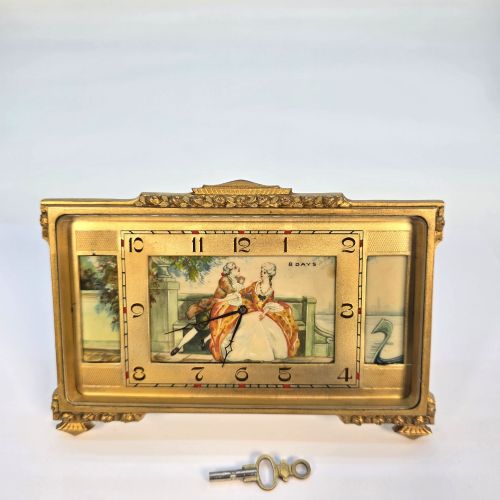
An antique folding clock combines timekeeping with clever cabinetry, designed to protect its face while on the move. Pieces span from the eighteenth century to the mid-twentieth century, capturing shifts in domestic habits and travel.
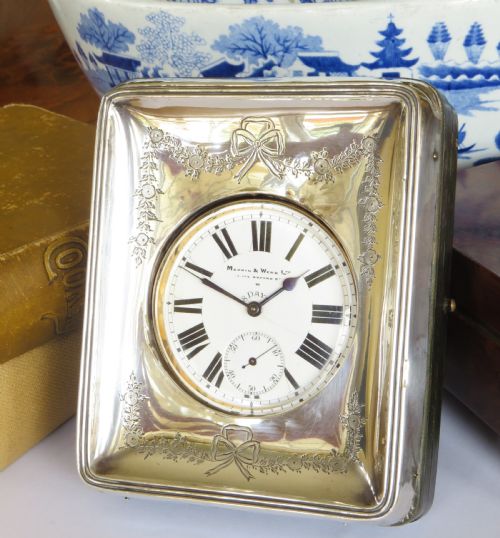
The selection ranges from pocket silver travel clocks and miniature boudoir timepieces to folding silver cases and novelty prayer book designs. French carriage clocks and Art Deco chrome-plated travel pieces also appear among the offerings.
Origin points include English and French workshops, utilising periods such as the Victorian era, Edwardian years, and the Art Deco movement. These objects frequently double as desk clocks or scientific instruments depending on their specific housing.
Materials and construction
Metals form the structural core of these timepieces, with gilt brass, silver, and chrome-plated brass providing both durability and decorative appeal. Glass protects the dial faces, while enamel often adds clean contrast to the numerals.
Exterior protection relies on fitted materials such as leather and wood, alongside paper linings and precious metal cases. Folding mechanisms depend on precise hinges and clasps designed to withstand regular movement.
The documented styles span Georgian, Victorian, Art Deco, and Edwardian design movements across various European workshops.
Assessing quality and finish
Quality rests in the crispness of the metal engraving, the tightness of the folding case joints, and the fineness of the interior movement. Fully engraved gilt brass cases show a level of hand-finishing absent in simpler mass-produced alternatives.
The choice of housing material also separates standard pieces from finer examples, such as solid hallmarked silver cases or specialised leather and wooden bindings. Intricate dial enamelwork and legible typography elevate the overall execution of the timepiece.
Mappin and Webb·J.C Vickery of London·Harrods of London·Doxa
The Antique Folding Clock Glossary
- Carriage clock
- A portable spring-driven clock designed for travel during the eighteenth and nineteenth centuries. These typically feature a glass-panelled brass case and a swinging handle.
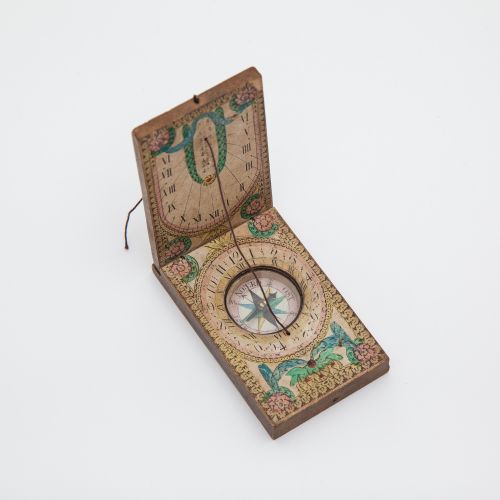
- Diptych sundial
- A pocket-sized navigation and timekeeping instrument comprising two hinged tablets. It usually incorporates a compass and string gnomon.
- Gilt brass
- Brass coated with a thin layer of gold to prevent tarnish and provide a rich metallic lustre. This finish is common on nineteenth-century French travel timepieces.
- Hallmarked silver
- Precious metal stamped by an official assay office to guarantee its purity standard. Such marks help date silver travelling cases and pocket timepieces accurately.
- Metamorphic
- A descriptive term for furniture or objects that transform from one function to another. In this context, it applies to writing desks incorporating hidden compartments or folding elements.
Antique Folding Clock: Frequently Asked Questions
How do I wind a folding travel clock?
Most portable timepieces utilise a matching key or an integrated butterfly winder at the back of the movement. Care must be taken not to over-wind the spring mechanism.
Older clockwork requires a gentle, steady hand to avoid placing undue strain on the historic gears and delicate escapements.
Are these clocks suitable for daily use?
While these pieces were engineered for movement, their age means they require thoughtful handling. Daily use is entirely possible if the movement has been recently serviced by a professional horologist.
Many collectors prefer to keep them wound occasionally rather than running them continuously to preserve the antique internal components.
How do I clean the silver cases?
Silver travel cases benefit from occasional wiping with a soft, non-abrasive cloth designed for precious metals. Polishing pastes should be kept away from engraved crevices and glass panels.
Care prevents the removal of hallmarks and surface details accumulated over a century or more of existence.
What periods do these clocks represent?
The selection spans several stylistic eras, including Georgian precision, Victorian novelty, Edwardian refinement, and Art Deco geometry. Each period introduced distinct casing materials and dial layouts.
Mid-century traditional and late nineteenth-century French designs further broaden the chronological range available to collectors.