


Antique Enamel Cuff Links
Antique enamel cuff links combine miniature painting with gentlemanly tailoring, offering a flash of colour from across the room.
Antique Enamel Cuff Links
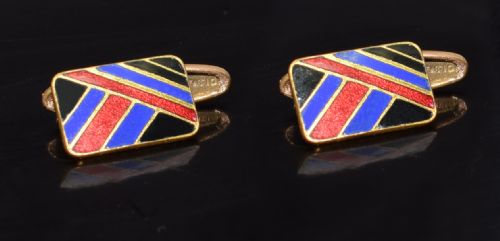
These antique enamel cuff links span from the late Victorian and Edwardian eras through the Art Deco period and into mid-century modern design. Buyers seeking antique enamel cuff links will encounter geometric Art Deco styles most frequently on this page, often rendered in contrasting green and black or stark modernist patterns.
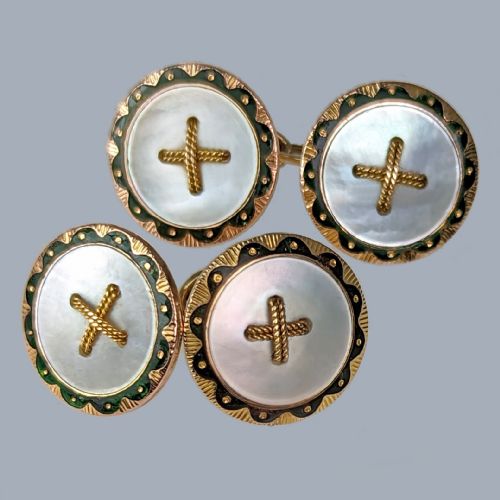
Beyond the predominant 1930s gentlemanly pairs, the selection includes pieces incorporating mother of pearl and pearls set into yellow gold. While cufflinks form the bulk of the objects, related jewellery items such as bracelets occasionally appear among the listings.
The periods represented stretch from the nineteenth century into the middle of the twentieth century. Origins span English workshops, French ateliers, and Scandinavian studios, reflecting diverse manufacturing centres across Europe.
How they were made
Vitreous enamel is fused to metal bases through high-temperature firing, creating durable coloured surfaces that resist wear. Goldsmiths and silversmiths mounted these enamel plaques into frames of 9ct gold, 18ct yellow gold, sterling silver, silver plate, chrome, brass, and base metals.
Techniques range from smooth opaque colour fields to guilloché patterns beneath translucent enamel layers, which catch the light through engine-turned engraving. Metal components are shaped, hallmarked, and hinged to allow easy fastening through shirt cuffs.
Listings span four decades of the twentieth century alongside nineteenth-century examples, paired with metals ranging from chrome and brass to 18ct gold.
What varies in quality
The standard of the metalwork establishes the baseline quality, with heavier gold and silver mounts generally supporting finer hand-finishing than plated or base-metal alternatives. Hallmarks provide definitive evidence of metal purity and manufacturing origin, adding considerable weight to a piece.
The precision of the enamel work dictates visual appeal, as well-executed kiln-firing prevents bubbling and uneven shrinkage across the decorated surface. Enamel that sits flush within its metal border without gaps demonstrates superior craftsmanship from the maker.
Solomon Blanckensee Son·Jakob Bengel·Taye Kenning Spencer Ltd
The Antique Enamel Cuff Links Glossary
- Guilloché
- A decorative technique involving precise mechanical engraving cut into metal beneath translucent enamel. This method creates repeating geometric patterns that shift as the light moves across the surface.
- Hallmark
- An official stamp applied by an assay office indicating the purity of the precious metal. These marks often reveal the maker's mark and the year of manufacture.
- Vitreous enamel
- A material made by fusing powdered glass to a metallic substrate through firing in a kiln. The resulting compound provides a hard, glossy surface that retains its colour indefinitely.
- Art Deco
- A design style dominant in the 1920s and 1930s characterised by streamlined geometric shapes and stark colour contrasts. This aesthetic heavily influences the modernist cufflinks found in this category.
- Mother of pearl
- An iridescent inner layer of mollusc shell utilised as a natural backing material. It provides a pearlescent contrast when paired with coloured enamel.
Antique Enamel Cuff Links: Frequently Asked Questions
How do I clean antique enamel cuff links?
Clean enamel pieces gently using a soft cloth dampened with mild soapy water, avoiding harsh chemical dips or ultrasonic cleaners that can loosen the vitreous glass.
Dry them thoroughly with a lint-free cloth to protect the metal mountings and any subsidiary materials like mother of pearl.
Are these cuff links suitable for modern shirts?
Most antique cufflinks fit standard double-cuff shirts easily, though fixed-post or chain-linked variants require a little practice to fasten.
The toggle and chain mechanisms designed a century ago remain entirely functional for contemporary formalwear.
How can I tell Art Deco pairs apart from older ones?
Art Deco examples rely on stark geometry, modernist motifs, and contrasting green or black enamel palettes typical of the 1930s.
Victorian and Edwardian pieces generally incorporate softer organic motifs, softer gold tones, and intricate chased metal borders.
Do enamel cufflinks chip easily with regular wear?
Vitreous enamel is essentially glass fused to metal, meaning it resists routine fading but can fracture if struck against hard surfaces.
Storing them in a dedicated box prevents impact damage when the cufflinks are not being worn.