



Antique Drawing Room Furniture
Antique drawing room furniture brings together the finest reception pieces of the nineteenth century, built to receive guests in style.
Antique Drawing Room Furniture
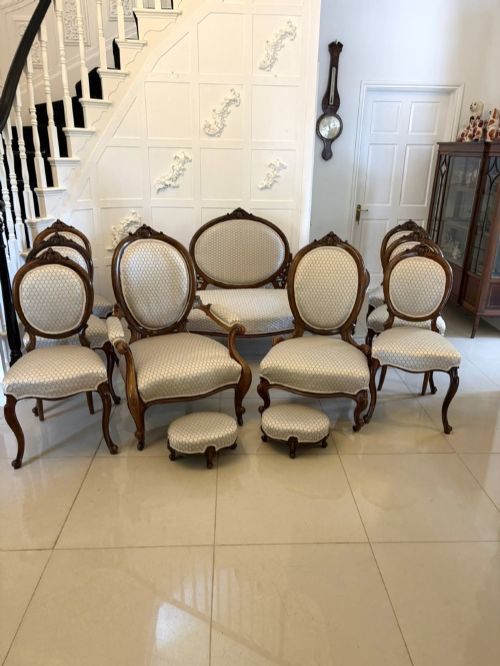
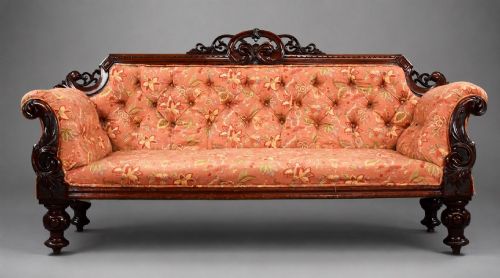
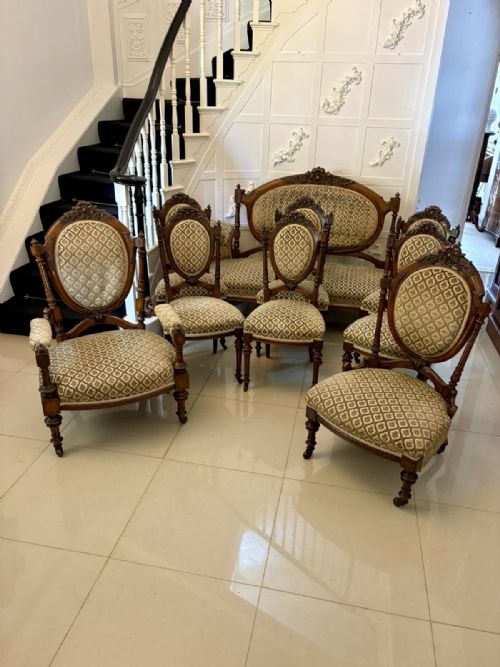
When buyers search for antique drawing room furniture, they look for formal seating and display pieces designed for nineteenth-century reception rooms. The pieces appearing here range from expansive salon suites and carved walnut settees to centre stools and show cabinets.
Most examples originate from the Victorian and Regency periods, alongside Edwardian suites and French Louis XV revival pieces. Buyers will frequently encounter matched parlour suites comprising sofas, armchairs, and side chairs upholstered in damask or woven fabric.
Forms vary from country house sofas to robust mahogany and burr walnut draw-leaf tables. The selection focuses heavily on multi-piece salon settings designed to furnish an entire formal space cohesively.
Materials and construction methods
The cabinet makers and workshops behind these pieces relied upon dense hardwoods like mahogany, rosewood, and walnut, often selecting burr walnut veneers for ornamental surfaces. Brass mounts and subtle inlay work frequently accent these timbers.
Upholstery forms a major component of the work, utilising traditional fabrics such as damask and woven textiles over sprung or stuffed frames. Carved details define the wooden structural elements of Victorian and Regency seating.
Antique Drawing Room Furniture Retail Price Guide 2026
Typical asking prices for drawing room furniture among the pieces listed under this phrase on Sellingantiques today, from the lower quarter to the upper quarter. They describe what is for sale here now, not the wider market.
Footstools come tucked inside full eleven-piece suites, proving that Victorians took resting their ankles very seriously indeed.
Assessing quality in reception pieces
Quality rests upon the ambition of the carving and the selection of timber figure, particularly in burr walnut and rosewood surfaces. Comprehensive multi-piece suites maintain higher desirability when their components share uniform timber and upholstery schemes.
The sophistication of maker attribution, seen in documented pieces by firms such as Morison and Co or Gillows, elevates the standing of an item. Exhibition quality works separate themselves through exceptionally crisp carving and integrated suite completeness.
Morison and Co·Gillows
The Antique Drawing Room Furniture Glossary
- Salon suite
- A matched set of seating furniture, usually comprising a settee and multiple arm or side chairs, made for formal entertaining. These groupings formed the core of Victorian and French-influenced reception rooms.
- Draw-leaf table
- A dining or centre table fitted with pull-out leaves stored beneath the main top, allowing the surface area to expand easily. This clever mechanism preserves a compact footprint when full extension is not required.
- Cameo back
- A chair or settee back shaped to resemble an oval carved gemstone portrait, popular in mid-nineteenth-century seating. The wooden frame frames the upholstered panel closely.
- Centre stool
- A large upholstered footstool or ottoman designed to sit in the middle of a room rather than against a wall. These pieces feature generous padding and decorative show-wood frames.
- Show cabinet
- A glazed display piece intended for the drawing room to exhibit porcelain, curiosities, and valued objects. They often utilise decorative veneers like burr walnut to catch the light.
Antique Drawing Room Furniture: Frequently Asked Questions
What defines a salon suite?
A salon suite consists of matching seating pieces designed specifically for entertaining guests in a formal nineteenth-century drawing room.
These groups typically include a settee accompanied by matching armchairs and side chairs, sometimes finished with matching footstools.
How do I date these pieces?
Dating relies upon identifying the prevailing style period, from Regency lines through heavy Victorian walnut carving to lighter Edwardian formats.
Wood choice also guides the period, as rosewood and mahogany predominate earlier in the nineteenth century while burr walnut gains favour later.
Where were these pieces used?
Drawing room furniture occupied the primary formal reception space of a large Victorian or Regency home, where guests were received.
These rooms showcased the status and taste of the household through matching suites, display cabinets, and comfortable upholstered seating.
Are centre stools seating or footrests?
Centre stools served as large upholstered ottomans placed centrally in a room rather than pushed against the perimeter walls.
They provided flexible seating or a surface to rest feet, constructed with substantial frames matching the surrounding chairs.