
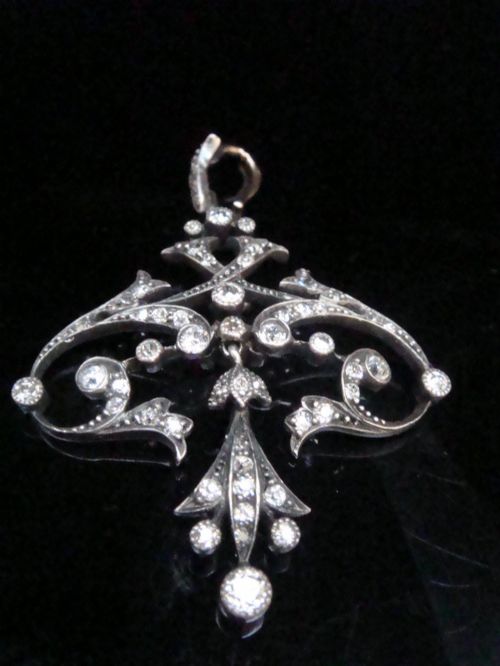


Antique Diamond Statement Pendant
These antique diamond statement pendant pieces bring together silver, platinum, and yellow gold with notable gemstone weight for high visual impact.
Antique Diamond Statement Pendant
An antique diamond statement pendant brings together significant carat weights of diamonds set in precious metals such as platinum, silver, and yellow gold. When buyers search for an antique diamond statement pendant, they encounter ornate configurations from periods including the Victorian era, Edwardian period, and the 1920s.
The selections available on this page include drop earrings, brooches that double as pendants, and substantial necklaces featuring central diamond clusters. These pieces often incorporate coloured gemstones like rubies, aquramarines, and pearls alongside the primary diamonds.
Makers and designers from the Victorian, Edwardian, Art Deco, and mid-century eras produced these substantial jewels for formal wear. Buyers most frequently meet pieces combining old European cut diamonds with intricate metalwork from the late nineteenth and early twentieth centuries.
How they were made
Craftsmen utilised platinum, silver, and yellow gold to construct the foundational mountings for these statement jewels. Platinum and silver frequently form the upper faces to enhance the brilliance of the diamonds, whilst yellow gold provides structural strength underneath.
Goldsmiths set old European cut and rose cut diamonds by hand into detailed bezels, collets, and claw settings. Sapphires, rubies, aquramarines, and pearls were integrated alongside the diamonds using traditional hand-piercing and granulation techniques.
Some versatile pieces double as both brooches and pendants, allowing wearers to pin a massive aquamarine directly to a lapel or hang it from a chain.
What varies in quality
The standard of workmanship in the metal settings separates standard items from exceptional examples. Fine pieces display delicate piercing and secure, even stone settings that hold large central gems without excessive metal bulk.
The weight, clarity, and matching of the diamonds and coloured stones dictate the upper tiers of value. Cohesion between the primary diamonds and secondary gems such as rubies or aquramarines creates a unified visual balance across the piece.
The Antique Diamond Statement Pendant Glossary
- Old European cut
- A round diamond cut popular from the late nineteenth into the early twentieth century featuring a small table, heavy crown, and open culet. This cut produces a softer, broader flash of light than modern brilliant cuts.
- Rose cut
- A vintage diamond cut characterised by a flat base and a domed crown faceted with triangles. It resembles an unopened rosebud and allows light to pass through with a subtle glow.
- Lavaliere pendant
- A drop necklace style featuring a central stone or ornament suspended below the main chain. It gained widespread popularity during the Edwardian period.
- Art Deco
- A design style spanning the 1920s and 1930s defined by geometric symmetry, clean lines, and platinum settings. Pieces from this era often contrast bright diamonds with calibrated coloured gemstones.
- Collet setting
- A metal collar that encircles the girdle of a gemstone to hold it securely in place. This method was widely used in Victorian and Edwardian jewellery manufacture.
Antique Diamond Statement Pendant: Frequently Asked Questions
How do I wear a large pendant?
These substantial pendants demand a neckline that complements their scale and weight. They sit well against solid fabrics or simple evening wear that allows the metalwork and stones to remain the focal point.
Pairing a convertible brooch and pendant with a suitable chain offers versatility in how the piece is displayed. Ensure the chain matches the metal composition and weight of the pendant itself.
How can I tell Edwardian pieces apart?
Edwardian jewellery relies heavily on platinum and silver-topped gold to create light, lace-like frameworks. These designs frequently incorporate garlands, bows, and intricate openwork metal scroll motifs.
Victorian pieces tend to use heavier yellow gold settings with more substantial, solid structures. Art Deco items shift towards rigid geometric shapes and stark symmetry.
What metals were used in these pendants?
Pendants and necklaces from these periods utilise silver, platinum, fourteen-carat white gold, and eighteen-carat yellow gold. Platinum became prevalent during the Edwardian and Art Deco eras due to its strength and bright finish.
Earlier Victorian pieces rely more on yellow gold or silver settings backed by gold. Combinations of silver and gold are common in nineteenth-century examples.
Are these pieces suitable for daily wear?
Substantial antique jewellery requires careful handling due to the age of the settings and the delicate nature of older stone cuts. Regular checks by a jeweller ensure the claws and collets remain secure around the diamonds.
Reserve these statement pieces for special occasions to protect the fine metalwork and softer gems like pearls from unnecessary wear.