
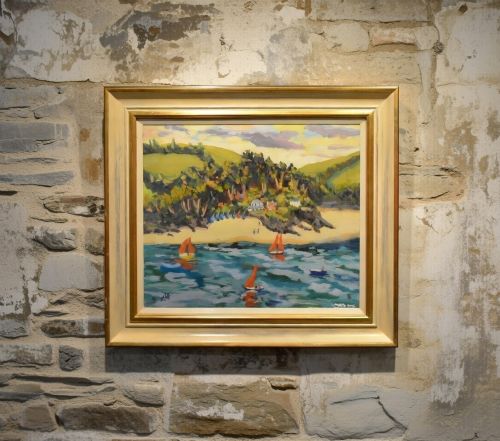


Antique Devon Landscape Painting
An antique devon landscape painting captures the rugged moorland, quiet rivers and dramatic coastlines of the West Country through the eyes of artists working from the nineteenth century into the mid twentieth.
Antique Devon Landscape Painting
An antique devon landscape painting represents a tradition of regional topographical and plein-air art spanning the Victorian era, Edwardian period and the early decades of the twentieth century. These works record specific West Country locations including Dartmoor, Exmoor, Lyme Bay, Lynmouth and the River Dart.
The pieces appearing on this page most frequently take the form of watercolours on paper, gouache, and oil paintings on canvas or wood panel, often retained in their original period frames. Subjects range from coastal scenes and maritime views to pastoral valleys and moorland paths with figures or animals.
Originating from both visiting artists and West Country residents, these paintings form part of the broader British School of landscape art. They combine topographical accuracy with the shifting atmospheric styles of British Impressionism and Victorian maritime painting.
How They Were Made
Artists working outdoors utilised media suited to rapid observation, selecting watercolour and gouache on paper or pastel for portability when capturing transient light on moor and coast. Oil paint applied to canvas or wood panel allowed for richer texture and greater depth, particularly in coastal scenes featuring sea spray and cliffs.
The physical support dictates much of the construction, with oil paintings stretched across wooden frames or laid onto wood panels, while works on paper require glass protection and acid-free mounts. Gilt wood frames provide the traditional finish for both oils and watercolours of the Victorian and Edwardian periods.
Listings feature works executed on paper, canvas, and wood panel, employing watercolour, oil, gouache, and pastel.
What Varies in Quality
The distinction between standard topographical recording and a superior painting lies in the handling of light, atmosphere and brushwork. Stronger works demonstrate confident command of tonal values and weather, whether depicting mist over Dartmoor or sunlight on chalk cliffs.
Provenance and documentation elevate certain pieces, particularly when a stretcher bears an inscription or signature confirming the exact Devon location and date. The integrity of the original period frame and the stability of the paper, canvas or wood panel also contribute significantly to the standing of the piece.
Joseph Knight·Charles William Adderton·Charles Walter Simpson·Ernest Higgins Rigg·William Traies·Walter Henry Sweet·Charles Branwhite·Samuel Edward Kelly·Edmund Gouldsmith·George Marks·Alfred Leyman·John Syer·John Dobby Walker·John Shapland·Richard Henry Nibbs·Lady Fanny Maxwell Lyte·J Jackson Curnock
The Antique Devon Landscape Painting Glossary
- Gouache
- An opaque water-based medium that provides denser colour and stronger highlights than traditional watercolour. Artists frequently combined it with watercolour on paper to describe coastal light.
- Stretcher
- The internal wooden framework that holds a canvas taut behind an oil painting. Inscriptions written directly onto the wood often supply vital historical context about the West Country location.
- British Impressionism
- A painting style reflecting the influence of French plein-air practice adapted to British light and weather. It appears in works recording Devon rivers and coastal villages with looser brushwork.
- Wood Panel
- A rigid wooden support used by artists for oil paintings before canvas became universal. Panels frequently survive from the nineteenth century in coastal and rural landscape studies.
Antique Devon Landscape Painting: Frequently Asked Questions
Where were these West Country scenes typically painted?
Artists worked across distinct Devon landscapes, focusing on the high terrain of Dartmoor and Exmoor, river valleys such as the Dart and the Lyn, and coastal locations including Lynmouth, Salcombe, and Lyme Bay.
Many painters returned repeatedly to specific villages and harbours, recording local architecture, fishing boats, and drovers crossing ancient stone bridges.
How do watercolours differ from oils in these coastal views?
Watercolours and gouache on paper offer a transparent or lightly bodied medium that captures the damp atmosphere and bright light of the Devon coast with immediate economy.
Oil paintings on canvas or wood panel provide heavier impasto and deeper colour saturation, allowing artists to build up the texture of rough seas, cliffs, and moorland earth.
How can I identify the date of a Devon landscape painting?
Dating relies on stylistic evidence, artist signatures, framing materials, and inscriptions left on the canvas stretcher or the reverse of the panel or paper.
Victorian works often display tighter detail and narrative elements, whereas pieces from the Edwardian period and the 1920s or 1930s tend towards looser brushwork associated with British Impressionism.
What subjects besides coastal views appear in these works?
While marine and coastal scenes predominate, artists frequently recorded inland rural life, including moorland ponies, farm cottages, almshouses, and drovers navigating river crossings.
These compositions document rural Devon before modern development altered the topography of towns like Honiton, Exeter, and Brixham.