




Antique Desk Clock Set
These antique desk clock sets bring together timekeeping and desk accessories, offering both practical utility and sculptural presence for the home office.
Antique Desk Clock Set
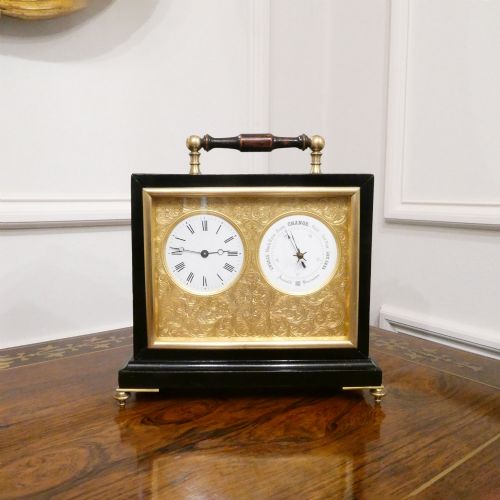
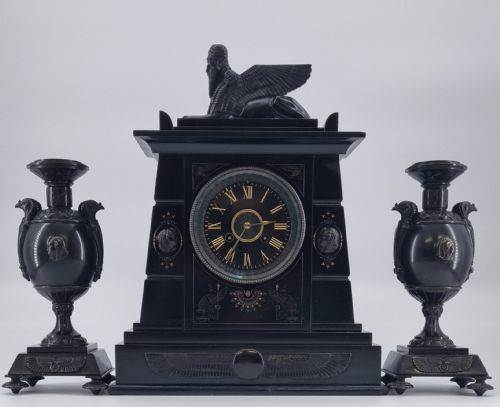
An antique desk clock set comprises a primary timepiece accompanied by matching instruments or side pieces, designed to sit upon a desk, mantel, or library table. The selection spans compact desk compendiums and inkwells fitted with clocks, alongside larger three-piece garnitures featuring matching urns, candelabras, or barometers.
You will encounter pieces originating from the nineteenth and twentieth centuries, encompassing Victorian, Edwardian, and Art Deco aesthetics. French workshops frequently supplied ormolu-mounted marble and gilt bronze sets, while English makers produced robust oak weather stations and capstan inkwells.
The objects serve multiple functions, often combining barometers, thermometers, and writing equipment into a single unified display. Whether you prefer the classical symmetry of Louis XVI style or the geometric lines of the 1930s, these sets anchor a room with period character.
Materials and Construction
The construction of these pieces relies on substantial metals and mineral supports, utilising brass, bronze, ormolu, and gilt bronze to form the structural housings and decorative mounts. Marble and onyx provide heavy, stable bases for the clock movements and matching side garnitures.
Glass protects the dial faces, while enamel frequently decorates the chapter rings and decorative panels with coloured detail. Sterling silver and oak appear in specific desk accessory formats, combining mechanical clockwork with practical writing or weather-recording equipment.
Antique Desk Clock Set Retail Price Guide 2026
Typical asking prices for desk clock set among the pieces listed under this phrase on Sellingantiques today, from the lower quarter to the upper quarter. They describe what is for sale here now, not the wider market.
One Art Deco desk set includes a sculpted German Shepherd dog keeping watch over the timepiece.
Distinctions in Quality
Quality rests upon the crispness of the casting in the bronze or ormolu mounts and the weight and selection of the marble or onyx housing. Finer examples display deeply chased surface detail and harmonious proportions between the central clock and its flanking pieces.
The integration of multiple instruments, such as barometers and thermometers alongside the clockwork, indicates a more ambitious desk compendium. Superior sets demonstrate cohesive design across every component, maintaining matching patination and unified decorative themes throughout the garniture.
Raingo Fres Paris·Michel Decoux·Ferdinand Berthoud·Japy Freres·Seth Thomas
The Antique Desk Clock Set Glossary
- Garniture
- A set of matching decorative objects designed to be displayed together on a mantelpiece or desk. A standard clock garniture includes a central timepiece flanked by two matching urns, vases, or candelabras.
- Ormolu
- Gilt bronze produced by applying a finely ground high-carat gold-mercury amalgam to a bronze object. This technique imparts a durable, rich golden finish characteristic of fine French decorative metalwork.
- Champlevé
- An enamelling technique where troughs or cells are hollowed out in the metal surface and filled with vitreous enamel paste before firing. The resulting design shows coloured enamel flush with the surrounding metal borders.
- Escapement
- The mechanical linkage in a clock that controls the release of power from the spring and imparts impulses to the pendulum or balance wheel. Specific mechanisms, such as the chaff-cutter escapement, dictate the mechanical character of the movement.
Antique Desk Clock Set: Frequently Asked Questions
What is included in a clock garniture?
A clock garniture consists of a central clock accompanied by two matching side pieces, such as candelabras, urns, or vases. These elements share identical materials, decorative motifs, and periods to create a balanced display.
Such sets were designed to sit across a mantelpiece, sideboard, or large desk, providing a unified decorative scheme for a principal room.
How do I identify an Art Deco desk set?
Art Deco sets typically feature geometric forms, stepped profiles, and materials like onyx, marble, and chrome-plated metals. The design often incorporates stylised animal sculptures or clean architectural lines.
These pieces usually date from the 1920s and 1930s, moving away from historical revival styles in favour of modern abstraction.
Where were these clock sets used?
These sets were placed in studies, libraries, drawing rooms, and formal offices to serve both practical and decorative functions. Desk versions incorporated inkwells and pen rests alongside timekeeping dials.
Larger garnitures occupied prominent positions on mantelpieces, reflecting the status and taste of the household through their expensive materials and craftsmanship.
How do I distinguish French styles from English ones?
French sets from the nineteenth century frequently employ gilt bronze, ormolu, and detailed marble bases influenced by Louis XVI aesthetics. They often feature sculptural allegory and complex cast ornamentation.
English pieces tend to favour oak, brass, and sterling silver, focusing on weather-station combinations, barometers, and robust desk compendiums with utilitarian practicality.