


Antique Crystal Regulator
An antique crystal regulator brings together heavy bevelled glass and precision movement under the influence of French Second Empire and Belle Epoque design.
Antique Crystal Regulator
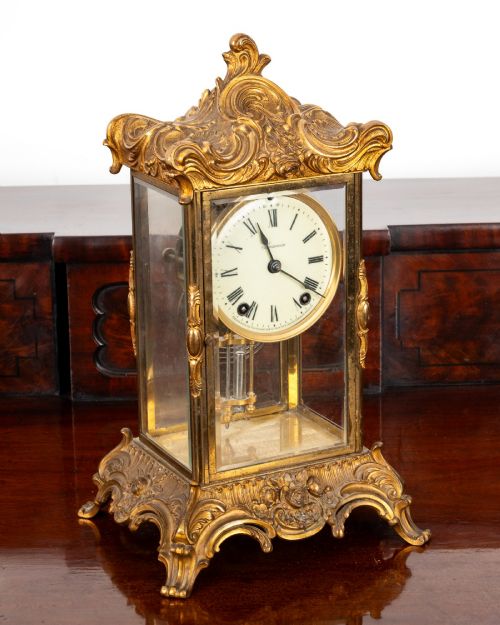
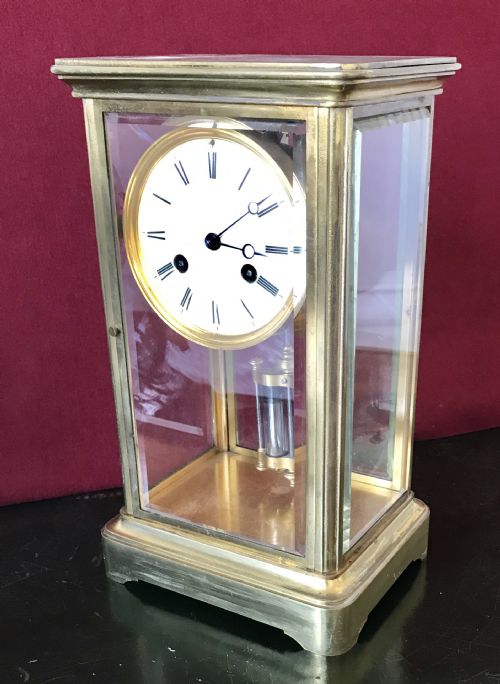
When you search for an antique crystal regulator, you are looking at mantel clocks housed in brass, gilt bronze, or ormolu frames with four glass panels that reveal the pendulum and gear train within. The most common form met on this page is the French mantel clock, often featuring enamelled dials with delicate painted details or coloured glass panels in pink, green, and blue.
These timepieces span periods from the late nineteenth century through to the Edwardian era, including Victorian examples and the 1960s. Makers such as Samuel Marti et Cie, Japy Freres, L Epee, and American firms like Ansonia produced these works, sometimes accompanied by matching garniture sets in onyx or specimen marble.
The architectural cases range from oval and bow-fronted designs to substantial four-glass structures that command attention on a mantelpiece. Buyers choose them for their visible mechanical inner workings and the way bevelled panes catch and refract room light from every angle.
Materials and construction
Makers constructed these clock cases using heavy brass, gilt bronze, and ormolu, casting structural elements to support thick bevelled glass panels without distortion. The visible brass frameworks required precise foundry work to ensure the panes fitted snugly against the metal surrounds.
Enamel dials and painted ceramic or metal panels demanded skilled artisan application, often fired at high temperatures to achieve vibrant pink, green, and blue hues. Movements were engineered with spring-driven or weight-driven escapements, designed to run accurately while remaining entirely on view through the transparent walls.
Listings feature clocks from the 1870s to the 1960s, employing brass, gilt bronze, ormolu, and bevelled glass across French Belle Epoque and Victorian styles.
What separates the finest examples
Quality in these clocks rests in the weight and finish of the gilt bronze or ormolu mounts, where crisp chasing and deep gilding elevate the architectural presence of the case. Lesser examples rely on thinner brass stampings and simpler corner pillars that lack sculptural definition.
The sophistication of the movement and dial execution dictates the upper tier, particularly when signed by renowned makers like Samuel Marti or Japy Freres. Finely painted enamel dials with undamaged numerals and mercury-filled compensating pendulums further distinguish superior specimens from standard production models.
Samuel Marti et Cie·Japy Freres·L Epee France·Ansonia New York·J E Caldwell
The Antique Crystal Regulator Glossary
- Crystal regulator
- A mantel clock featuring glass panels on four sides that expose the movement and pendulum to view. These designs became popular in France during the late nineteenth century.
- Ormolu
- Gilded bronze created through a mercury amalgamation process that produced a deep, lasting metallic sheen. It provides the decorative framing for many high-end clock cases.
- Bevelled glass
- Glass panes with angled edges ground and polished to a specific slope. This technique creates prismatic light effects around the perimeter of the clock case.
- Garniture set
- A clock accompanied by matching decorative side pieces, such as urns or vases in onyx, marble, or ormolu. Sets were designed to be displayed together on a mantelpiece.
- Escapement
- The mechanical linkage that controls the release of power in a clock movement while giving impulses to the pendulum. It is the beating heart visible through the crystal walls.
Antique Crystal Regulator: Frequently Asked Questions
How do I wind a crystal regulator?
Use the designated key on the enamel dial to wind the springs gently until resistance is felt, taking care not to over-wind the movement.
Ensure you turn the key in the correct direction specified for the particular striking or time train of the clock.
Why do some clocks have mercury pendulums?
Mercurial columns were engineered to compensate for temperature changes, expanding or contracting to keep the clock ticking accurately across different seasons.
These visible liquid-filled tubes add an extra layer of mechanical fascination to the interior of the glass case.
What is a four glass clock?
A four glass clock is an alternative term for a crystal regulator, describing the transparent panels on the front, back, and both sides.
This construction style maximises light entry and allows the owner to inspect the escapement from multiple angles.