
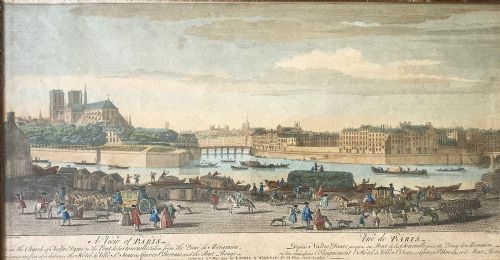
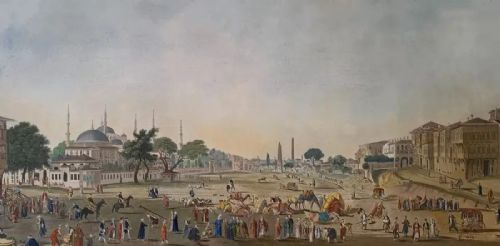


Antique Cityscape Print
An antique cityscape print captures the streets, rivers, and architecture of past eras through ink, watercolour, and paper.
Antique Cityscape Print
An antique cityscape print brings historical urban views into domestic spaces, ranging from expansive river scenes to detailed architectural studies. Buyers seeking an antique cityscape print will encounter various formats, from single framed engravings to sets of river views and original watercolours.
The selection includes pieces from the eighteenth century, the Victorian era, and the early twentieth century, showing cities such as London, Paris, Constantinople, and Venice. These works frequently depict famous landmarks, rivers like the Thames, and continental streetscapes captured by period artists and engravers.
Materials and techniques
These works rely primarily on paper sheets marked with ink, watercolour, and hand colouring, sometimes complemented by gold leaf, gilt wood, and burr walnut frames. Makers employed techniques such as etching, engraving, drypoint, and lithography to transfer intricate urban details onto the sheet.
Many examples feature original hand colouring applied over printed lines, while others are executed directly in watercolour on paper. Framing materials typically include wood and gilt surrounds that protect the delicate paper surfaces.
One oversized nineteenth century engraving of the Thames was specifically built to satisfy a collector who desired art for a very long wall.
Assessing quality in urban views
Quality in an antique cityscape print rests upon the sharpness of the printed line, the precision of any hand applied colour, and the overall condition of the paper. Stronger examples display clear architectural detail and well preserved pigment without excessive fading.
The distinction between standard decorative plates and works by named artists or skilled engravers also shapes the character of each piece. Superior framing, particularly period wooden or gilt surrounds, further distinguishes the presentation.
Anton Ignaz Melling·Claes Jansz Visscher·Francis Dodd·Louis Icart·Henry Wimbush·H.P. Parker
The Antique Cityscape Print Glossary
- Etching
- A intaglio printmaking technique where lines are bitten into a metal plate with acid before being inked and pressed onto paper.
- Lithography
- A planographic printing process based on the antipathy of oil and water, commonly used for nineteenth century topographical views.
- Drypoint
- A printmaking method where a design is scratched directly into a metal plate with a sharp needle, producing characteristic soft burr lines.
- Watercolour
- A paint medium consisting of water soluble pigments applied to paper to create translucent washes of colour.
- Engraving
- A technique where an artist cuts lines directly into a hard plate using a burin to hold the printing ink.
Antique Cityscape Print: Frequently Asked Questions
How do I date an antique cityscape print?
Dating relies on the paper type, printing technique, and stylistic clues within the architecture or clothing depicted in the urban scene. Reference dates found in signatures, publisher inscriptions, or framing details also provide reliable chronological markers.
Catalogues and period records further help narrow down the decade of production for eighteenth and nineteenth century topographical works.
Are these prints hand coloured?
Many examples feature original hand colouring applied with watercolour over etched or engraved lines. This additional pigment was added by hand in the workshop to enhance the visual appeal of the architectural and landscape details.
Close inspection under magnification reveals the brushstrokes characteristic of manual pigment application rather than uniform mechanical printing.
Where should I hang a cityscape print?
These works suit studies, living rooms, and hallways, particularly when paired with traditional wooden or gilt frames that complement period interiors. They pair well with wall spaces that allow for either single focal pieces or paired topographical studies.
Protecting the paper from direct sunlight ensures the inks and watercolours retain their original tones over time.
What is the difference between an engraving and a watercolour?
An engraving is a printed multiple produced from an inked metal plate, whereas a watercolour is a unique painted artwork executed directly onto paper by hand. Engravings often show repeated fine lines and plate marks around the image boundary.
Watercolours display varied pigment density and brush texture unique to the individual artist's hand.