

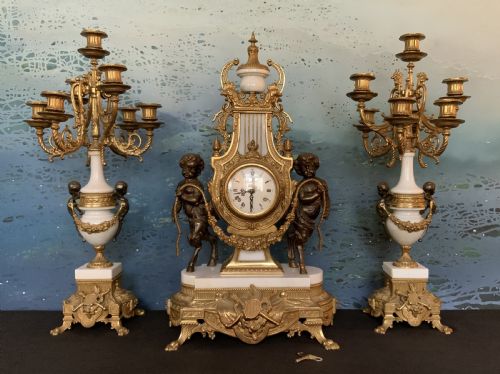


Antique Bronze Mantel Piece
An antique bronze mantel piece brings the weight and ornament of the nineteenth century directly to the hearth.
Antique Bronze Mantel Piece
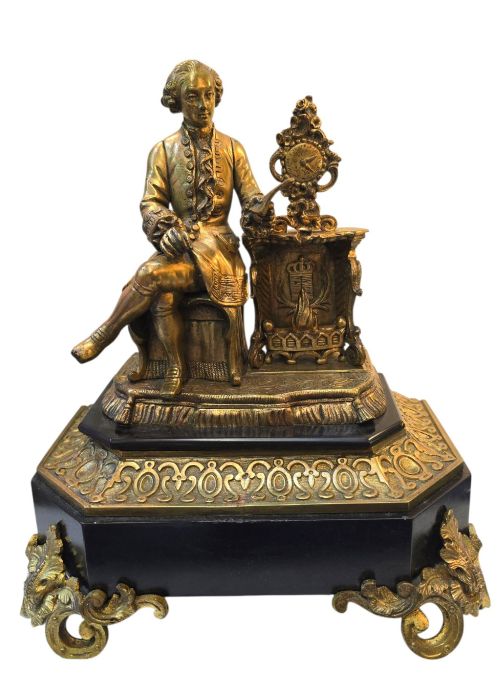
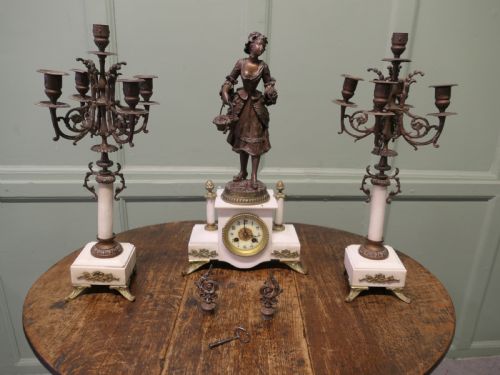
An antique bronze mantel piece typically takes the form of a substantial clock garniture set, often accompanied by matching candelabra or sculptural sidepieces. Buyers encounter numerous French examples spanning the nineteenth century, finished with classical figures, architectural marble bases, and ornate gilt mounts.
The dominant configurations on this page include three-piece sets combining patinated bronze with white or coloured marble, onyx, and porcelain panels. These works originated as domestic timekeepers and decorative centrepieces for nineteenth-century drawing rooms.
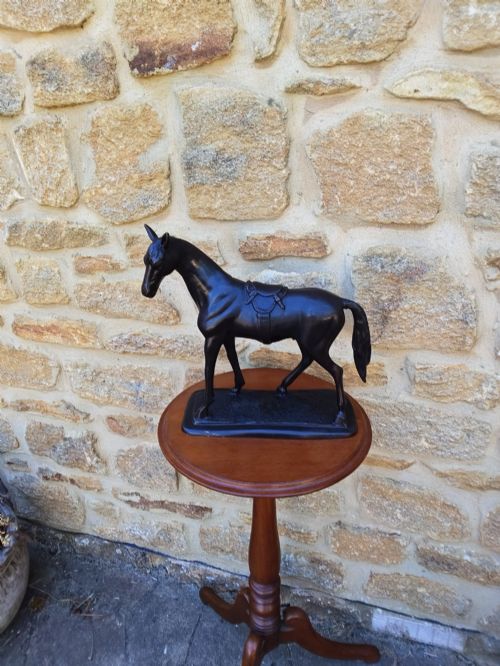
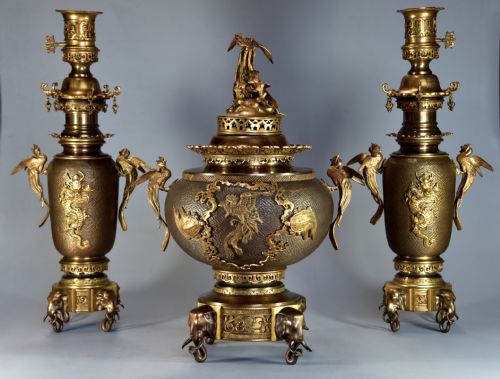
Alongside complete clock sets, the selection includes standalone patinated bronze sculptures, animalier figures, and ornamental incense burners. Most items trace their origins to French workshops and Victorian production centres operating between eighteen sixty and nineteen twenty.
Assessing the standard
The degree of hand-chasing on the bronze mounts distinguishes standard production items from superior works, as sharper chisel work creates crisper definition in hair, foliage, and garments. Weight and density in the supporting marble or onyx plinths also signal higher manufacturing ambition.
Consistency between the clock movement and the matching side garnitures determines the integrity of a set, as assembled pairings lack the uniform patination and matching serial numbering found in unified workshop commissions.
Listings feature nineteen-century periods including Victorian, eighteen sixty, and nineteen twenty, constructed from gilt bronze, marble, ormolu, and porcelain.
Pierre-Augustin Caron de Beaumarchais·Isadore Bonheur·Jules Dalou·Susse Freres·Payne and Co London·Finnigan Manchester·Ferdinand Berthoud·Japy Freres
The Antique Bronze Mantel Piece Glossary
- Garniture set
- A matching centrepiece, such as a clock, flanked by two side ornaments like candelabra or urns designed for a mantelpiece. These groupings were conceived as a single decorative scheme.
- Ormolu
- Finely ground high-carat gold applied to a bronze base using a mercury amalgamation technique, yielding a rich golden lustre. This surface treatment defines the bright highlights on nineteenth-century French clocks.
- Clock movement
- The internal mechanical brass gear train driven by springs or weights that powers the timekeeping and striking functions. French movements from this era often bear maker stamps on the backplate.
- Breccia marble
- A composite stone made of broken rock fragments embedded in a fine-grained matrix, creating a mottled surface pattern. This material frequently forms the heavy plinths beneath bronze clock cases.
- Patinated bronze
- Metal treated with chemical solutions to produce a darkened brown, green, or black surface finish rather than a bright metallic gleam. This coating protects the bronze while defining the contours of sculptural figures.
Antique Bronze Mantel Piece: Frequently Asked Questions
What is a clock garniture?
A clock garniture is a matched suite of decorative objects designed to sit together on a mantelpiece, consisting of a central clock flanked by two matching side pieces such as candelabra, urns, or vases.
These sets were produced in great quantities during the nineteenth century in France and England to create a balanced, symmetrical display in formal reception rooms.
How do I care for marble and bronze?
Dust bronze surfaces gently with a soft dry cloth and avoid applying liquid polishes or modern chemical cleaners that can strip the historic patination or ormolu finish.
Marble bases benefit from occasional wiping with a damp cloth followed by immediate drying, keeping moisture away from any exposed metal mounts or clock movements.
Are these clocks still in working order?
Many antique mantel clocks retain their mechanical movements and strike trains, though operating condition varies across individual pieces depending on recent servicing history.
Buyers should expect that mechanical clocks from the nineteenth century may require professional adjustment or cleaning by a specialist horologist to run reliably.
How can I tell Victorian pieces apart from earlier ones?
Victorian pieces often display heavier neoclassical or eclectic Revival ornament, while earlier eighteenth-century and early nineteenth-century works adhere more strictly to Louis XVI or French Empire proportions.
Examining the casting quality, the style of the dial numerals, and any maker signatures stamped on the bronze or movement plates helps narrow down the production period.