


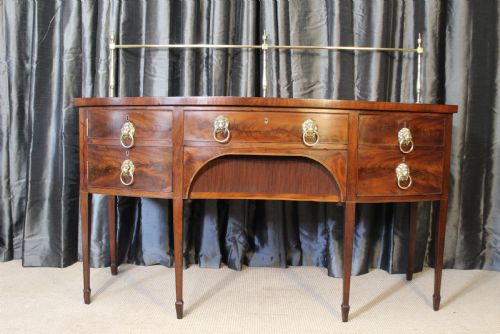

Antique Brass Rail Credenza
An antique brass rail credenza offers robust metal galleries atop timber sideboards, bringing formal storage and display surfaces into modern rooms.
Antique Brass Rail Credenza
Buyers seeking an antique brass rail credenza examine large dining room servers, sideboards, and side cabinets primarily constructed from mahogany, rosewood, and satinwood. The pieces span the Georgian, Regency, Victorian, and later revival periods, bringing distinct proportions and decorative treatments into domestic spaces.
The defining gallery feature appears on items catalogued with brass galleries or rails, often accompanying serpentine or bowfront timber bodies. Most examples on display originate from the eighteenth and nineteenth centuries, supplemented by later nineteenth-century Sheraton Revival interpretations.
Related forms include chiffoniers and pedestal sideboards that share the timber vocabulary and hardware of these serving pieces. The selection ranges from compact side cabinets to large nineteenth-century servers equipped with display rails.
Materials and construction methods
Cabinetmakers utilised dense hardwoods such as mahogany and rosewood for the primary carcass, frequently embellishing surfaces with satinwood, boxwood, and amboyna wood inlays. These timbers provided a stable foundation for curved serpentine and bowfront configurations.
Metal components, specifically brass galleries and rails, were secured to the upper timber surfaces to retain display items. Inlaid stringing and contrasting borders define the decorative surface work across the Georgian and revival periods.
Listings feature mahogany, rosewood, and satinwood across Georgian, Regency, and Victorian periods.
Distinctions in construction and design
Quality separates pieces through the precision of timber selection and the complexity of the cabinetwork, particularly in the execution of curved bowfront and serpentine shapes. Superior examples display balanced grain patterns and meticulous contrasting wood inlays.
The refinement of the brass gallery and the integration of the metal rail into the timber top indicate the level of craftsmanship. Secondary timbers and internal drawer construction further distinguish standard production from finer cabinetmaking.
Robson and Sons·H Mower and Stephenson
The Antique Brass Rail Credenza Glossary
- Brass gallery
- A metal rail system mounted to the top surface of a sideboard or server to prevent items from sliding off. These fixtures add a reflective vertical element to the timber top.
- Serpentine front
- A furniture facade featuring a convex central section flanked by concave curves. This shaping requires advanced woodworking skill to execute properly.
- Bowfront
- A convex, outward-curving front profile commonly found on eighteenth and nineteenth-century case furniture. It softens the linear appearance of a standard rectangular sideboard.
- Chiffonier
- A small sideboard or low cabinet equipped with shelving or a gallery on top. It serves a similar function to larger dining room servers.
- Inlay
- A technique where contrasting pieces of wood or other materials are inserted into recesses within the base timber. This creates decorative patterns across the surface of the cabinet.
Antique Brass Rail Credenza: Frequently Asked Questions
What is a brass gallery?
A brass gallery is a decorative metal rail mounted to the upper surface of a sideboard or server.
It was originally designed to keep serving dishes and glassware secure while food was being prepared or displayed.
How were these sideboards used?
These pieces served as dining room servers and storage units for porcelain, cutlery, and linens during formal meals.
The top surface provided space for displaying serving platters, while drawers and cupboards held dining accessories.
How do I date a sideboard?
Dating relies on examining the timber species, secondary woods, construction methods, and overall decorative style.
Georgian and Regency pieces typically show hand-cut dovetails and specific cabinetmaking proportions that differ from later Victorian revivals.
Where should I place one?
These cabinets suit dining rooms, living spaces, and large hallways where their surface length and storage capacity function effectively.
The brass rail adds height, making them suitable against bare walls that require visual balance.