

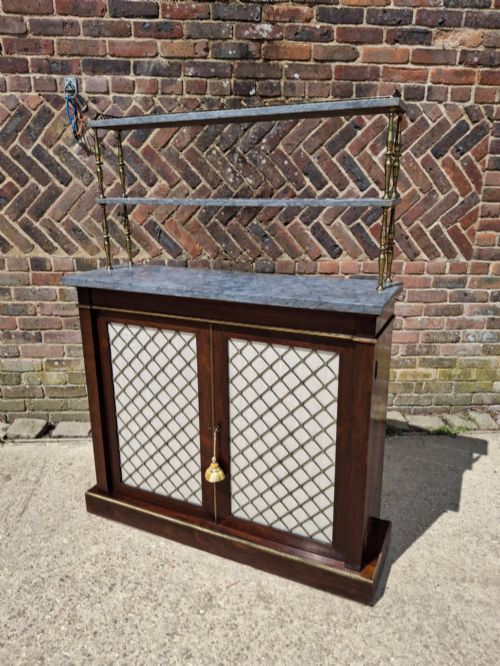
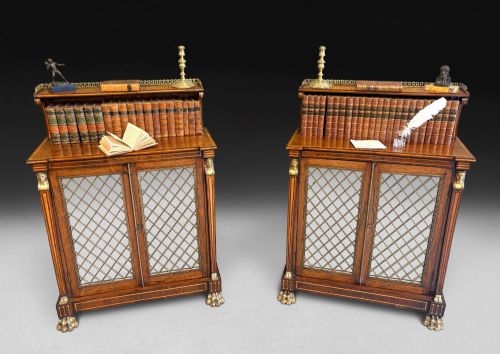
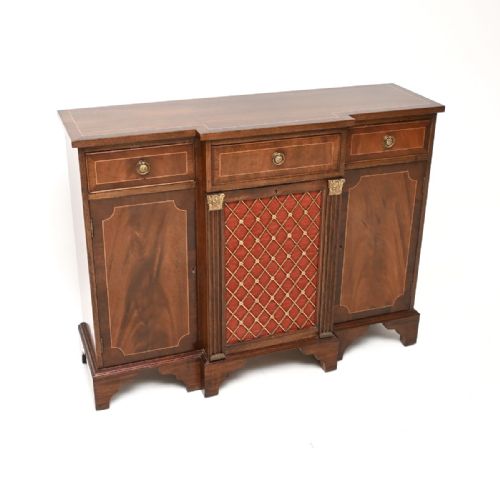
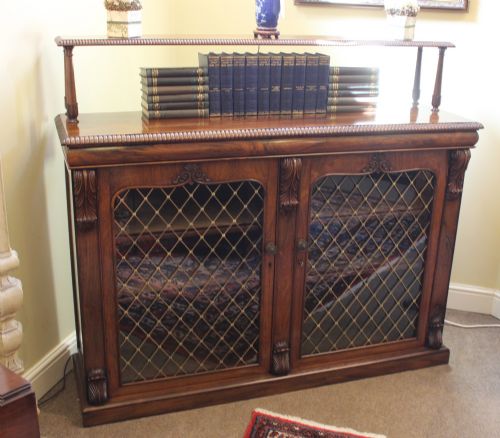


Antique Brass Lattice Sideboard
These antique brass lattice sideboard options bring together rich timber and metalwork from the nineteenth century for a formal interior.
Antique Brass Lattice Sideboard
Buyers searching for an antique brass lattice sideboard encounter refined nineteenth-century timber cabinetry designed for display and storage. The selection on this page centres primarily on side cabinets, chiffoniers and sideboards executed in rich woods.
Most examples hail from the Regency and Victorian periods, displaying the formal lines and polished surfaces characteristic of those eras. Pieces take the form of dwarf bookcases, breakfront side cabinets and compact chiffoniers rather than strictly designated sideboards.
Makers and workshops of the time utilised dark hardwoods to anchor formal rooms, incorporating brass details to catch the light. This specific grouping demonstrates the shift from strict Regency proportions toward heavier Victorian utility.
Materials and construction
Cabinet makers constructed these pieces using dense hardwoods such as mahogany, rosewood and pollard oak as the primary carcass materials. These timbers were selected for their deep grain and ability to take a high polish.
Craftsmen inlaid brass and boxwood into the timber surfaces, creating geometric lines and decorative highlights across doors and panels. Glass and mirror elements were also integrated into cabinet doors and backs to lighten the heavy timber forms.
Antique Brass Lattice Sideboard Retail Price Guide 2026
Typical asking prices for brass lattice sideboard among the pieces listed under this phrase on Sellingantiques today, from the lower quarter to the upper quarter. They describe what is for sale here now, not the wider market.
Listings span the nineteenth century, featuring Regency and Victorian periods alongside later twentieth-century interpretations.
Judging the quality
Quality rests upon the selection of timber veneers and the precision of the brass inlay work set into the wood. Finer examples display meticulous grain matching and crisp metalwork that remains flush with the surrounding surface.
Proportion and scale separate standard workshop production from pieces of higher ambition, particularly in Regency and early Victorian cabinets. The integration of secondary timbers like ebony and pollard oak indicates a more costly commission.
The Antique Brass Lattice Sideboard Glossary
- Chiffonier
- A low cabinet originating in the nineteenth century, typically featuring shelves or a mirrored back above enclosed cupboards. They served as versatile storage pieces in dining rooms and parlours.
- Pollard Oak
- Timber taken from trees pollarded at a height to encourage a dense, knotted grain pattern. Cabinet makers valued this wood for its decorative movement and rich colour.
- Breakfront
- A cabinet design where the central section projects forward from the flanking wings. This architectural arrangement creates depth and shadow across the front elevation.
Antique Brass Lattice Sideboard: Frequently Asked Questions
Where were these cabinets used?
These cabinets sat in formal dining rooms, drawing rooms and parlours to store linens, silver or books.
Their compact proportions allowed them to fit against walls where larger case furniture would overwhelm the space.
How do I identify a Regency piece?
Regency pieces often display classical architectural proportions, clean lines and restrained brass or boxwood stringing.
They rely on the natural beauty of mahogany or rosewood rather than heavy carved ornamentation.
What is pollard oak?
Pollard oak is a decorative timber harvested from trees cut back to promote dense branching and a swirling grain.
Cabinet makers used its distinct mottled appearance on prominent surfaces to draw the eye.
How should I care for rosewood?
Rosewood requires stable humidity levels and protection from direct sunlight to prevent the timber from drying out or fading.
Regular dusting with a dry cloth maintains the polish without building up chemical residues.