



Antique Bloodstone Jewellery
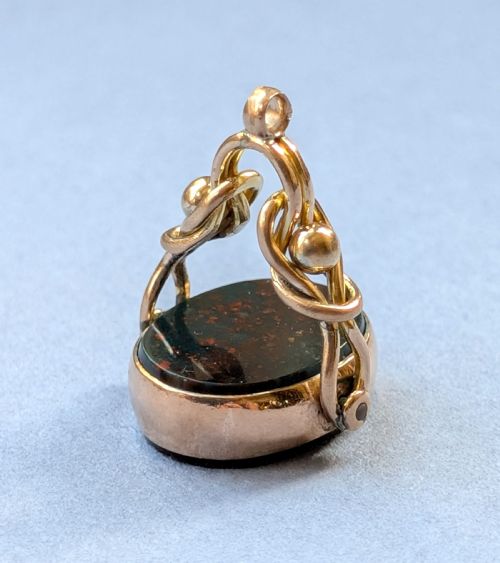
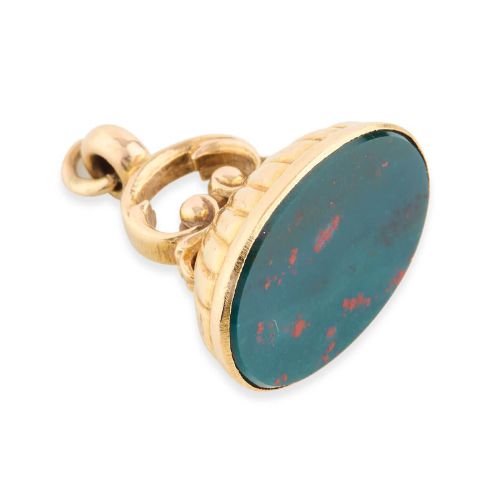
Antique bloodstone jewellery delivers deep green chalcedony splashed with red jasper, appearing most often in heavy Victorian fobs and rings.
Antique Bloodstone Jewellery
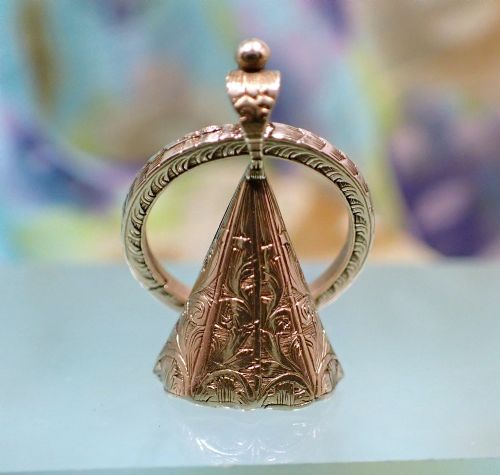
Antique bloodstone jewellery comprises rings, brooches, charms, and particularly spinning fobs set in gold or silver. Buyers seeking antique bloodstone jewellery encounter pieces spanning the Victorian, Edwardian, and mid-twentieth-century periods, alongside Georgian origins.
The material itself dominates these forms, appearing frequently paired with agate, carnelian, and jasper in Scottish pebble work. Fobs designed to hang from watch chains form the largest share of what meets the eye on this page, often featuring rotating seals.
Rings and brooches also emerge in gold and silver, ranging from nine-carat rose gold to eighteen-carat gold and white gold. These items reflect a heritage of gentleman's desk seals converted to personal adornment or worn as watch accessories.
How they were made
Goldsmiths set the opaque dark green stone into mounts of nine-carat, fifteen-carat, or eighteen-carat gold, as well as silver and white gold. Stones were sliced and polished flat for intaglio seals or shaped into cabochons for rings and brooches.
Techniques include hand engraving into the stone itself, creating crests and monograms on spinning fobs, and mounting multiple hardstones together in geometric Scottish pebble designs. Metalwork relies on cast and chased frames, split rings, and secure bezel settings.
Some nineteenth-century silver watch chains include tiny lucky charms shaped like pigs, bugs, and musical bugles alongside the bloodstone fob.
What varies in quality
Quality rests upon the richness of the green chalcedony and the density of the red jasper inclusions within the stone. Superior pieces display a vivid contrast of colour without dull fracture lines across the face.
The depth and crispness of hand engraving on seals or intaglios further separate the work, alongside the weight and purity of the gold or silver mount. Heavier gold spinning fobs with fully articulated swivels command greater presence than lighter, mass-produced later iterations.
The Antique Bloodstone Jewellery Glossary
- Bloodstone
- An opaque green chalcedony variety flecked with red jasper spots resembling drops of blood. This stone was historically carved into signet seals.
- Fob
- A short chain or pendant attached to a pocket watch, frequently featuring a swivel mechanism with hardstone panels. Victorian gentlemen used them to press wax seals on correspondence.
- Intaglio
- A design carved into the surface of a gemstone so that an impression pressed in wax appears in relief. These often bore family crests or initials.
- Jasper
- An opaque, microcrystalline variety of quartz often combined with bloodstone and agate in regional Scottish pebble jewellery. It occurs in various earthy tones.
- T Bar
- A short horizontal metal bar attached to a pocket watch chain, designed to slip through a waistcoat buttonhole. They commonly anchor antique fob assemblies.
Antique Bloodstone Jewellery: Frequently Asked Questions
What is bloodstone?
Bloodstone is a dark green chalcedony quartz containing distinctive red inclusions of iron oxide or jasper. It has been utilised for signet rings and decorative seals for centuries.
The stone takes a high polish, making it durable enough for daily wear in rings, fobs, and brooches set in gold or silver.
How do I wear a fob pendant?
Fob pendants originally hung from pocket watch chains worn across waistcoats by Victorian and Edwardian gentlemen. Today, many wear them suspended from modern neck chains or charm bracelets.
Spinning fobs allow the wearer to rotate the central stone block to display different faces, such as a carved stone and a blank gold panel.
What is Scottish pebble jewellery?
Scottish pebble jewellery incorporates native hardstones like bloodstone, jasper, agate, and carnelian set into silver or gold mounts. These designs gained immense popularity during the Victorian era following royal patronage in Scotland.
Pieces often take the form of brooches, dirks, and padlocks, showcasing intricate geometric arrangements of polished multi-coloured stones.
How do I date an antique seal?
Dating relies on stylistic clues in the metal mount, hallmark stamps where present, and the architectural form of the swivel frame. Georgian and early Victorian seals often feature heavier hand chasing and deeper bezels.
Later Edwardian and twentieth-century examples tend towards lighter gauge gold mounts and mass-produced swivel mechanisms.