




Antique Backgammon Board
An antique backgammon board brings centuries of social play into a room, offering tactile timber folding surfaces and clever dual-purpose box designs.
Antique Backgammon Board
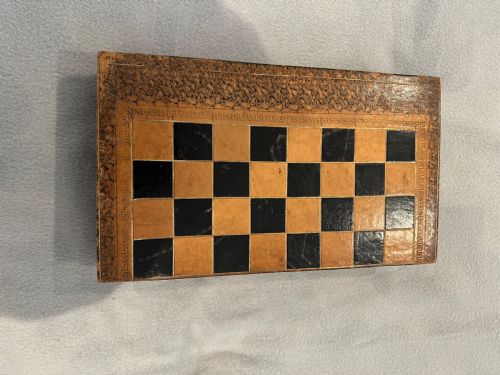
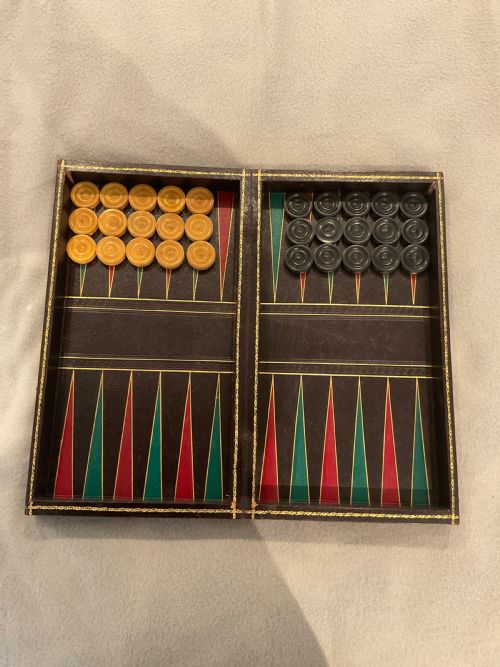
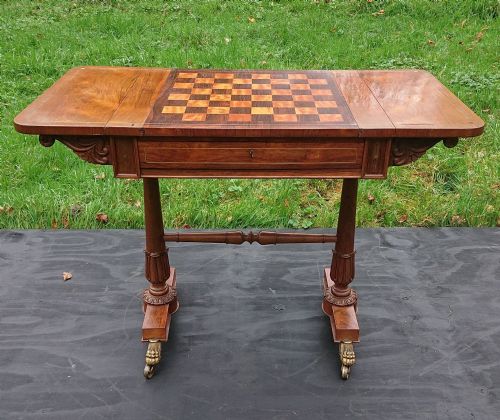
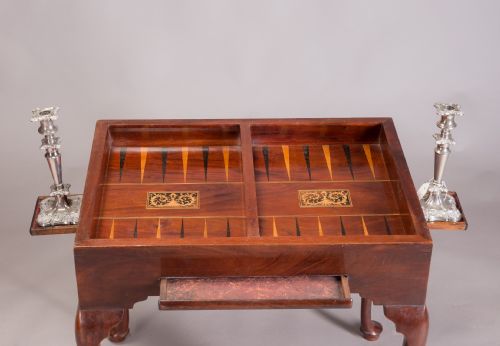
An antique backgammon board takes several distinct forms, most commonly appearing as folding wooden boxes, games tables, or clever leather-bound faux books that conceal the playing surface within.
The pieces on this page span the Victorian and nineteenth-century periods, showing traditional English craftsmanship alongside Ottoman Revival and Georgian Irish influences.
Many examples double as chess or checkers boards, combining multiple pastimes into a single compact box or pivoting table top.
Materials and construction
Cabinet makers utilised robust timbers such as mahogany, rosewood, walnut, and boxwood, often pairing contrasting grains to delineate the triangular points of the playing field.
Outer surfaces frequently incorporate tooled leather, brass hinges, and delicate inlay work using mother-of-pearl or gold leaf to ornament the folding cases.
Distinguishing quality in older boards
Superior examples reveal themselves in the precision of the wood inlay and the crispness of the leather tooling, where lines remain sharp and hinges are countersunk flush with the timber.
The choice of dense cabinet timbers like rosewood and mahogany, combined with original matching counters, separates standard folding boards from finer exhibition pieces.
Gillows
The Antique Backgammon Board Glossary
- Faux book
- A games board constructed to resemble a leather-bound volume when closed, designed to sit discreetly on a library shelf.
- Games compendium
- A multi-use box containing equipment for several different pastimes, including backgammon, chess, and checkers.
- Birdseye maple
- A decorative timber figuring featuring small circular swirls resembling tiny eyes, frequently used for contrasting board points.
- Boxwood
- A dense, pale yellow wood utilised for light-coloured playing points and turned gaming pieces.
Antique Backgammon Board: Frequently Asked Questions
How do I date an antique backgammon board?
Dating relies upon timber selection, hinge construction, and the overall style of the outer case. Nineteenth-century examples often utilise rosewood or mahogany with hand-tooled leather.
Faux book formats and travelling sets also carry distinct construction markers typical of the Victorian era.
Were these boards made for travel?
Many nineteenth-century boards were specifically engineered for portability, folding securely into compact wooden boxes or leather cases. Some incorporated miniature designs for use on journeys.
Travelling variants often secured the playing pieces internally during transit.
Do these boards usually include playing pieces?
Some surviving examples retain their original turned wooden or bone counters, while others appear as boards alone. Complete sets with matching original counters are particularly satisfying to find.
Collectors frequently reunite boards with period-appropriate counters if the originals are missing.
How should I display an antique backgammon board?
These folding boards and games boxes look striking displayed closed on a side table or open to reveal the intricate interior layout of contrasting wood points.
Keeping them away from direct sunlight and sudden temperature changes protects the delicate leather and timber veneers.