



Antique Anatolia Carpet
An antique anatolia carpet brings rich history into a room, offering centuries of regional weaving traditions through intricate prayer designs and grand village carpets.
Antique Anatolia Carpet
When searching for an antique anatolia carpet, buyers encounter a diverse selection of hand-woven rugs and carpets originating from different regions of Anatolia. These textiles range from large decorative floor coverings to small village prayer rugs, capturing centuries of distinct cultural expression.
The pieces available on this page reflect diverse regional identities, including village and tribal formats from centres such as Konya, Bergama, Ushak, and Kirsehir. Formats vary from compact prayer rugs designed for personal devotion to expansive carpets created for stately interiors.
Originating across the nineteenth and early twentieth centuries, these rugs display styles spanning Anatolian tribal, Ottoman, and traditional regional weaving. Each piece acts as a tangible record of the specific town or nomadic group where the loom was set up.
Materials and construction
Weavers relied on natural materials, utilising wool, cotton, and occasionally silk for finer pictorial details. Hand-spun wool provided the resilient foundation for most village and tribal pieces, paired with cotton warps and wefts in larger format carpets.
Colour palettes derived from natural dyes, yielding deep blues, ivory grounds, and soft secondary shades that mellow gracefully over time. These organic colourants interacted with the wool to produce the rich, varied tonalities visible across different regional workshops.
Antique Anatolia Carpet Retail Price Guide 2026
Typical asking prices for anatolia carpet among the pieces listed under this phrase on Sellingantiques today, from the lower quarter to the upper quarter. They describe what is for sale here now, not the wider market.
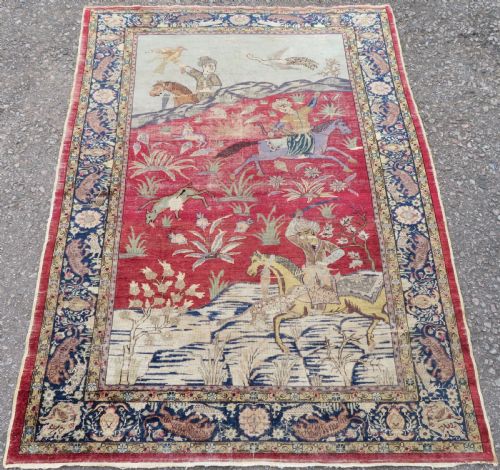
Among hunting scenes and geometric medallions, an unexpected animal or hunting figure occasionally peers out from an intricate village border.
Evaluating quality and execution
Quality rests in the precision of the knotting and the handling of the regional design vocabulary, whether the piece is a geometric village rug or a curvilinear Oushak carpet. Artisanal execution dictates how sharply medallions and star borders are rendered against the field.
The integrity of the natural dyes and the quality of the hand-spun wool determine the depth and longevity of the surface. Superior examples maintain balanced proportions and harmonious colour saturation across the entire field without appearing rigid.
The Antique Anatolia Carpet Glossary
- Prayer rug
- A small format rug featuring a mihrab or niche design, historically used to indicate the direction of prayer.
- Medallion
- A central ornamental motif dominating the field of larger carpets, commonly seen in Ushak productions.
- Kilim
- A flat-woven textile produced without a pile, created by tightly interweaving warp and weft strands.
- Natural dye
- Colouring matter sourced from plants and minerals before the advent of synthetic aniline dyes.
- Yatak rug
- A heavier, longer-piled format traditionally utilised as a sleeping mat or bed cover in central regions.
Antique Anatolia Carpet: Frequently Asked Questions
How do I identify a prayer rug?
Prayer rugs feature a distinct architectural arch or mihrab at one end, designed to direct the user during daily devotions. Their compact proportions distinguish them from large decorative floor carpets.
These pieces often highlight specific regional weaving traits from centres such as Konya, Ghiordes, or Mujur, making them distinct focal points in smaller spaces.
Where were these rugs made?
They were woven across various provinces and villages of Anatolia, encompassing western weaving towns like Ushak and Bergama, alongside central hubs such as Konya and Kirsehir.
Each producing region developed distinct palettes, border motifs, and structural characteristics tied to local tribal or urban traditions.
Are natural dyes used in these carpets?
Traditional pieces rely entirely on natural dyes sourced from local flora and minerals, producing organic tones that soften gracefully over generations. These colours interact uniquely with hand-spun wool.
Such dyes generate subtle variations in shade across the field, a key characteristic that separates older regional weaving from modern chemical dyeing.
How should I care for an antique rug?
Gentle vacuuming without a rotating brush helps remove embedded dust while protecting the delicate wool pile and natural fibre foundations. Professional cleaning tailored to antique textiles ensures the preservation of the dyes.
Keeping the rug away from prolonged direct sunlight prevents the natural colours from fading prematurely while maintaining the wool's natural lanolin.