

Amethyst Drop Pendant
An amethyst drop pendant suspends purple quartz from gold or silver settings, offering the rich colour that defined Edwardian and Victorian jewellery.
Amethyst Drop Pendant
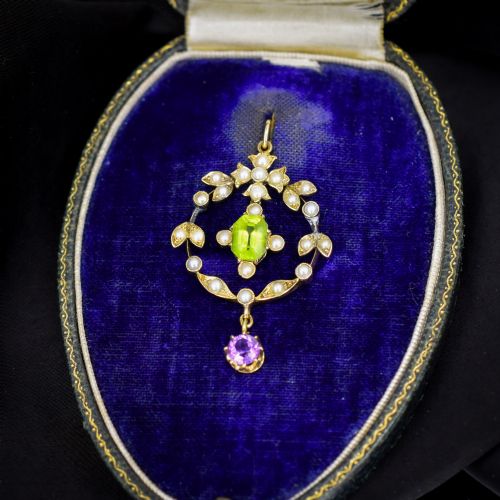
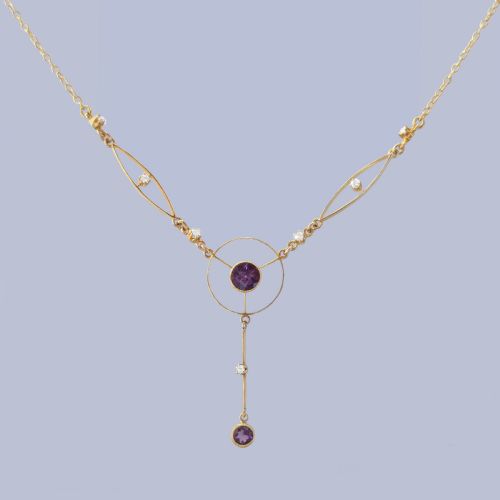
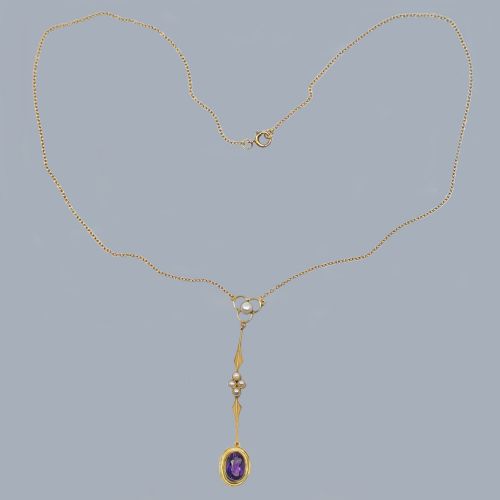
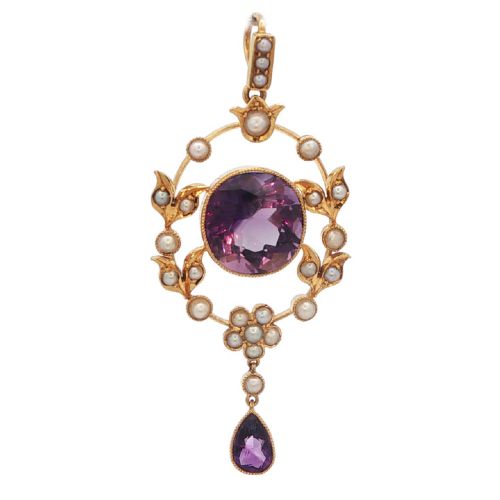
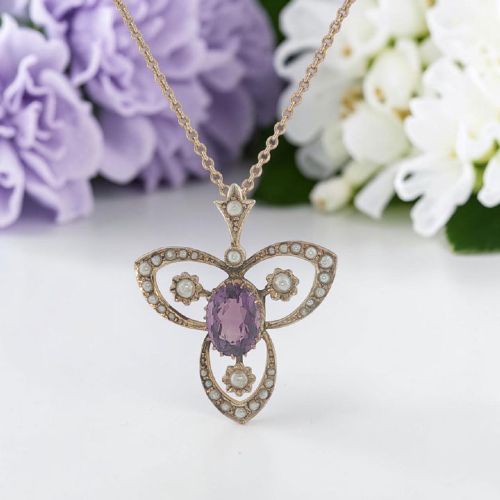
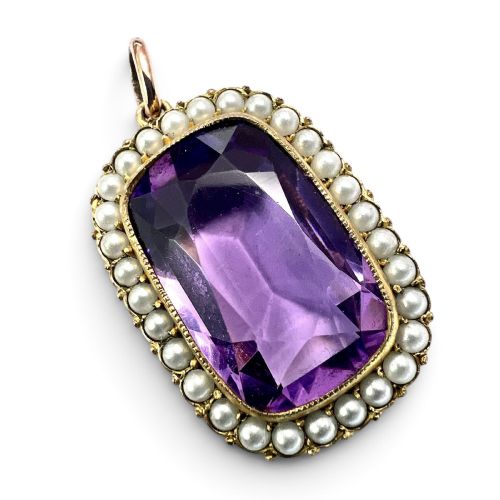
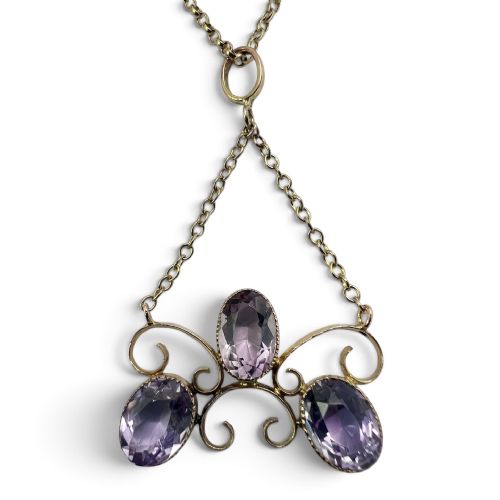
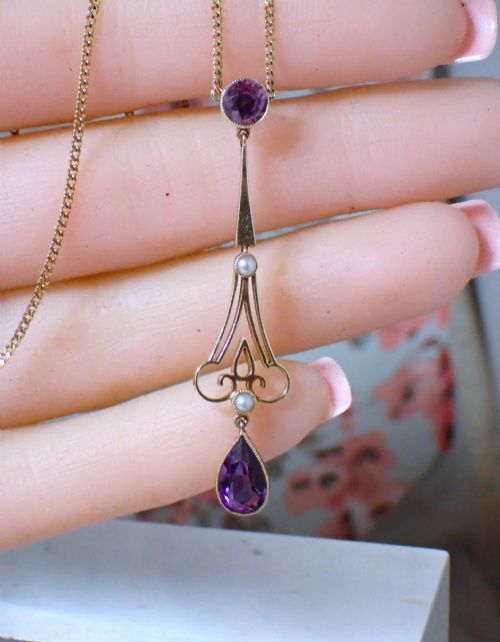
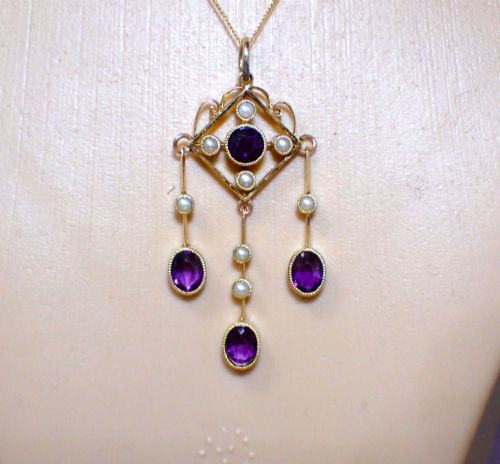
An amethyst drop pendant positions a faceted or cabochon purple quartz stone below a chain or collar, frequently paired with seed pearls or diamonds in Edwardian and Victorian designs. Buyers searching this phrase meet lavalier necklaces, negligé styles, and simple drop mounts created during the late nineteenth and early twentieth centuries.
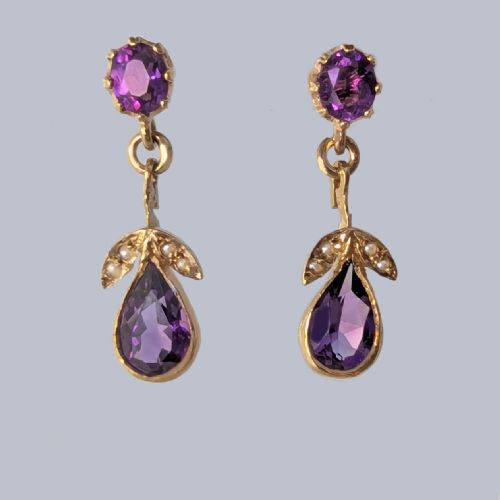
The selection ranges from delicate 9ct gold lavaliers set with seed pearls to substantial 15ct gold pieces incorporating old cut diamonds. Alongside traditional pendants, the records show drop earrings and brooches featuring suspended amethysts.
Dating primarily from the Edwardian and Victorian eras, these pieces reflect the aesthetic priorities of their period, combining saturated purple stones with intricate metalwork. The forms vary from symmetrical pear-shaped drops to flowing Art Nouveau curves.
Materials and construction
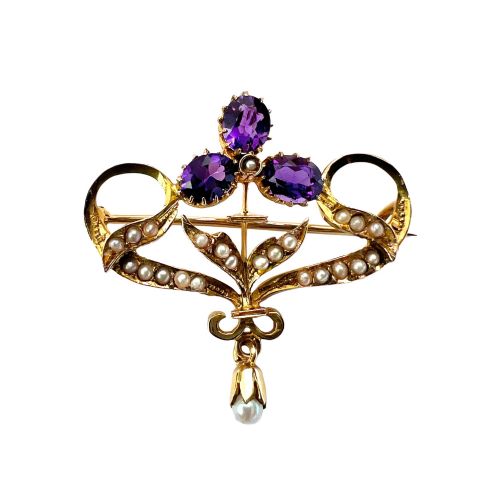
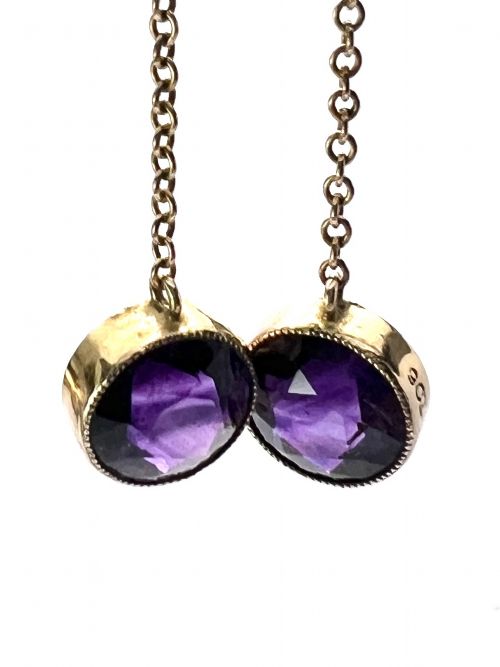
Goldsmiths worked predominantly in 9ct and 15ct yellow gold, utilising hollow-formed or stamped components soldered together to create light, dimensional settings. Amethysts were secured in claw settings or bezel mounts, often surrounded by halos of seed pearls threaded on silk or fine wire.
Silver appears in later or alternative contexts, while yellow and white gold dominate the earlier periods alongside platinum accents in diamond-set sections. Stones were faceted to maximise light return through the purple quartz, or left as smooth cabochons for a softer visual weight.
Listings feature amethysts combined with 9ct and 15ct gold, alongside seed pearls and old cut diamonds across Edwardian and Victorian periods.
Variations in quality
Quality rests on the saturation and cut of the central amethyst, with deeper, evenly distributed purple tones commanding greater attention than pale or uneven stones. The crispness of the surrounding goldwork and the matching quality of accompanying seed pearls or diamonds further separate standard production from finer goldsmithing.
Makers' marks, original chains, and intact settings with all original pearls intact indicate superior preservation and original design intent. Pieces demonstrating careful proportional balance between the drop and the suspension bale show higher workshop standards.
S. Blanckensee & Son·Hamilton & Co
The Amethyst Drop Pendant Glossary
- Lavalier
- A pendant style featuring a suspended stone or drops hanging from a central motif, popular during the Edwardian period. These pieces often swing freely on fine gold chains.
- Seed pearl
- A very small, natural or cultured pearl utilised in clusters and borders around central gemstones. They add a delicate white contrast to the purple quartz.
- Negligé necklace
- A necklace design featuring two uneven drops suspended from a central element or bow. This asymmetrical layout gained favour during the early twentieth century.
- Cabochon
- A gemstone cut with a smooth, rounded surface rather than facets. This technique highlights the internal colour and depth of the amethyst.
- Old cut diamond
- A hand-cut diamond shape typical of the Victorian and Edwardian eras, featuring a smaller table and larger culet. These stones display a softer candlelit sparkle compared to modern cuts.
Amethyst Drop Pendant: Frequently Asked Questions
How do I date an amethyst drop pendant?
Dating relies on metal purity marks, stone cuts, and stylistic clues such as Edwardian garland motifs or Victorian halo settings. The construction techniques and accompanying chain types also provide clear chronological markers.
Items from the late nineteenth century typically feature heavier yellow gold mounts, while Edwardian examples often employ lighter, openwork gold frames set with seed pearls.
What is the difference between an amethyst and paste?
Amethyst is a natural variety of quartz, displaying distinct internal crystal structures and cold weight. Paste is a type of dense lead glass moulded or cut to imitate gemstones.
Under magnification, paste may show tiny gas bubbles or mould seams, whereas natural quartz reveals crystalline inclusions.
Can I wear an antique pendant every day?
Antique pendants require careful handling due to their age and delicate seed pearl settings. Removing the jewellery before swimming, sleeping, or strenuous activity preserves the delicate goldwork.
Storing the piece in a dedicated box prevents the chain from tangling and protects the softer pearls from abrasion.