





All Over Pattern Rug
An all over pattern rug brings continuous motifs across the floor without a central medallion, offering great balance for furnishing large spaces.
All Over Pattern Rug
An all over pattern rug covers the field with repeating motifs rather than a single central medallion, creating a balanced surface that suits open rooms. The selections span the late nineteenth century through to the early twentieth century, originating mainly from Persian and Indian weaving centres alongside traditional kilims.
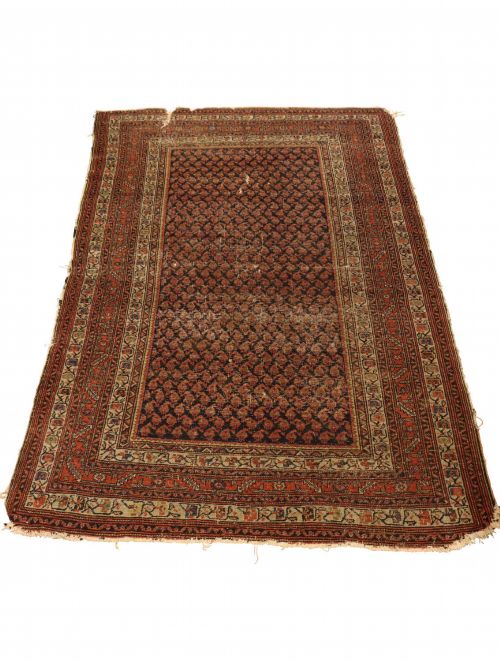
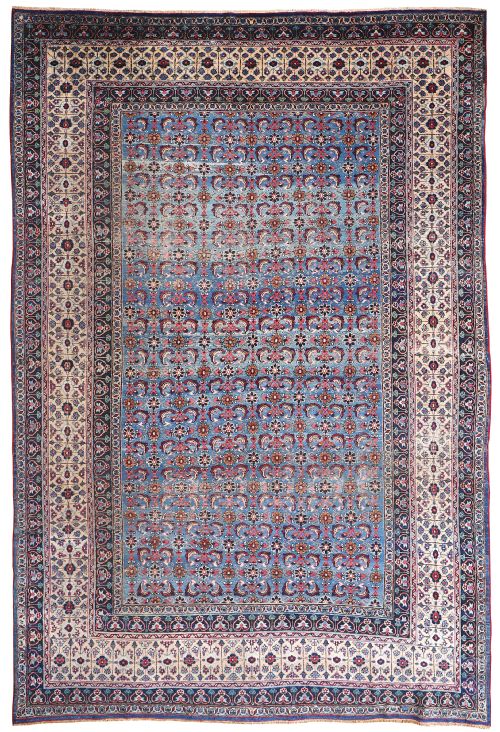
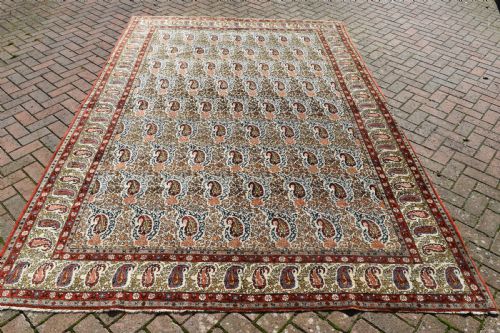
Buyers will encounter various room-sized carpets, runners, and area rugs displaying continuous design elements such as boteh, shrub, Mina Khani, Herati, lattice, and traditional patterns. These pieces utilise wool, cotton, and silk foundations and piles, spanning periods from the eighteen-eighties to the nineteen-thirties.
Materials and construction methods
These carpets and rugs are constructed using hand-knotted techniques where wool, cotton, and silk fibres form the pile and foundation. Weavers tied individual knots onto warp and weft threads to build dense, durable textile structures designed for domestic foot traffic.
Natural materials dominate the evidence, with wool providing resilient warmth and cotton or silk offering structural stability and fine detail. The tactile quality derives directly from these traditional hand-knotting methods executed across various regional workshops.
Listings feature traditional Persian, Indian, and tribal rug styles executed in wool, cotton, and silk across the late nineteenth and early twentieth centuries.
Judging quality and execution
Quality separates through the precision of the hand-knotting and the complexity of the repeating all over design across the field. Finer knot densities allow intricate floral and geometric motifs to maintain crisp outlines and fluid movement.
The depth and richness of the wool or silk pile influence how the continuous pattern catches the light in a room. Superior examples display harmonious dye work and balanced proportions that anchor the surrounding interior architecture.
Mahal·Tabriz·Heriz·Khorassan·Sultanabad·Qum·Agra·Afshar·Malayer·Sharkoy
The All Over Pattern Rug Glossary
- Boteh
- A teardrop or almond-shaped motif with a curved upper end, frequently repeated in rows across textile fields. This ancient Persian symbol resembles a stylized shrub or flame.
- Herati
- A popular repeating pattern composed of a central rosette enclosed by four leaves, flanked by curved lancet leaves. It forms a continuous geometric lattice across the carpet field.
- Mina Khani
- A traditional all-over design layout featuring repeating daisy-like flowers connected by delicate lattice stems. The pattern creates an orderly and balanced visual rhythm.
- Kilim
- A flat-woven textile produced without a pile by tightly interweaving warp and weft strands. These pieces function as lightweight rugs or wall hangings.
- Foundation
- The underlying grid of warp and weft threads that supports the knotted pile of a rug. Cotton and wool are standard structural materials.
All Over Pattern Rug: Frequently Asked Questions
Where were these antique rugs made?
The pieces originate primarily from traditional weaving centres in Persia, alongside examples from India and regional kilim traditions.
Each area developed distinct knotting structures and local vegetable dye palettes.
How do I choose the right size?
Consider whether you need a long narrow runner, an area rug, or a large room-sized carpet to anchor your furniture layout.
Measure your floor space carefully to ensure the repeating border and field remain visible around seating arrangements.
What materials are used in these rugs?
These textiles utilise wool, cotton, and silk fibres combined in hand-knotted pile and flat-weave constructions.
Wool provides durable resilience for daily walking, while silk offers finer detail work.