

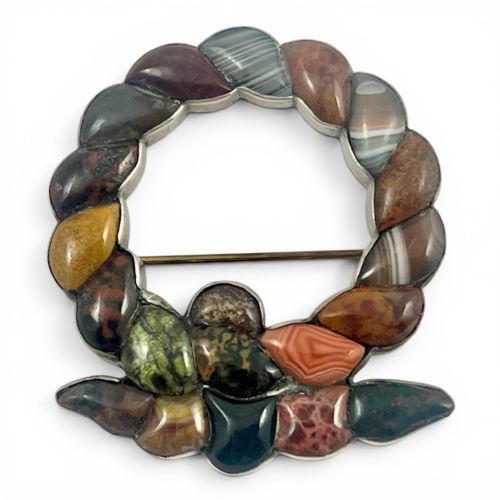
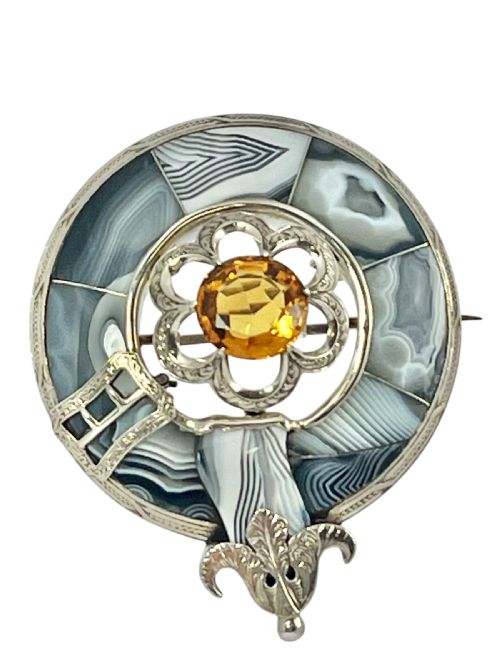
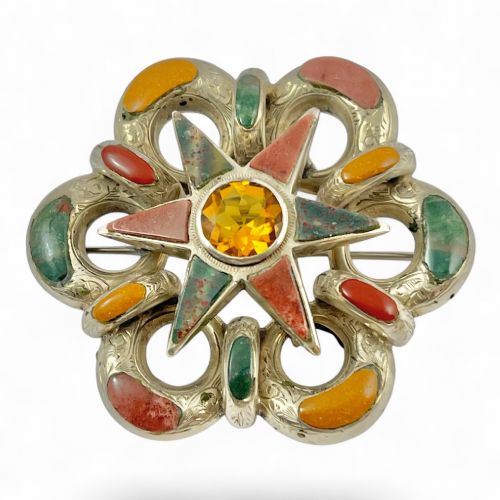
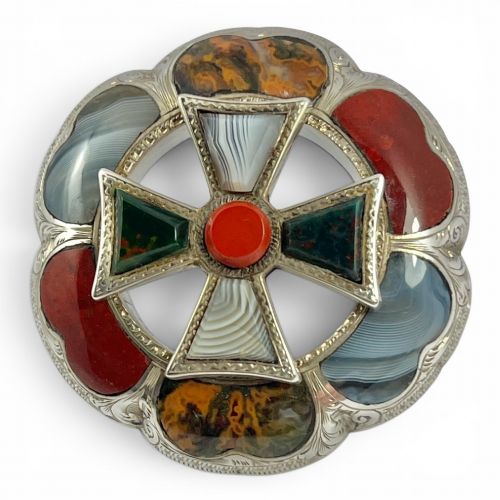
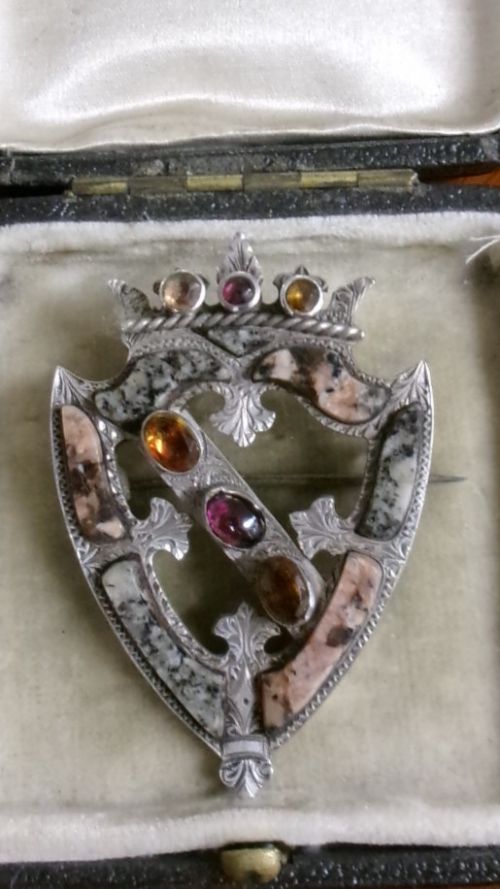


Agate Pebble Brooch
An agate pebble brooch is a colourful piece of Victorian highland jewellery that brings hard stone and silver together in wearable form.
Agate Pebble Brooch
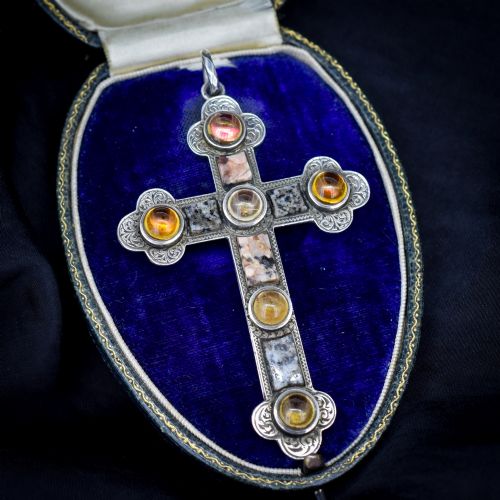
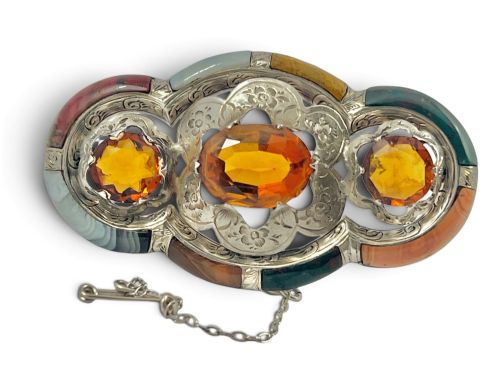
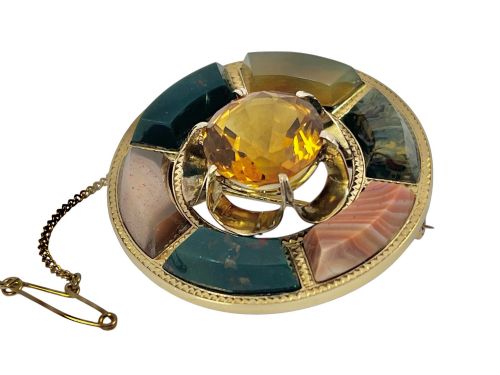
An agate pebble brooch is a distinctive form of jewellery originating in the nineteenth century, heavily tied to the Victorian Scottish Revival movement. These pieces take the form of pins, dirks, shields, and basket-hilted broadswords, often fashioned from silver and mounted with patterned stones. Buyers searching for an agate pebble brooch will most commonly encounter Victorian silver examples set with multicoloured banded agates and citrines.
The aesthetic draws directly from nineteenth-century romanticism towards the Scottish Highlands, popularised by Queen Victoria. Many pieces incorporate local geological specimens like Montrose agate, jasper, and bloodstone alongside traditional Highland motifs such as dirks and swords. They function equally well as traditional kilt pins or as statement fastening brooches on modern heavier fabrics.
How they were made
Lapidaries cut and polished native hardstones into geometric or shield shapes to reveal the natural banding of the quartz. These polished stones were then closely fitted into substantial silver or sometimes eighteen-carat gold settings.
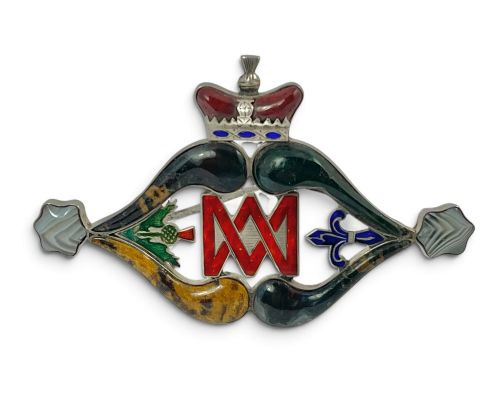
Metalwork involved casting and engraving silver to mimic Highland weaponry or traditional Celtic knotwork, securely housing the heavy stones without modern adhesives. Enamel accents and foil-backed citrines were frequently integrated to complement the earthy tones of the main agate panels.
Agate Pebble Brooch Retail Price Guide 2026
Typical asking prices for agate pebble brooch among the pieces listed under this phrase on Sellingantiques today, from the lower quarter to the upper quarter. They describe what is for sale here now, not the wider market.
Listings show these brooches span the Victorian era, utilising silver and gold alongside natural stones like agate, jasper, bloodstone, and citrine.
What varies in quality
The standard of lapidary work dictates the upper tier of these pieces, specifically the precision of the stone-cutting and the symmetry of the natural banding. Superior examples display tightly fitted stones with high-polish finishes that catch the light evenly across the entire face.
Metal weight and complexity also divide the range, moving from simple bezels to intricate silver dirks, basket-hilted broadswords, and matched suites. Original pin mechanisms and intact gold or silver hallmarks further elevate the standing of a piece.
The Agate Pebble Brooch Glossary
- Agate
- A cryptocrystalline variety of quartz characterised by its colourful bands and patterns. It forms the primary visual element in these nineteenth-century highland pieces.
- Montrose agate
- A specific Scottish variety of chalcedony known for distinct coloration and patterning. Lapidaries prized it for regional authenticity.
- Citrine
- A yellow or orange variety of quartz frequently used as a central foil-backed gemstone in these brooches. It provides a warm contrast to the cooler greys and browns of the agate.
- Dirk
- A traditional long dagger of the Scottish Highlands, often miniaturised in silver as the structural form for a heavy kilt pin. These pieces mimic the hilt and blade in metal and stone.
- Victorian Scottish Revival
- A nineteenth-century artistic and cultural movement that popularised Highland imagery, tartan, and agate jewellery following royal patronage. It produced the vast majority of these pebble pieces.
Agate Pebble Brooch: Frequently Asked Questions
What is an agate pebble brooch?
An agate pebble brooch is a Victorian ornament made from polished Scottish hardstones set in silver or gold. They often take shapes inspired by traditional Highland weaponry and dress.
These pieces reflect nineteenth-century romanticism and were frequently worn to secure plaids or heavier garments. Their enduring appeal lies in the natural variety of the banded quartz stones.
How do I date an agate pebble brooch?
Dating relies on stylistic markers such as the presence of Victorian Scottish Revival motifs, specific pin findings, and associated hallmarks. Most examples date from the middle to late nineteenth century.
Makers often utilised solid silver mounts and traditional box or C-clasps during this active period of production. Comparing the stone cutting to documented pieces helps narrow down the decade of manufacture.
Can I wear a kilt pin as a brooch?
Yes, many larger agate pebble brooches and dirk pins were designed specifically for fastening thick wool garments like kilts. Their sturdy pin stems and substantial weight make them well suited for heavy fabrics.
When wearing one on modern clothing, ensure the fabric is robust enough to support the metal and stone weight safely without pulling.
What stones are used besides agate?
These brooches frequently incorporate jasper, bloodstone, and yellow quartz known as citrine alongside the primary banded agates. Some pieces also feature malachite or small touches of enamel.
Lapidaries sourced these hardstones locally in Scotland to create contrasting patterns within the silver or gold metalwork.