




Aesthetic Movement Writing Table
These aesthetic movement writing tables combine functional nineteenth-century workspace with the striking linearity and decorative restraint of the period.
Aesthetic Movement Writing Table
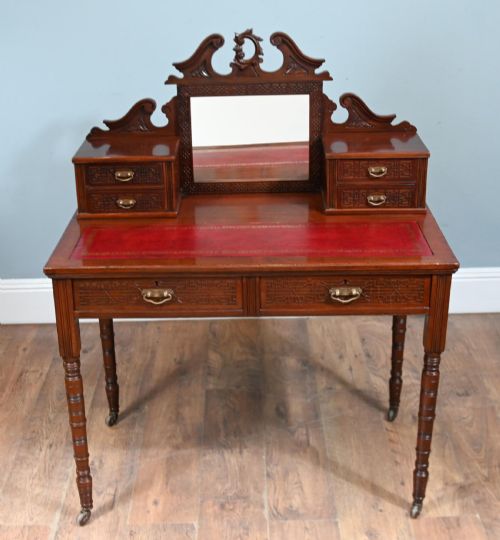
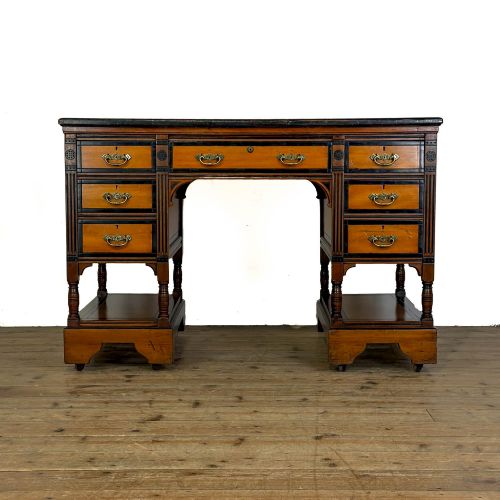
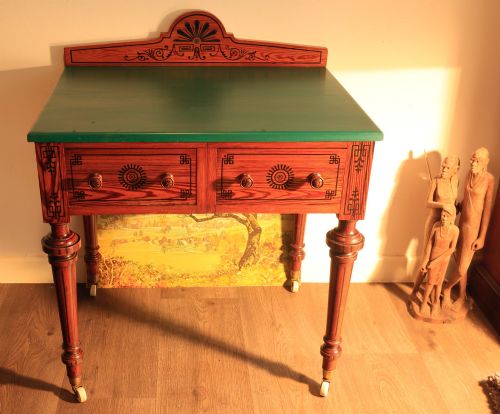
An aesthetic movement writing table spans the later Victorian decades, appearing in forms ranging from compact ladies' morning room desks to substantial double-sided partners desks and library tables. You will encounter side tables and occasional tables adapted for writing, alongside more elaborate exhibition quality pieces.
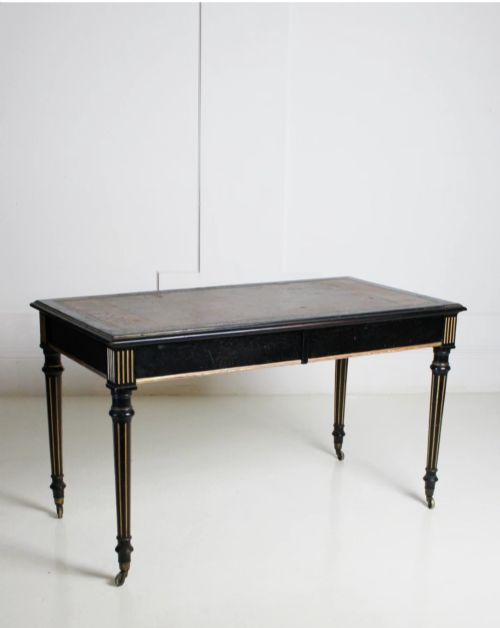
The material palette of these desks relies heavily on ebonised wood, mahogany, walnut, and ash, frequently complemented by satinwood, burr walnut, and pitch pine. Accents of brass hardware and inset leather writing surfaces complete the standard configuration of these Victorian pieces.
Judging quality
Exhibition quality pieces demonstrate superior timber selection, highly refined marquetry, and cabinet work associated with prominent London firms. Simpler utility desks show straightforward construction while retaining the characteristic linear profile of the style.
The distinction lies in the crispness of the joinery, the quality of the brass mounts, and the integrity of the secondary timbers used within the drawers and interior compartments.
Aesthetic Movement Writing Table Retail Price Guide 2026
Typical asking prices for aesthetic movement writing table among the pieces listed under this phrase on Sellingantiques today, from the lower quarter to the upper quarter. They describe what is for sale here now, not the wider market.
Listings feature Victorian pieces executed in ebonised wood, mahogany, walnut, and pitch pine, spanning the period from eighteen seventy to nineteen hundred.
Blyth & Son·George Faulkner Armitage·Marsh Jones & Cribb·Howard & Sons·Collinson & Lock·Edwards and Roberts·Maple & Co·Robson & Son
The Aesthetic Movement Writing Table Glossary
- Ebonised wood
- Timber treated with a dark stain or finish to imitate ebony. This technique creates a smooth, light-absorbing surface popular in nineteenth-century design.
- Bonheur du jour
- A small, light ladies' writing desk featuring a tiered superstructure with shelves and small drawers above the main writing surface. These pieces often incorporate delicate inlay and parcel gilding.
- Partners desk
- A large double-sided desk designed for two people to work opposite one another. These tables feature drawers and cupboards accessible from both sides.
- Marquetry
- Decorative patterns formed by the insertion of contrasting veneers into a wood base. Makers utilised this technique to create geometric and floral motifs across tabletops.
- Parcel gilt
- Portions of an object highlighted with thin layers of gold leaf or paint. This treatment accentuates carved details and mouldings against dark timber.
Aesthetic Movement Writing Table: Frequently Asked Questions
What is an aesthetic movement writing table?
These are nineteenth-century desks that reject heavy Victorian ornamentation in favour of cleaner lines, often drawing influence from Japanese and Gothic design. They serve as functional workspaces built from ebonised woods, mahogany, and walnut.
You will find them in various sizes, from compact morning room desks to large library tables and partners desks, suited for modern study or living spaces.
How do I care for an ebonised desk?
Ebonised wood requires gentle dusting with a soft, dry cloth to prevent scratching the dark finish. Avoid placing the table in direct sunlight or near heat sources to protect the timber and leather inserts.
Regular application of suitable wax helps maintain the lustre of the polished surface without building up residue.
Where were these desks used originally?
Originating in late Victorian homes, these tables found places in libraries, private studies, and morning rooms. Larger partners desks served institutional or domestic administrative duties.
Smaller side tables and bonheur du jour variants were typically positioned in reception rooms for correspondence and light reading.
How do I distinguish these from other Victorian desks?
Aesthetic movement pieces avoid the profuse floral carving and heavy proportions typical of standard high Victorian furniture. Instead, they favour geometric restraint, ebonised surfaces, and subtle brass hardware.
Details such as Anglo-Japanese joinery or delicate marquetry often point directly to this specific design reform period.