


Aesthetic Movement Candle Holders
Aesthetic movement candle holders bring a distinct, reform-minded charm to a room, offering the rich detail and artistic form that collectors prize.
Aesthetic Movement Candle Holders
Aesthetic movement candle holders combine Victorian craftsmanship with a fresh artistic freedom, drawing on styles from the late nineteenth century through to the Edwardian era. When you search for aesthetic movement candle holders, you find pieces designed to bring beauty to everyday domestic spaces rather than merely follow rigid historical revivals.
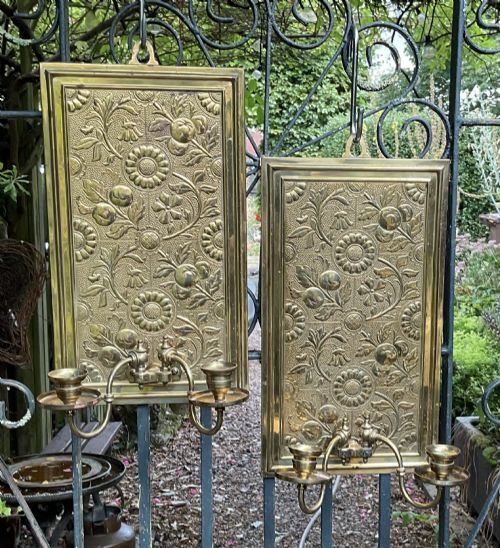
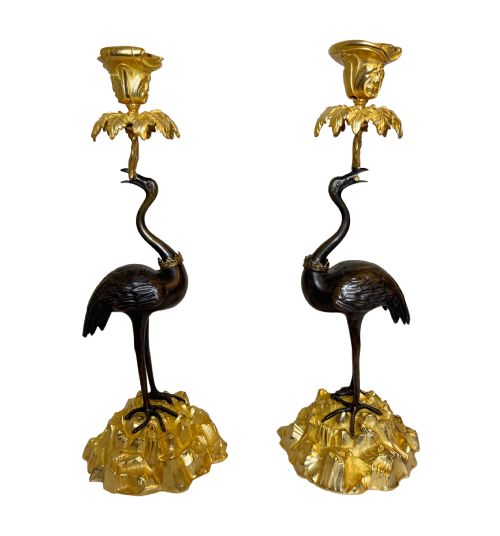
The objects on this page take several distinct forms, most commonly appearing as pairs of brass or copper candlesticks, wall sconces, wall mirrors, and candelabra. Many incorporate ceramic elements, porcelain, gilt bronze, patinated bronze, or mirror glass to create reflective surfaces and varied textural contrast.
Origins span standard Victorian production as well as pieces reflecting Chinoiserie and early Arts and Crafts sensibilities. You are most likely to meet sturdy brass constructions, occasionally featuring specific designer touches or contrasting porcelain components that capture the spirit of the period.
How they were made
Makers utilised durable metals like brass, copper, and bronze, often combining them within a single piece to achieve a two-tone metallic effect. Casting and hammering allowed workshops to shape rigid metal into fluid, nature-inspired motifs.
Ceramic and porcelain inserts were frequently integrated into the metal framework, painted with flora or avian subjects such as flamingos. Gilt and patinated finishes were applied to create depth and warmth on the surface of the bronze and brass.
A flamingo motif occasionally peers out from the bronze, proving that late Victorians knew how to let loose with their decor.
What varies in quality
The distinction between standard domestic items and superior examples lies in the crispness of the casting and the integration of secondary materials like porcelain and mirror glass. Finer pieces demonstrate careful attention to surface finish, whether through rich patination or precise hand-painting on ceramic components.
Attribution to known designers or documented potteries elevates a piece above standard factory output of the period. The weight of the metal and the harmony of mixed materials also separate mass-produced items from more considered artistic commissions.
Bruce Talbert·Dr Christopher Dresser·James Hadley
The Aesthetic Movement Candle Holders Glossary
- Aesthetic movement
- A late nineteenth-century design ethos prioritising visual beauty and art for art's sake over traditional moral narrative. It drew heavily from Japanese art and nature.
- Girandole
- An ornamental branched candlestick or candle holder, often incorporating a wall mirror to reflect the candlelight. They were popular in the nineteenth century for enhancing illumination.
- Patinated bronze
- Bronze that has been treated chemically or naturally aged to produce a specific surface colour and texture. This finish protects the metal and adds visual depth.
- Chinoiserie
- European artistic style reflecting Chinese motifs and decorative techniques. It frequently appears in nineteenth-century decorative arts alongside aesthetic movement designs.
- Sconce
- A wall-mounted lighting fixture designed to hold candles or lamps. In this period, they often featured reflective brass or mirror backplates.
Aesthetic Movement Candle Holders: Frequently Asked Questions
What materials are typical?
Brass and copper form the backbone of these pieces, often paired with porcelain or ceramic sections. Bronze and mirror glass also appear frequently to enhance the play of light.
Makers utilised these mixed media to achieve the varied textures characteristic of the late nineteenth century.
How were wall sconces used?
Wall sconces were mounted in pairs beside mirrors or fireplaces to maximise ambient room lighting. The reflective brass and mirror glass amplified the glow of flickering candles.
They served both a practical illumination purpose and a decorative role on the drawing room wall.
Are ceramic elements fragile?
Porcelain and ceramic inserts require careful handling during cleaning and relocation. While securely seated within the metal framework, the glazed surfaces can chip if subjected to sharp impacts.
Most surviving pieces demonstrate robust mounting that has endured over a century of domestic life.
How do I spot the period?
Look for characteristic construction methods, such as heavy brass casting, patinated finishes, and stylized natural motifs. The presence of mixed metals like brass and copper together often points toward the late Victorian era.
Design cues leaning away from heavy historical revivals toward simplified artistic forms confirm the aesthetic influence.