


Adjustable Tripod Floor Lamp
These adjustable tripod floor lamps offer versatile lighting through height-adjustable mechanisms and steady three-legged bases, spanning periods from the Victorian era to the twentieth century.
Adjustable Tripod Floor Lamp
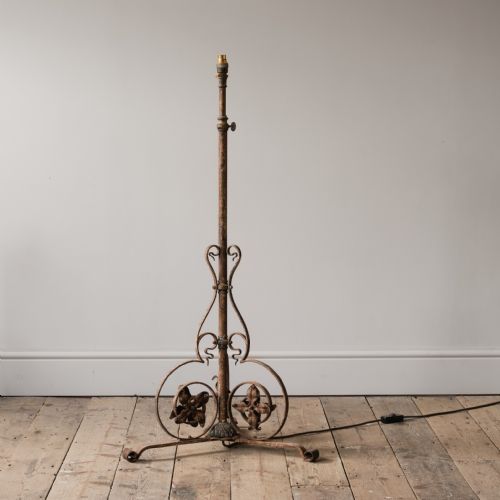
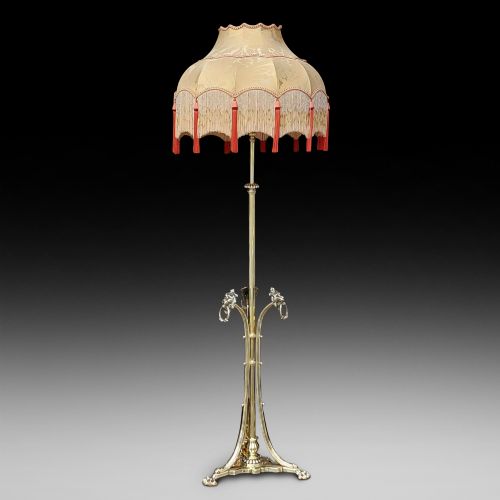
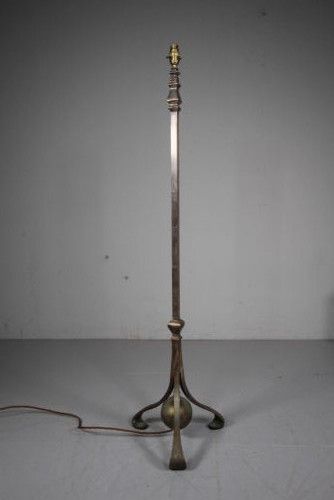
An adjustable tripod floor lamp brings focused illumination to a room via a sturdy three-legged base and a height-adjustable column. These pieces emerge in styles ranging from Victorian and Edwardian to Arts and Crafts and Industrial Modern, reflecting functional design from the nineteenth and early twentieth centuries.
The most common versions encountered here utilise brass or wrought iron construction, often paired with telescopic mechanisms for raising and lowering the light source. Many examples originate as converted oil lamps or standard lamps adapted for modern electrical use.
How they were made
Metalworking techniques dictate the construction of these lamps, with brass and wrought iron shaped into slender telescopic shafts and stable tripod feet. Blacksmith-made pieces demonstrate hand-forged scrollwork and riveted joints, while refined models employ turned brass components and silver-plated finishes.
Wiring and conversion from earlier oil or candle configurations involve adapted burners and weighted bases to maintain balance. Shades in fabric, silk, or opaline glass complement the metal frames, diffusing light across period interiors.
An early twentieth-century Bleriot searchlight stands ready to illuminate the room like a vintage aeroplane.
What varies in quality
The sophistication of the telescopic mechanism sets superior examples apart, where smooth adjustment relies on precisely fitted inner and outer metal tubes rather than simpler friction catches. Heavier gauge brass and solid forged iron provide enduring stability to the three-legged base compared to lighter, more flexible alternatives.
Integrity of period components also influences value, distinguishing original oil lamp conversions with intact burners from later replacements. The quality of surface finishing, from hand-beaten wrought iron texture to polished brass details, indicates the maker's original intent.
The Adjustable Tripod Floor Lamp Glossary
- Telescopic standard lamp
- A floor lamp featuring a sliding inner shaft that allows the overall height to be adjusted. This mechanism is frequently found on Victorian and Edwardian brass models.
- Bouillotte lamp
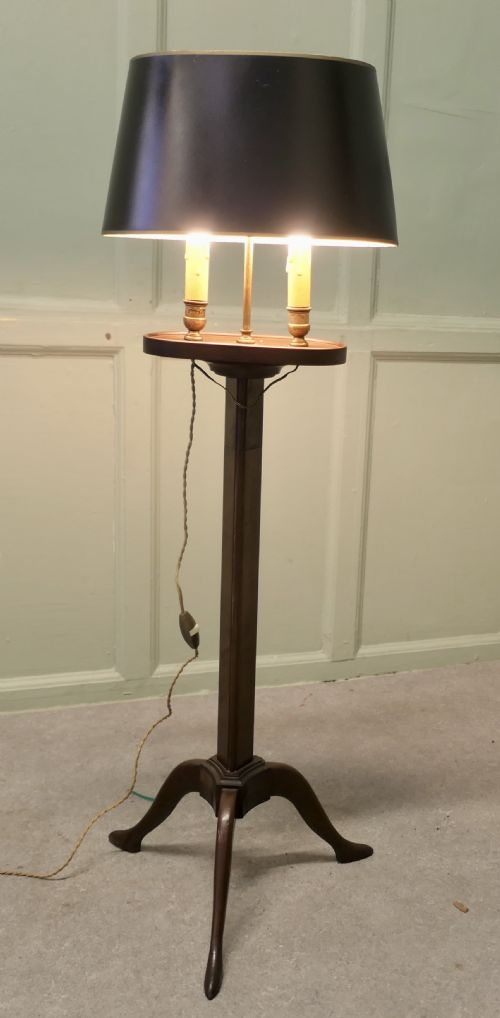
- A type of lighting fixture derived from French card game tables, traditionally featuring adjustable shades to direct light downward. Nineteenth-century examples often incorporate twin candle fittings.
- Opaline glass
- A type of semi-translucent white glass popular in the Victorian and Edwardian periods. It diffuses light evenly when used in lamp shades and uplighters.
- Standard lamp
- A British term for a floor lamp designed to stand independently in a room. These fixtures often support heavy shades and adjustable arms.
Adjustable Tripod Floor Lamp: Frequently Asked Questions
How do you adjust the height?
Height adjustment typically relies on a telescopic inner column secured by a thumb screw, sliding collar, or friction mechanism.
Users simply loosen the locking device, raise or lower the lamp to the desired level, and tighten it to secure the position.
Were these originally electric?
Many older examples begin life as oil lamps or candle stands before later conversion to electricity.
Original oil burners and reservoirs are frequently adapted to house electrical fittings while retaining their outer period appearance.
How do I style one in a modern room?
The metallic finishes and industrial or Arts and Crafts lines pair well with both traditional and contemporary interiors.
Positioning the lamp beside a reading chair or in a dark corner makes best use of the adjustable height and focused illumination.
How do I date an adjustable floor lamp?
Dating relies on material combinations, manufacturing methods, and stylistic cues such as Arts and Crafts hand-beating or Victorian brass ornamentation.
Telescopic mechanisms and weighted bases also evolve from nineteenth-century oil standards to early twentieth-century electric designs.