




Adjustable Revolving Piano Stool
An adjustable revolving piano stool brings mechanical ingenuity and turned timber together at the keyboard, offering a pianist reliable height control.
Adjustable Revolving Piano Stool
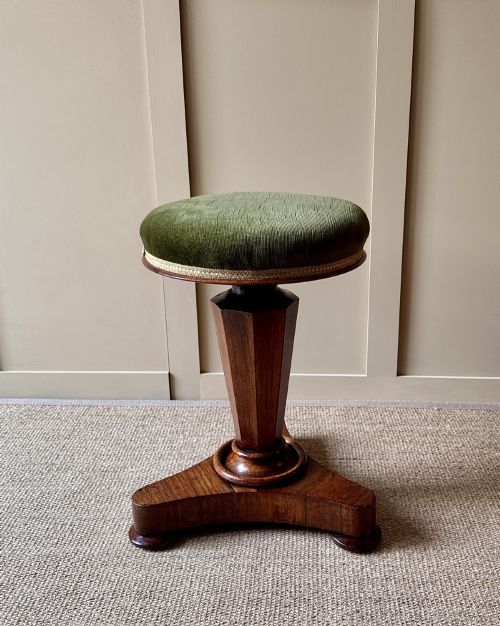
The adjustable revolving piano stool serves musicians and dressing tables across the nineteenth century, appearing most frequently in Victorian and William IV iterations. These pieces combine a rotating top with a threaded or rise-and-fall mechanism to alter the seat height for the player.
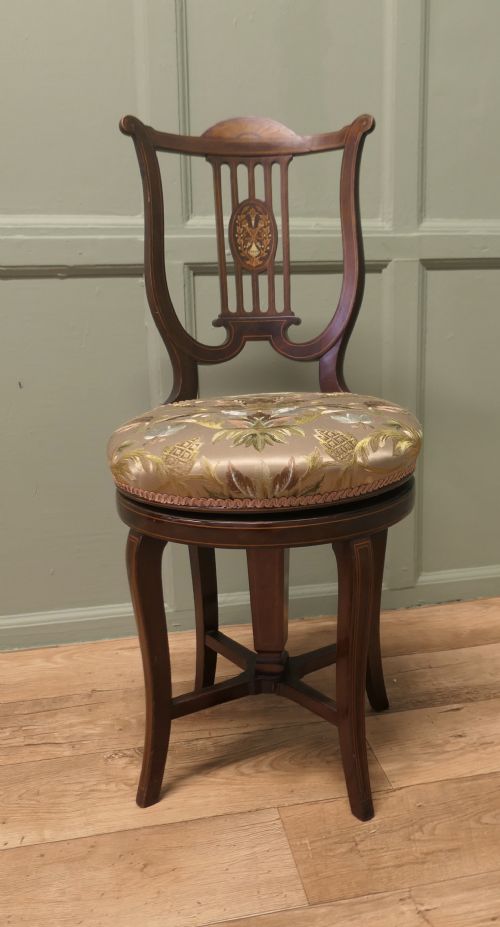
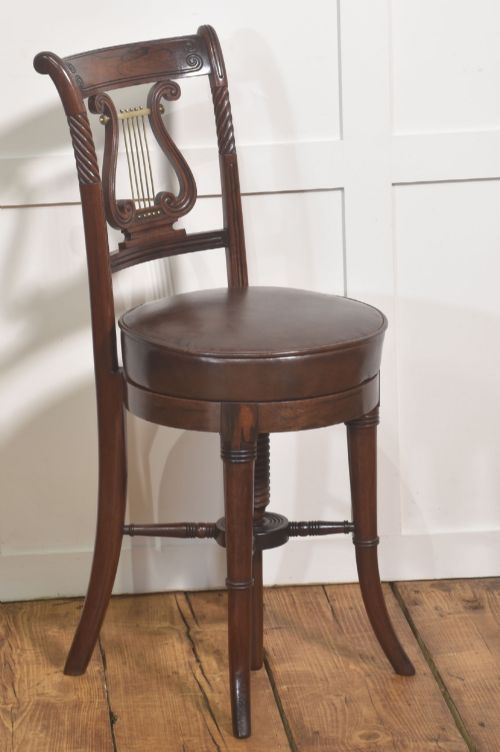
Makers shaped these items in mahogany, walnut, and rosewood, often pairing them with brass mounts or glass ball feet. The forms range from simple tripod legs to elaborate lyre-back music chairs and papier-mâché frames.
Materials and Mechanical Construction
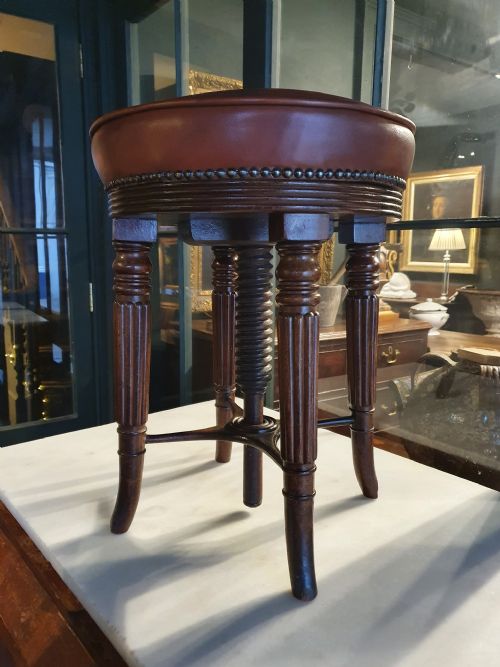
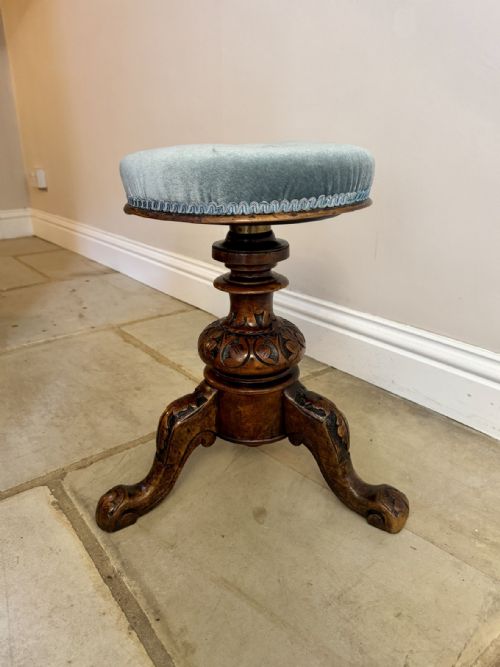
Craftsmen built the frames using dense hardwoods like mahogany, walnut, and rosewood, turning the central columns and carving the tripod or four-legged bases by hand. These timbers provide the structural strength needed to support the twisting action of the swivel mechanism.
Upholstery departments finished the round or square seats in velvet, fabric, or leather, secured over padding. Internal iron or brass screws allow the top to rise and fall smoothly when rotated.
Adjustable Revolving Piano Stool Retail Price Guide 2026
Typical asking prices for adjustable revolving piano stool among the pieces listed under this phrase on Sellingantiques today, from the lower quarter to the upper quarter. They describe what is for sale here now, not the wider market.
Some Victorian organists needed glass ball feet on their stools to glide smoothly across chapel floorboards while playing.
Distinctions in Execution and Design
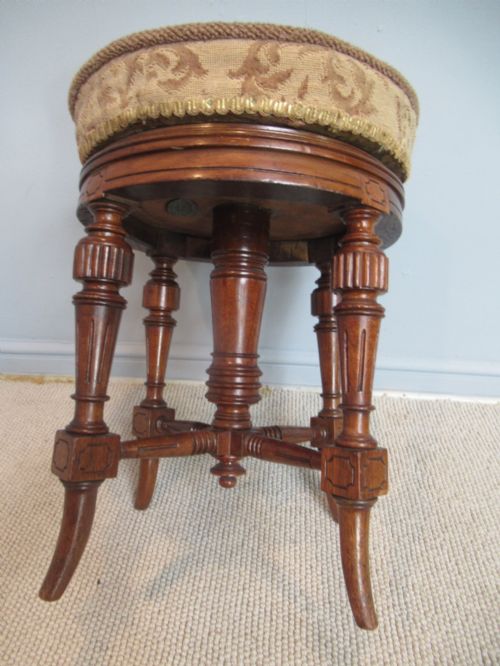
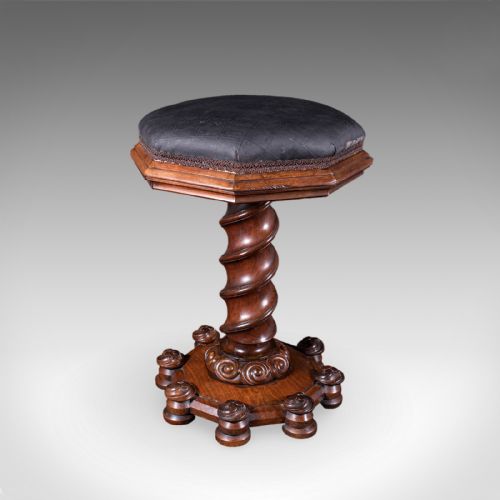
The sophistication of the turning and carving marks the boundary between standard production and superior examples. Finer pieces display crisp acanthus leaves on the legs, reeded columns, or inlaid brass details.
The smoothness of the mechanical action and the rigidity of the central spindle distinguish better workshops. Heavy cast iron components and robust framing ensure the seat remains stable at elevated heights.
Jennens and Bettridge·Gillows·James Shoolbred
The Adjustable Revolving Piano Stool Glossary
- Rise and fall
- A mechanical system utilising a threaded wooden or metal screw to adjust seat height. Turning the top clockwise or anti-clockwise raises or lowers the seating surface.
- Swivel base
- A pivoting assembly allowing the seat to rotate fully without altering its vertical position. This motion helped musicians turn towards sheet music cabinets or instrument pedals.
- Lyre back
- A chair backrest shaped to resemble the ancient Greek musical instrument. This motif appears frequently on seating designed for music rooms.
- Tripod leg
- A three-legged base configuration commonly used on piano stools for stability on uneven nineteenth-century floors. It spreads the weight evenly beneath the central column.
- Papier-mâché
- A composite material formed from paper pulp mixed with glue and resin, pressed in moulds and lacquered. Jennens and Bettridge utilised this technique for decorative music stool frames.
Adjustable Revolving Piano Stool: Frequently Asked Questions
How does the height adjustment work?
The seat top connects to a threaded metal or wooden spindle housed inside the central column. Rotating the seat rotates the screw within a threaded collar, moving the platform up or down.
Older examples rely on hand-cut wooden threads, while later Victorian models use machine-threaded iron rods for smoother operation.
Can I use these at a modern piano?
Many nineteenth-century piano stools reach heights compatible with modern instruments, though some sit lower than standard contemporary benches. Checking the minimum and maximum height range ensures proper posture at the keyboard.
The revolving mechanism allows quick adjustments between different players sharing the instrument.
Where were these pieces used historically?
Musicians placed them beside upright pianos, grand pianos, and chapel organs to maintain proper arm angles during long practice sessions. Their compact footprint also suited them for use as dressing table chairs in Victorian bedrooms.
Music rooms and parlours frequently featured matching sets of revolving chairs and music stands.
How do I identify a William IV stool?
William IV examples typically display bold carved details, robust mahogany or rosewood timbers, and faceted or reeded pillar supports. They date from the 1830s and often feature substantial scroll feet or platform bases.
Cabinetmakers of this era favoured architectural weight and restrained classical ornamentation.