


Adjustable Fire Surround
These adjustable fire surround pieces let you fit a hearth fender precisely to your fireplace opening using extending rails.
Adjustable Fire Surround
An adjustable fire surround is typically a hearth fender, fire kerb, or extending fender designed to protect the room from stray embers while framing the fireplace. When you search for an adjustable fire surround, you encounter nineteenth-century English and French examples that feature sliding sections to accommodate varying hearth widths.
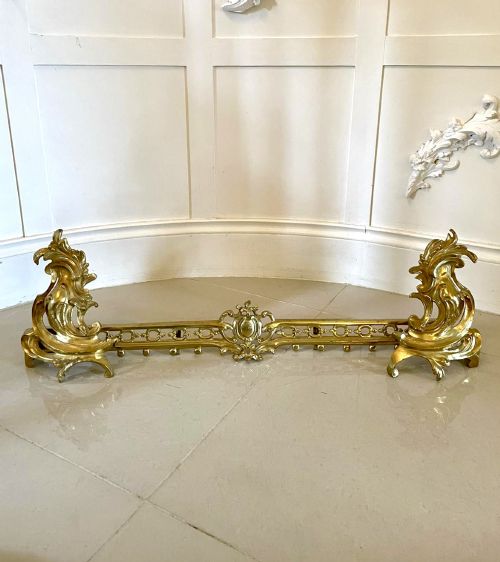
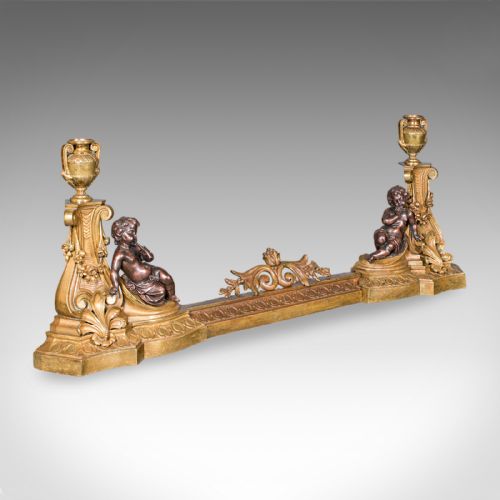
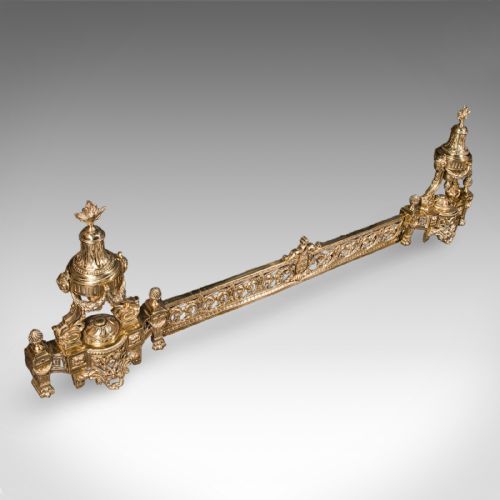
The pieces listed on this page span the Victorian period, the nineteenth century, and later decades into the nineteen thirties. You will find items originating from England and France, taking forms such as extending brass fenders, club fenders, and ormolu chenets with adjustable widths.
Most items on this page utilise metalwork configurations, including extending rails and rope twist designs. They serve a practical containment function at the hearth while reflecting stylistic influences ranging from French Rococo and Louis XV to Arts and Crafts.
How they were made
Makers utilised cast brass, bronze, ormolu, and gilded brass to construct the main bodies and decorative elements of these hearth accessories. Techniques involved casting metal into ornate scrolled patterns, rococo motifs, and rope twist rails, supplemented by applied gilt bronze finishes.
Certain examples incorporate solid oak timber alongside metal components, particularly within Arts and Crafts club fender variations. The sliding mechanisms require precise engineering of overlapping rails so the width can expand smoothly while maintaining structural integrity.
Some adjustable fenders included built-in seats so Victorians could warm their shins while perched directly on the hearth.
What varies in quality
Quality rests primarily on the weight of the metal and the crispness of the casting. Heavy brass, thick bronze, and deep, hand-chased ormolu detailing distinguish finer pieces from lighter production.
The sophistication of the decorative style also sets examples apart. Elaborate French Rococo scrolling, finely carved oak club elements, and well-executed rope twist finials elevate a piece well beyond plain utilitarian extending rails.
The Adjustable Fire Surround Glossary
- Fender
- A low metal guard placed in front of an open fireplace to contain coals and sparks. It sits directly on the hearth.
- Ormolu
- Finely ground high-carat gold-mercury amalgam applied to a bronze base metal. This technique creates a rich golden decorative surface seen on French pieces.
- Chenet
- An alternative term for an andiron or firedog. Pairs of chenets sometimes incorporate adjustable fender components.
- Club fender
- A sturdy hearth fender featuring upholstered leather seats on top. This form emerged during the Arts and Crafts period.
- Rococo revival
- A nineteenth-century design style mimicking the asymmetrical scrolls, C-curves, and naturalistic motifs of the eighteenth-century French movement.
Adjustable Fire Surround: Frequently Asked Questions
How do adjustable fire surrounds work?
These fenders feature telescoping or overlapping metal rails that slide in and out to alter the total width. This mechanism allows a single fender to fit different hearth dimensions.
Securing screws or simple friction holds the extended sections at the desired length once positioned against the fireplace surround.
What is the difference between a fender and a club fender?
A standard fender is a low metal barrier made of brass, bronze, or iron designed solely to keep logs and embers inside the fireplace. It sits flat on the floor.
A club fender incorporates padded leather top rails that function as low seats around the hearth, offering a place to sit close to the fire.
Are these pieces English or French?
The selection includes both English and continental European origins. English pieces often lean toward heavy functional brass or Arts and Crafts oak designs.
French examples frequently display elaborate ormolu, gilt bronze, and Louis XV or Rococo revival styling with ornate scrolled chenets.
How do I date an antique brass fender?
Dating relies on examining the manufacturing methods, material composition, and stylistic markers such as Victorian Gothic elements or Arts and Crafts simplicity. Heavier cast components and specific patination on the brass or bronze provide clues to nineteenth-century production.
Makers occasionally incorporated exhibition marks or registration details that help narrow down the decade of manufacture.