




Adjustable Fire Screen Stand
An adjustable fire screen stand directs warmth away from the face while framing needlework, prints, or painted panels beside the hearth.

Adjustable Fire Screen Stand
These adjustable fire screen stand designs function as movable hearth guards, featuring a vertical pole mounted on a tripod or heavily weighted base. The central panel slides vertically to intercept the heat of an open fire.
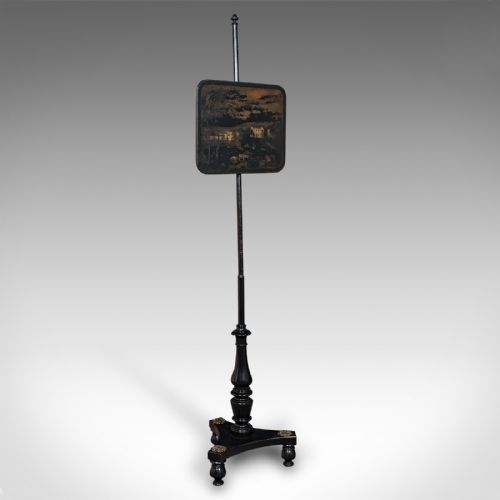
Most examples found here date from the Georgian, Regency, and Victorian periods, spanning the opening decades of the nineteenth century up to eighteen fifty. Forms range from simple mahogany tripods to grand rosewood stands and papier mâché shields.
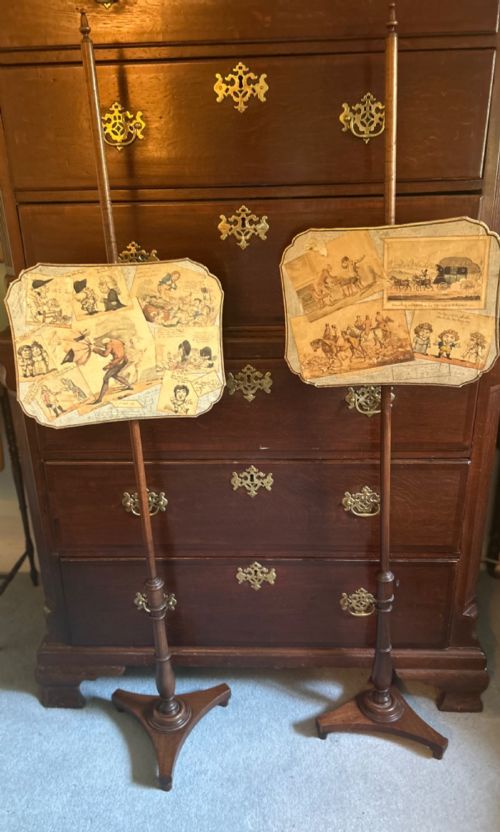
Makers of the period adapted these stands to hold embroidered tapestries, needlepoint panels, satirical prints, and glass reflectors. The primary mechanism relies on a sliding collar or screw key that secures the panel at the desired height.
How they were made
Cabinetmakers utilised dense timbers such as mahogany, rosewood, satinwood, and ebonised wood to turn the slender poles and carve the supporting tripod bases. The timber was selected for strength to prevent the tall standard from tipping under the weight of the screen.
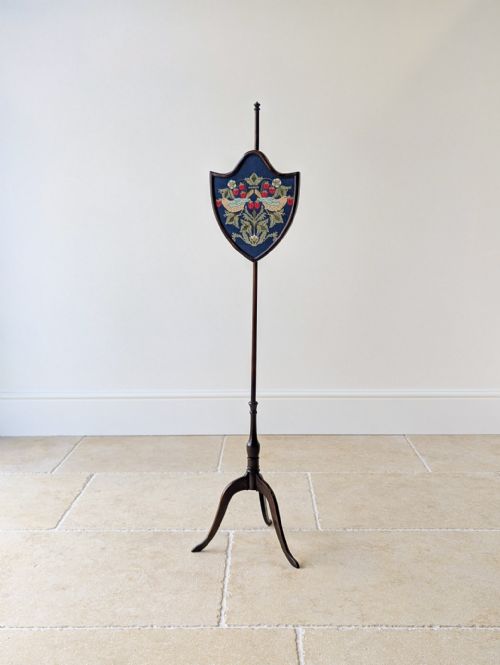
Panels combined carved wooden frames with textile inserts including wool needlepoint, tapestry, and embroidered silk. Brass fittings provided the adjustable sliding mechanism, allowing the display portion to move freely along the turned wooden shaft.
Listings feature timbers including mahogany, rosewood, satinwood, and ebonised wood across Georgian, Regency, and Victorian periods.
What varies in quality
The sophistication of the timber turning and the carving on the tripod base dictate the standard of the stand. Substantial rosewood or figured mahogany with crisp, deep carving represents the upper tier of production.
The needlework or panel insert contributes heavily to the overall merit of the piece. Fine petit-point embroidery, satirical prints, or painted papier mâché indicate a higher grade of commission than plain fabric panels.
The Adjustable Fire Screen Stand Glossary
- Pole screen
- A freestanding hearth accessory comprising a vertical shaft on a base with an adjustable viewing panel. It was designed to protect the complexion from the direct heat of an open fire.
- Tripod base
- A three-legged support system commonly turned from mahogany or rosewood. It provides stability for the tall upright shaft.
- Needlepoint
- Stitched textile work executed on canvas mesh using wool or silk threads. These panels formed the decorative screen held within the wooden frame.
- Reflector
- A glass or polished metal insert fitted into the frame instead of fabric. It bounced light and warmth back toward the room or away from the seated person.
- Poker work
- A decorative technique using heated metal tools to burn designs into wood or leather panels. This created monochromatic illustrative scenes on the screen shield.
Adjustable Fire Screen Stand: Frequently Asked Questions
How do you adjust the height?
A brass collar or sliding mechanism grips the vertical pole and holds the panel in place. Loosening this collar allows the screen to slide up or down.
Once the desired position is reached, the mechanism is tightened again to secure the panel against gravity.
Were these used for sewing?
Many examples served a dual purpose as needlework frames while positioned by the hearth. Ladies worked on tapestries mounted directly into the adjustable frame.
Other stands held completed decorative panels simply intended to block radiant heat from the fire.
How do I date an antique stand?
Dating relies on the timber species, base turning style, and the framing of the panel. Regency and George III examples often feature slender mahogany tripods.
Victorian pieces frequently display heavier rosewood construction, carved scrolls, or papier mâché shields dating around eighteen fifty.
Are the needlework panels original?
Most period stands retain their original textile inserts or period-appropriate replacements executed in matching wool or silk techniques. Close inspection of the mounting backing reveals how the panel sits within the wooden frame.
Needlepoint and embroidery wear naturally over time, showing gentle fading consistent with age near the fireplace.