



Abstract Modernist Art
Abstract modernist art brings together mid-century visual experiments on canvas, paper, and wood that reward close looking.
Abstract Modernist Art
Abstract modernist art encompasses paintings, prints, and works on paper created across the earlier and mid-twentieth century. These pieces record a period of radical experimentation with form, perspective, and colour by artists working within movements such as Cubism, Abstract Expressionism, and the St Ives School.
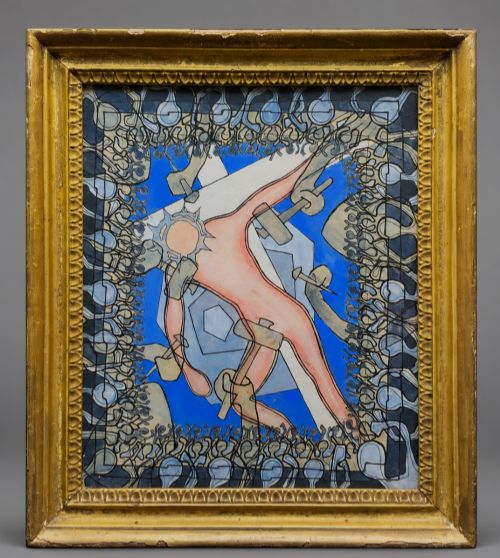
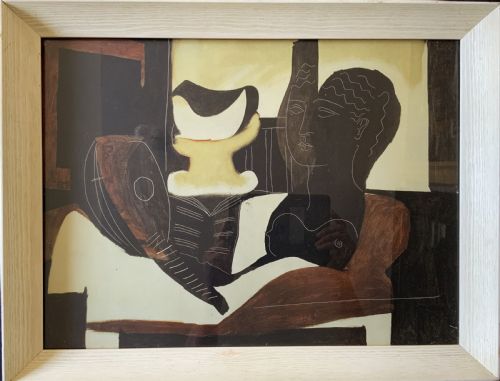
The selections available here lean heavily into mid-century modernism, featuring oil paintings, gouaches, and watercolours dated from the nineteen-twenties through to the nineteen-sixties. Buyers frequently encounter framed landscape studies, still lifes, and figure compositions originating from British, French, and Spanish studios.
Subject matter ranges from abstracted domestic kitchens and Mediterranean landscapes to non-representational geometries and portraits. Each piece reflects the twentieth-century shift away from strict realism toward an expressive handling of line and medium.
Materials and methods of execution
Artists working in this sphere employed traditional supports such as canvas, wood panels, and heavy paper, applying oil paint, gouache, watercolour, or acrylic. The handling of these materials often emphasises visible brushwork, texture, and the physical qualities of the pigment rather than a smooth, blended finish.
Works on paper frequently utilise gouache and watercolour to achieve flat, vibrant planes of colour, characteristic of mid-century French and British modernist illustration. Oil and acrylic works on canvas demonstrate varied application, from thin, translucent washes to thick, impasto surfaces.
Printmaking techniques also appear, including woodcuts in colour, alongside framed original drawings and mixed media compositions. The integration of support and pigment defines the visual weight of each composition.
Abstract Modernist Art Retail Price Guide 2026
Typical asking prices for abstract modernist art among the pieces listed under this phrase on Sellingantiques today, from the lower quarter to the upper quarter. They describe what is for sale here now, not the wider market.
Several canvases capture domestic kitchen geometry and lions named Astra, proving modernists found inspiration in both soup tureens and fantastical beasts.
Distinctions in quality and execution
Quality in abstract modernist art rests upon the confidence of the line and the deliberate control of composition. Superior examples demonstrate a cohesive balance of colour and form, where every element contributes to the structural integrity of the picture plane.
Works by established makers or those with documented exhibition provenance exhibit a higher degree of intentionality in handling their chosen medium. The distinction between a minor decorative piece and a compelling collector's work lies in the vigour of the execution and the clarity of the artist's vision.
Pablo Picasso·Denis Mitchell·Barbara Hepworth·Edward Carter Preston·Derek Latimer Sayer·William McCance·Peter Jackson·Adrian Heath·Antonio Ferri·Rowland Fade
The Abstract Modernist Art Glossary
- Cubism
- An early twentieth-century avant-garde art movement that revolutionised European painting by breaking down subjects into multi-angled geometric shapes. Works in this style fragment traditional perspective in favour of flattened, abstracted planes.
- Gouache
- An opaque water-based paint that dries to a matte finish, frequently used on paper for modernist works requiring flat, saturated areas of colour. It allows artists to build up vivid compositions with sharp linear contrasts.
- Impasto
- The technique of laying paint thickly on a canvas or panel so that it stands out in relief. This method gives the surface a tactile, three-dimensional quality.
- Provenance
- The chronology of the ownership, custody, or location of a historical artwork. Good provenance confirms authenticity and historical context.
- St Ives School
- A group of artists living and working in and around the coastal town of St Ives in Cornwall during the mid-twentieth century. They played a central role in the development of British abstract art.
Abstract Modernist Art: Frequently Asked Questions
How do I date an abstract painting?
Dating relies primarily on signatures, gallery labels, exhibition history, and stylistic markers inherent to specific decades like the nineteen-fifties or nineteen-sixties.
Material analysis of the canvas, stretcher frames, and pigments also assists in placing the work within a particular modernist era.
What is the difference between gouache and oil?
Gouache is an opaque, water-based medium typically applied to paper, offering a matte surface and rapid drying times suited to graphic modernist compositions.
Oil paint uses a drying oil binder, allowing for rich impasto textures, blended transitions, and longevity on canvas or wood panels.
How should I frame mid-century art?
Mid-century works are best housed in simple wooden frames or shadow boxes that complement the aesthetic of the period without overwhelming the artwork.
Using conservation-grade materials ensures the paper or canvas remains protected from environmental degradation over time.
What defines the St Ives School?
The St Ives School refers to a prominent community of artists in Cornwall who embraced abstraction and landscape-inspired modernism from the nineteen-forties onward.
Their output bridges British landscape traditions with international modernist concerns regarding form and material.