






Abstract Expressionist Oil Painting
An abstract expressionist oil painting brings raw gestural energy and mid-century character directly onto the wall.
Abstract Expressionist Oil Painting
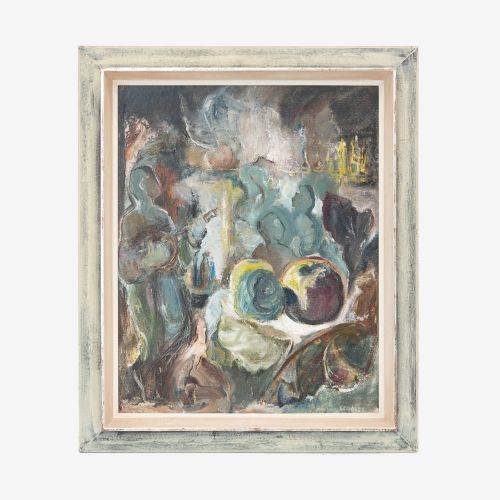
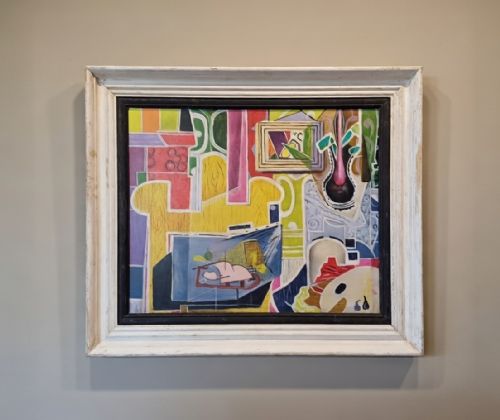
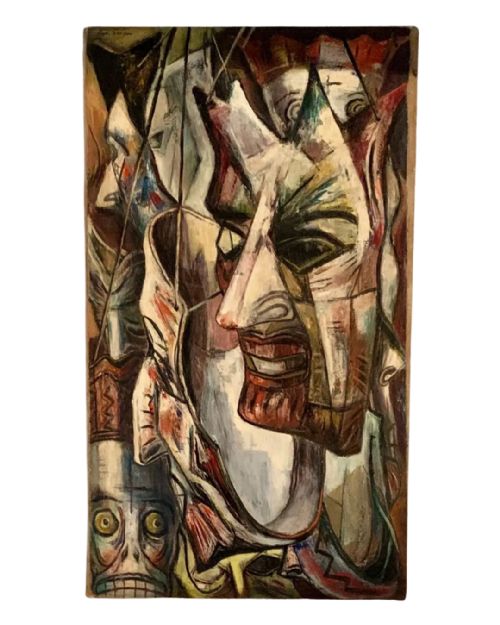
An abstract expressionist oil painting is a mid-century work focusing on gestural brushwork, bold mark-making, and non-representational compositions. Collectors encounter cityscapes, figure studies, and still lifes spanning the decades from the 1930s through the 1960s.
The pieces on this page originate from British, French, and American hands, showing influences from mid-century modernism, cubism, and avant-garde figuration. Most examples employ canvas or board as their primary support.
Works range from intimate still lifes to large relief paintings and colourful canvases. Each piece captures the experimental spirit of twentieth-century painting through distinct application of pigment.
How They Were Made
Makers applied oil paint directly onto wood, canvas, or board, often building up thick impasto textures that sit proud of the surface. Some compositions incorporate relief elements to create a tangible sense of depth.
Artists worked within mid-century modern and expressionist traditions, utilising dynamic brushstrokes and palette knives. Wooden frames frequently complete the construction, housing works signed, dated, or produced within mid-century studios.
Materials used across the selection include wood, canvas, board, and oil paint.
What Varies in Quality
Quality rests in the conviction of the mark-making and the internal balance of the composition. Stronger examples hold the eye through confident handling of colour and medium.
The integration of surface texture, whether flat oil application or heavy impasto, dictates the visual impact of the work. Provenance and attribution to recorded mid-century artists further elevate a piece.
Lilian Colbourn·Tony Giles·William McCance·Peter Jackson·Burr Singer·Richards Rubin·William Ernst Burwell
The Abstract Expressionist Oil Painting Glossary
- Impasto
- Paint laid thickly on a canvas or board, so that the brush or palette knife strokes remain visible. This technique adds tactile relief and physical presence to mid-century works.
- Mid-Century Modern
- A style spanning roughly from the 1930s to the 1960s, characterised by clean forms and abstraction. It embraces progressive approaches to traditional media like oil paint.
- Avant-Garde
- Works that push boundaries and experiment with unconventional perspectives and non-naturalistic colour palettes. These paintings break away from strict academic representation.
- Cubism
- An early twentieth-century artistic approach that breaks subjects down into geometric planes and abstracted shapes. French and English painters utilised this structure to reshape conventional landscapes and figures.
- Relief Painting
- Artwork that projects outward from a flat background, introducing sculptural elements to the surface. Artists employ this method to create physical depth beyond standard two-dimensional oil on canvas.
Abstract Expressionist Oil Painting: Frequently Asked Questions
What periods do these abstract paintings cover?
The works span from the 1930s through the 1960s, capturing decades of experimentation in oil paint.
Mid-century modernism and expressionism dominate the dates recorded across the listed items.
Which materials appear on the canvas support?
Artists used oil paint applied to canvas, board, and wood supports.
Many examples feature heavy impasto textures and auxiliary wooden frames.
How do I identify a mid-century cityscape?
Cityscape pieces employ abstracted geometric lines and heavy brushwork to evoke urban environments.
They sit alongside still lifes and nude studies within the broader abstract tradition.
Are these paintings signed by the artists?
Several pieces carry visible signatures and specific dating from their creators.
Attributions reference documented mid-century painters and regional British or French artists.