





Abstract Canvas Painting
When you choose an abstract canvas painting, you acquire a mid-century modernist work defined by energetic brushwork and expressive composition.
Abstract Canvas Painting
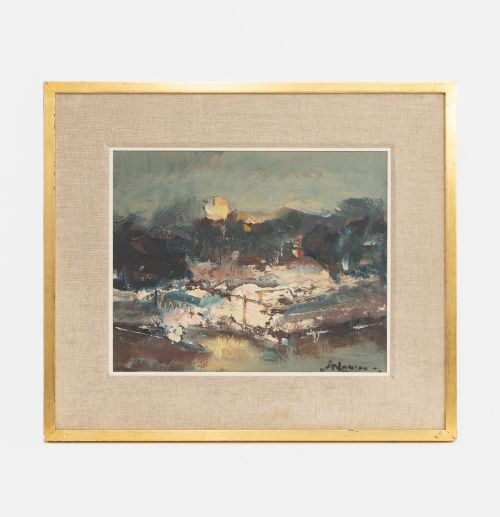
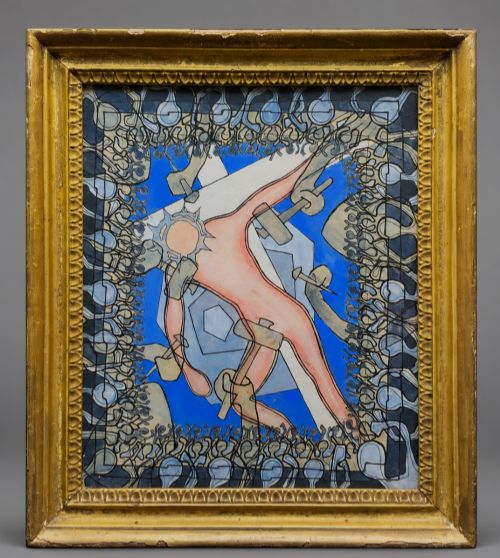
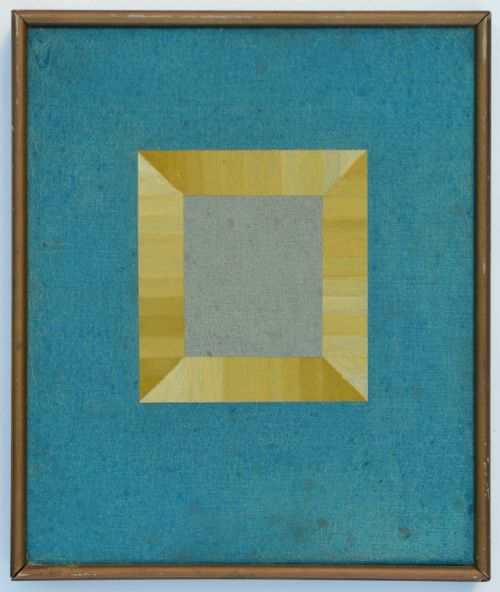
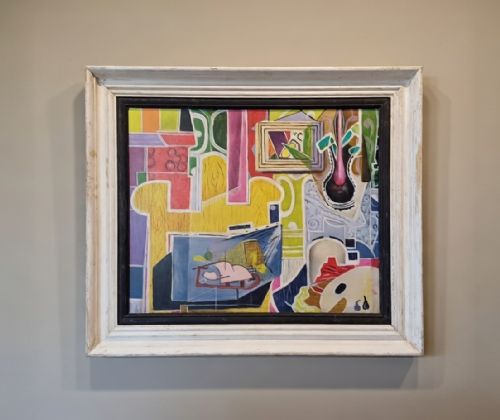
An abstract canvas painting captures the mid-century modern and modernist movements spanning from the 1930s through the 1960s. The selection on this page leans heavily toward mid-century abstract oil paintings, still lifes, cityscapes, and landscapes created across Britain, France, and Spain.
Buyers encounter everything from gestural works associated with the St Ives School to geometric op art and heavy impasto cityscapes. These pieces reflect regional European modernism, utilising canvas or board as the primary support within period wooden frames.
Materials and technique
Artists built these surfaces using oil paint, mixed media, and acrylic applied to canvas or board, often employing thick impasto or smooth brushwork depending on the regional style. Many pieces incorporate supportive wood frames that complete the mid-century presentation.
The technique relies on abstraction, cubist influence, and expressive mark-making rather than strict representation, utilising texture and bold colour relationships to construct depth on a flat support.
Abstract Canvas Painting Retail Price Guide 2026
Typical asking prices for abstract canvas painting among the pieces listed under this phrase on Sellingantiques today, from the lower quarter to the upper quarter. They describe what is for sale here now, not the wider market.
Listings feature works created across several decades, spanning from the 1930s through the 1960s and beyond.
Judging quality and execution
Quality rests in the confidence of the brushwork, the stability of the paint layer on the canvas or board, and the structural integrity of the stretcher and frame. Stronger examples demonstrate a purposeful command of colour and composition rather than random application.
The distinction between standard decorative work and finer execution lies in the depth of the impasto, the nuance of the palette, and the historical context provided by documented artist signatures or school affiliations.
Robert Jacks·Tony Giles·Denis Mitchell·Barbara Hepworth·Raymond Picque·Gino Severini·William Littlejohn·William McCance·Peter Jackson·Antonio Ferri·Rowland Fade·Burr Singer·Leon Kossoff·Sonia Delaunay·Terry Frost·William Ernst Burwell
The Abstract Canvas Painting Glossary
- Impasto
- Paint applied thickly to a canvas or board, standing out in relief from the surface so that the marks of the brush or palette knife remain visible. This technique adds literal physical texture and depth to the composition.
- St Ives School
- A group of artists based in Cornwall, Britain, associated with modern abstract art developments from the 1940s onward. Painters in this circle focused on the landscape and abstract expressionism.
- Cubism
- An early twentieth-century style of art where subjects are broken up, analyzed, and re-assembled in an abstracted form. Instead of depicting objects from one viewpoint, the artist portrays the subject from a multitude of angles.
- Op Art
- A style of visual art that uses optical illusions, employing geometric patterns in contrasting colours. These works create a sensation of movement, hidden images, or swelling on the two-dimensional surface.
Abstract Canvas Painting: Frequently Asked Questions
What defines an abstract canvas painting from this era?
These works are characterised by non-representational or abstracted imagery produced during the mid-twentieth century, focusing on colour, form, and texture.
They utilise oil paint or mixed media on canvas and board, reflecting modernist movements across Britain and continental Europe.
How should I hang an oil painting on canvas?
Ensure the wall supports the weight of the framed canvas and keep the artwork away from direct sunlight and excessive temperature fluctuations.
Most period pieces arrive with wooden frames ready for standard picture hooks.
How do I identify a mid-century abstract work?
Look for stylistic cues such as thick impasto, cubist influences, or flattened perspective typical of the 1930s through the 1960s.
Signatures, framing materials, and stretcher construction often provide additional clues to the period.
Are these paintings executed on materials other than canvas?
Several pieces in this selection utilise wooden boards or mixed media alongside traditional stretched canvas.
Both supports were common among mid-century artists working in abstract and modernist idioms.