
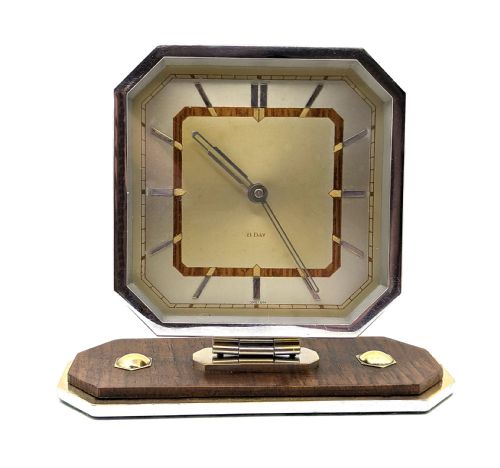


8 Day Movement Clock
An 8 day movement clock offers the mechanical reliability of a week-long power reserve housed within timeless cabinetry and cases.
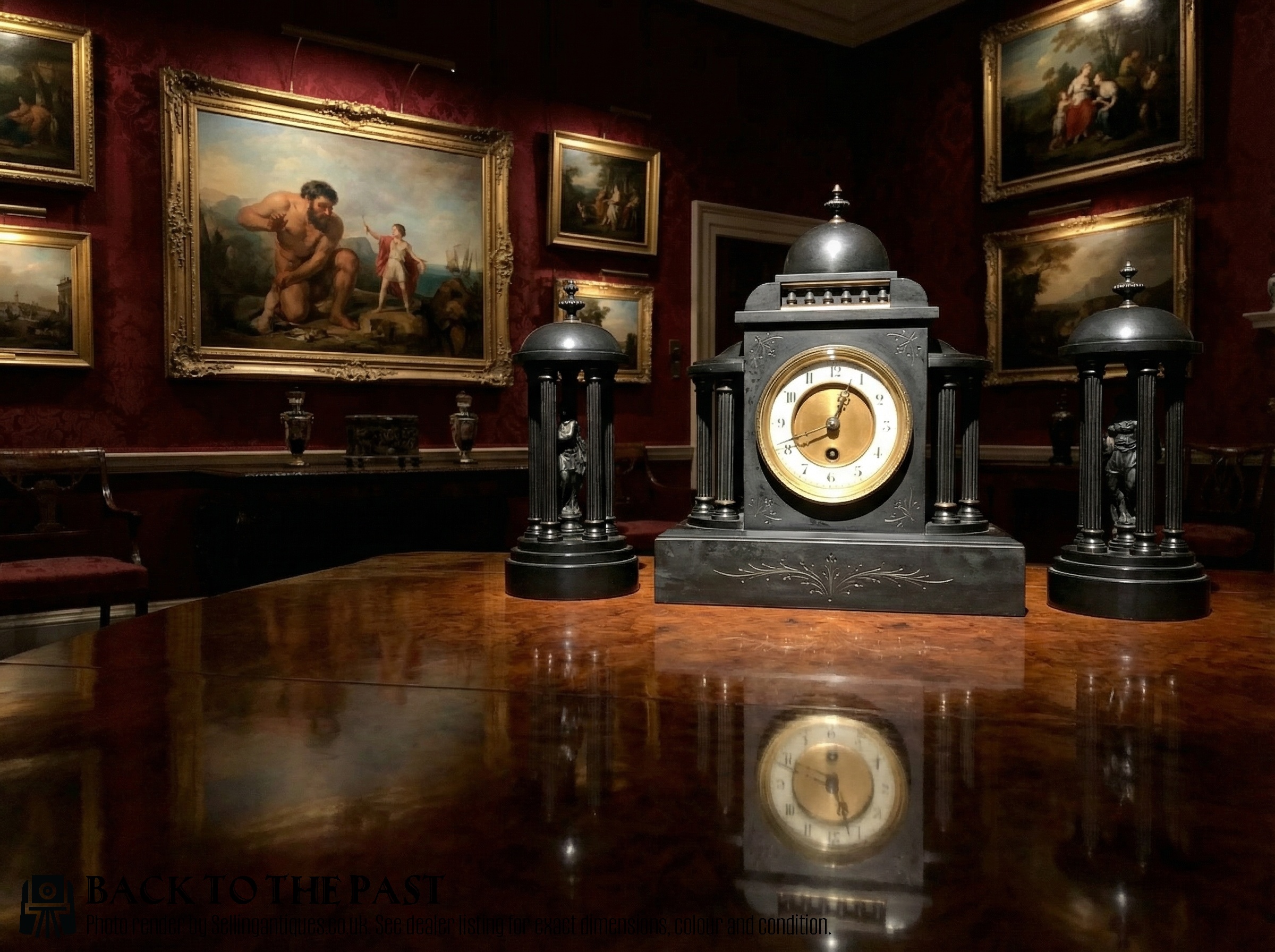
8 Day Movement Clock
An 8 day movement clock refers to a timekeeper designed to run for approximately eight days before requiring manual winding, reducing the frequency of intervention for the owner. These pieces encompass a wide spectrum of formats, spanning tall longcase grandfather clocks, compact mantel timepieces, wall dials, and portable carriage instruments.
The selection ranges from 18th-century oak and mahogany floor-standing longcases with moon phase dials to mid-20th-century Art Deco desk clocks framed in chrome and glass. Buyers frequently encounter traditional wooden tall clocks alongside industrial railway wall issues and ornate French brass carriage designs.
Origins vary from provincial English workshops and London makers to continental European factories and Scottish towns. This variety allows collectors to find examples suited to domestic interiors of differing scales, from grand hallway longcases to modest bedroom or office desk models.
Materials and Construction
Enclosures rely heavily on traditional timbers such as oak, mahogany, walnut, and maple, often combined with cast brass dials, glazed doors, and silvered chapter rings. Later 20th-century iterations incorporate industrial elements like chromium plating, bakelite, peach glass, and black marble.
Clockwork mechanisms utilise metal gear trains driven by weight drops, steel springs, or fusee cones that equalise the pull of the mainspring as it unwinds. Dials feature hand-painted porcelain, engraved brass, or enamelled numerals, whilst movements employ anchor escapements or platform balances for time regulation.
Several carriage clocks are built robustly enough to survive bumpy Victorian horse-drawn carriage rides without losing a minute.
Evaluating Craftsmanship and Preservation
Quality rests upon the precision of the mechanical gear cutting, the smoothness of the fusee or spring power delivery, and the integration of complications such as chiming trains or moon phases. Finer examples exhibit hand-engraved dial signatures, robust pillar construction, and clean plates without excessive wear around the pivot holes.
Cabinetry standards differ between utilitarian workshop issues and bespoke furniture pieces featuring fine wood veneers, astragal glazing, and intricate dial brasswork. The integrity of the original components, dial painting, and case timber largely dictate the character and historical value of the piece.
Edward White Birmingham·Philippes Paris·James Harvey of Abergavenny·Mappin and Webb·Winterhalder W and H·Gustav Becker·Camerer Cuss·Japy Freres·Bernard Freres·Ebenezer Handscomb·Geo Borrett of Stowmarket·John McGregor Wick
The 8 Day Movement Clock Glossary
- Fusee
- A conical pulley connected to the mainspring by a cord or chain that equalises the diminishing power of the spring as it unwinds. This mechanism helps maintain uniform force on the gear train to improve timekeeping accuracy.
- Moon Phase
- A specialised dial mechanism tracking the lunar cycle through painted representations of the moon. It typically rotates once every synodic month.
- Longcase Clock
- A tall floor-standing timekeeper, often termed a grandfather clock, housed in a wooden trunk with a weighted pendulum descending below the dial. The tall case protects the weights and pendulum whilst providing structural stability.
- Carriage Clock
- A small portable spring-driven timepiece fitted with a handle, originally designed for travelling officers and gentry. They frequently feature glass panels that expose the internal escapement.
- Escapement
- The mechanical linkage that restrains the gear train, releasing it at regular intervals to allow the wheels to move forward by a fixed amount. It imparts impulses to the pendulum or balance wheel to sustain its motion.
8 Day Movement Clock: Frequently Asked Questions
How often do I need to wind an 8 day clock?
These movements require winding approximately once every week, typically using a key inserted into the dial face to tension the springs or draw up the weights.
Adhering to a consistent weekly schedule prevents the mechanism from running down completely and maintains steady operational tension.
Where should I place a longcase clock?
Tall longcase clocks require a stable, dry interior wall away from direct sunlight, central heating vents, and heavy vibrations that might disturb the pendulum.
Securing the case upright to the wall using mounting brackets ensures the pendulum swings evenly and the mechanism keeps accurate time.
How do I tell an older dial from a modern replacement?
Early dials often feature hand-engraved brass chapter rings, individual cast spandrels in the corners, and hand-hammered fixing pins rather than modern screws.
Painted iron or aluminium dials with machine printing typically indicate 19th or 20th-century production eras rather than the 1700s.
Can these clocks run on uneven surfaces?
Mantel and desk clocks tolerate minor surface variations, but tall floor clocks must stand on level flooring to ensure the beat of the escapement remains even.
Adjusting the feet or placing shims beneath the base corrects minor floor slants so the tick sounds regular rather than halting.