
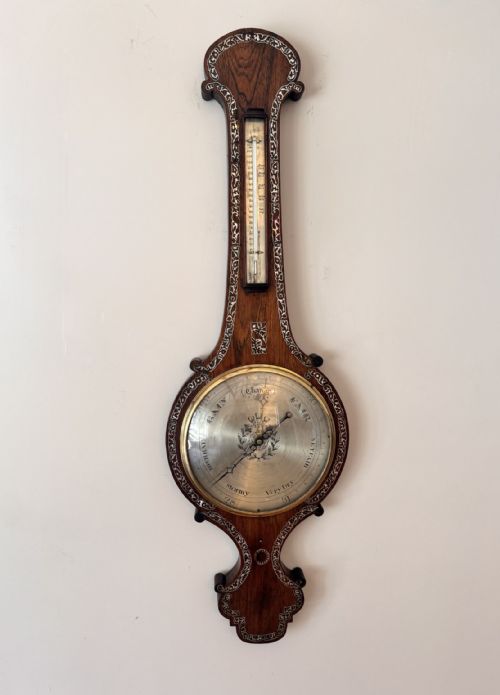


19th Century Wheel Barometer
These 19th century wheel barometer examples combine domestic weather observation with striking hallway furniture.
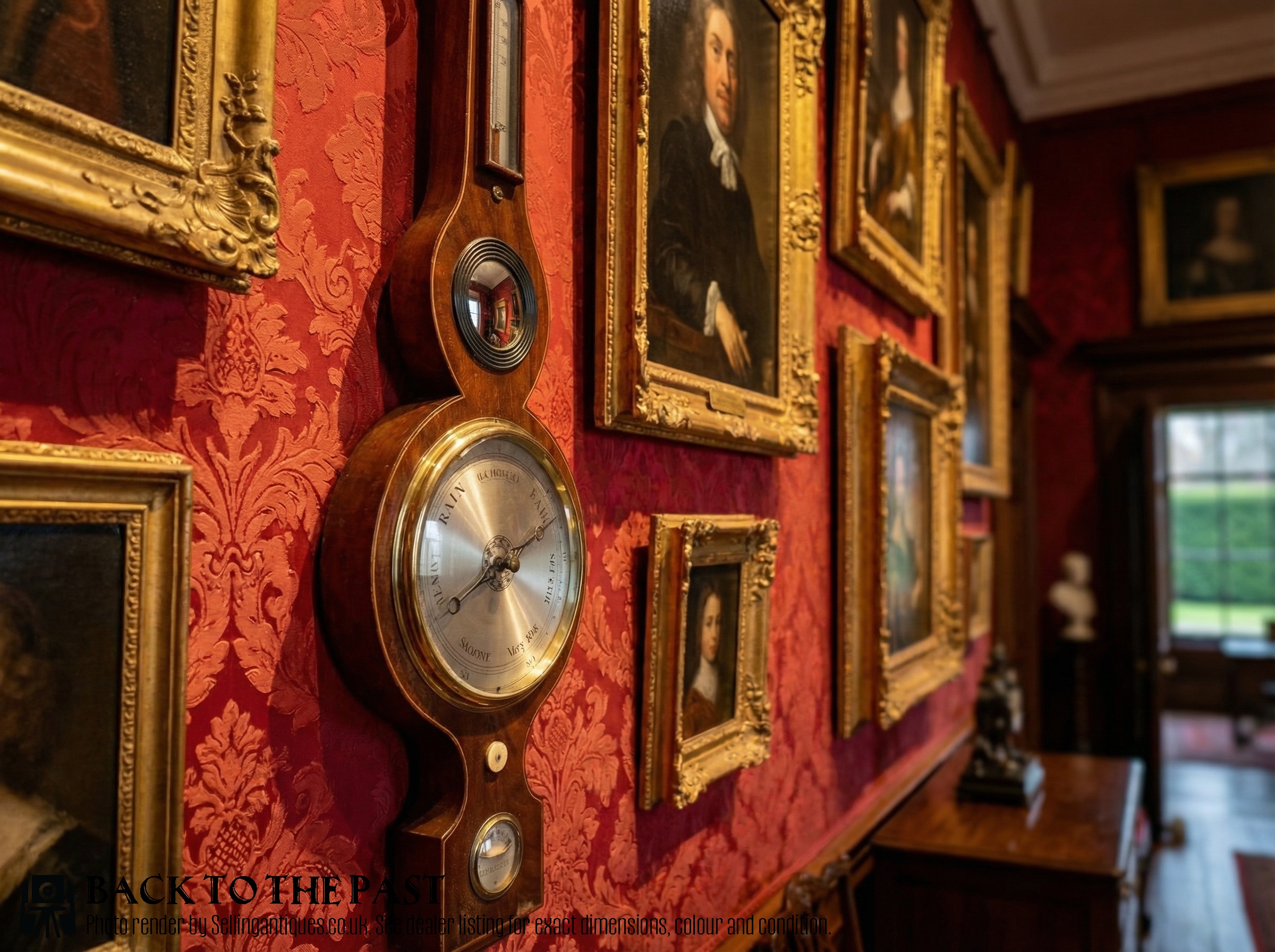
19th Century Wheel Barometer
A 19th century wheel barometer serves as a domestic wall instrument designed to measure atmospheric pressure through a mercury column connected to an indicator hand. When you search for a 19th century wheel barometer, you encounter pieces spanning Georgian, Regency, and Victorian periods.
The dominant form on this page is the banjo shape, characterised by a slender stem expanding into a circular dial at the base and a hygrometer or thermometer at the top. These instruments hung in prominent domestic interiors to guide daily travel and agricultural pursuits.
Makers housed these mechanisms in rich timber cases, often embellished with mother-of-pearl inlay or delicate stringing. Surviving examples reflect both provincial English craftsmanship and metropolitan precision.
How they were made
Cabinetmakers constructed the architectural cases using solid and veneered timbers such as mahogany, rosewood, and burr walnut, frequently applying boxwood stringing and mother-of-pearl inlay for decoration. These woods provided the necessary stability and grain variation to support heavy glass dials and brass bezels.
The barometer mechanism relies on a sealed column of mercury within a siphon tube, where pressure changes cause a float to turn a pulley wheel and move the pointer across a silvered metal dial. Artisans engraved these metal scales with weather descriptions and calibration marks by hand.
Listings feature woods including mahogany, rosewood, burr walnut, and satinwood, paired with silvered metal dials.
What varies in quality
Quality in a 19th century wheel barometer rests primarily on the crispness of the cabinetwork and the complexity of the case veneers. Mahogany and rosewood examples with intricate mother-of-pearl inlay or burr walnut surfaces demonstrate superior workshop investment compared to plain pine-backed alternatives.
The execution of the engraved silvered metal dial and the reputation of the inscribed maker significantly elevate the standing of an instrument. Signed dials from provincial or London makers indicate higher grade mechanical and decorative components.
Ganthony of London·Prada of High Wycombe·Molton of Norwich·Jenkins Of Old Swindon·L Casatelli of Liverpool·James H Kelly of Glasgow·Roncoroni·Bianchi Ipswich·J Groce York·J C Moretti·Russell of Liverpool·L. Malacrida·F. Amadio and Son·J. Gatty·Tara of Louth·Abraham of Bath
The 19th Century Wheel Barometer Glossary
- Banjo barometer
- A household weather glass housed in a case shaped like a banjo, featuring a narrow stem and a bulbous lower section containing the main dial. This form dominated hallway decoration throughout the Victorian and Regency periods.
- Silvered metal
- A brass or copper dial plate treated with a silver solution to create a matte reflective surface for engraved markings. This material tarnishes gracefully over time if exposed to damp air.
- Hygrometer
- A secondary dial mounted at the top of the instrument to measure atmospheric humidity alongside barometric pressure. These indicators typically utilise a human hair or animal membrane to register moisture.
- Stringing
- A narrow inlay of contrasting wood, such as boxwood, set into the borders of mahogany or rosewood cases. This technique defines the linear geometry of the instrument.
19th Century Wheel Barometer: Frequently Asked Questions
How do I read a wheel barometer?
The pointer moves clockwise as atmospheric pressure rises, indicating fair weather, and counter-clockwise as pressure falls, signaling rain or storm.
Most dials include a secondary manual indicator needle that you set over the main hand to track daily pressure changes.
Can these barometers still measure the weather?
Many surviving examples retain their original mercury tubes and remain functional if the internal siphon is unbroken and free of air locks.
Calibration by a specialist ensures the mercury responds accurately to current barometric fluctuations in your home.
How do I distinguish Georgian from Victorian models?
Georgian and Regency examples tend to feature restrained mahogany or satinwood cases with simple geometric stringing and understated dampness dials.
Victorian pieces frequently display heavier rosewood or burr walnut construction, bolder carvings, and extensive mother-of-pearl inlay.