


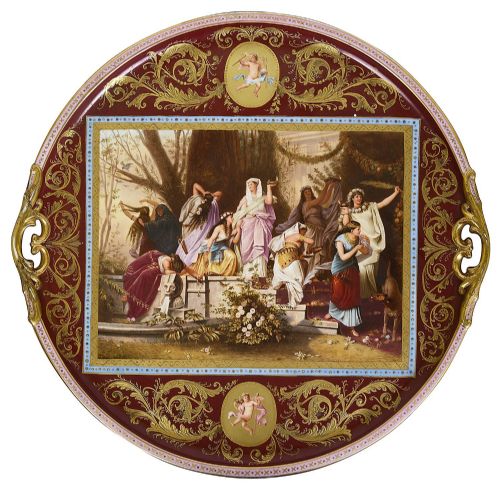


19th Century Vienna Charger
These 19th century vienna charger pieces bring grand mythological and classical scenes into the home on hand-painted porcelain.
19th Century Vienna Charger
A 19th century vienna charger is a large decorative plate or tray made of porcelain, often measuring around forty centimetres in diameter. The form functions primarily for display rather than dining, designed to be shown on a cabinet or wall.
The objects appearing on this page span the nineteenth century and into the early twentieth century, including pieces dated around eighteen fifty, eighteen ninety, and nineteen twenty. Neoclassical styles and nineteenth century historicism dominate the visual language of these large plates.
Subjects painted on these chargers draw heavily from classical mythology, biblical narratives, and historical legends. Common themes include mythological figures such as Venus, Bacchus, and Adonis alongside dramatic scenes like King Tristan's death and the wise and foolish virgins.
How they were made
Makers shaped these items from fine porcelain, utilising traditional ceramic techniques to create broad, smooth surfaces suited for detailed figurative painting. The resulting cabinet plates and decorative trays provide a stable white ground for complex polychrome compositions.
Artisans applied rich gold leaf and gilding to frame the central painted reserves, adding heavy decorative borders that catch the light. Enamel colours were layered within the scenes, fixed by firing to achieve lasting depth and brilliance across the figurative subjects.
Listings on this page exclusively feature items made from porcelain, incorporating enamel, gold leaf, and traditional gilding techniques.
What varies in quality
The standard of painting forms the primary distinction between ordinary production and exceptional examples, particularly in the rendering of facial expressions and anatomical detail within complex narrative scenes. Signed works by notable painters like Wagner indicate a higher level of artistic ambition and execution.
The application and tooling of the gilding also separate tiers of quality, with superior pieces featuring elaborate, burnished gold leaf borders rather than flat or rubbed metallic paint. Overall scale and the preservation of the porcelain surface determine the presence of a truly impressive cabinet charger.
Wagner
The 19th Century Vienna Charger Glossary
- Charger
- A large decorative plate, typically exceeding standard dinner service dimensions, utilised for display on tables or walls rather than for serving food.
- Cabinet Plate
- A smaller porcelain plate intended for display in a cabinet or on a stand rather than practical dining use.
- Gilding
- The application of gold leaf or gold powder to the surface of porcelain to create decorative borders and highlights.
- Neoclassical
- A style drawing inspiration from the classical art and culture of ancient Greece and Rome, prevalent across nineteenth century porcelain decoration.
- Enamel
- A glass-like substance fused to the porcelain surface through firing to provide permanent coloured decoration.
19th Century Vienna Charger: Frequently Asked Questions
What is a 19th century vienna charger?
A 19th century vienna charger is a large porcelain decorative plate or tray painted with detailed classical, mythological, or historical scenes. These items were produced primarily for display in cabinets or on walls rather than for everyday use.
Such pieces showcase elaborate enamel work and gold leaf borders, reflecting nineteenth century historicism and neoclassical tastes.
How were these chargers used?
These chargers served purely as decorative objects in formal nineteenth century interiors, displayed on specialised stands, walls, or inside glass cabinets. Their large proportions and narrative paintings made them centerpieces for visual appreciation.
They were not intended for dining or holding food, functioning instead as portable canvases for skilled ceramic artists.
How do you date a 19th century vienna charger?
Dating relies on stylistic clues, marked dates, and signatures found on the porcelain, ranging from mid nineteenth century examples to those from eighteen ninety and nineteen twenty. Neoclassical revival motifs and historicism styles help place pieces within the broader nineteenth century period.
Individual artist signatures, such as Wagner, offer further reference points for establishing the time of manufacture.
What subjects appear on these pieces?
The painted scenes draw heavily from classical mythology, featuring figures like Venus, Bacchus, and Adonis in elaborate narrative compositions. Biblical stories and legendary events, such as the wise and foolish virgins or King Tristan's death, also appear frequently.
These detailed figurative works turn standard porcelain plates into pictorial records of nineteenth century taste.