





19th Century Surveying Instrument
A 19th century surveying instrument brings precision brasswork and optical glass to a desk or study.
19th Century Surveying Instrument
When buyers search for a 19th century surveying instrument, they encounter precision mechanical devices used by engineers, architects, and cartographers to measure angles, levels, and distances. These tools span scientific instrument categories, including drafting and nautical equipment alongside dedicated field gear.
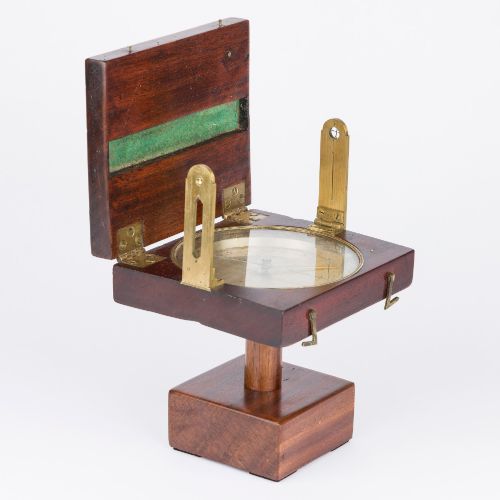
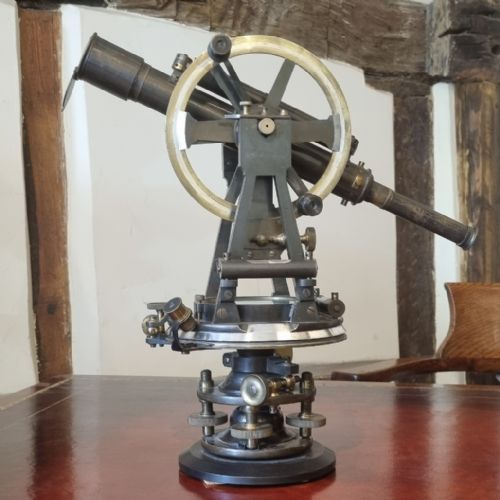
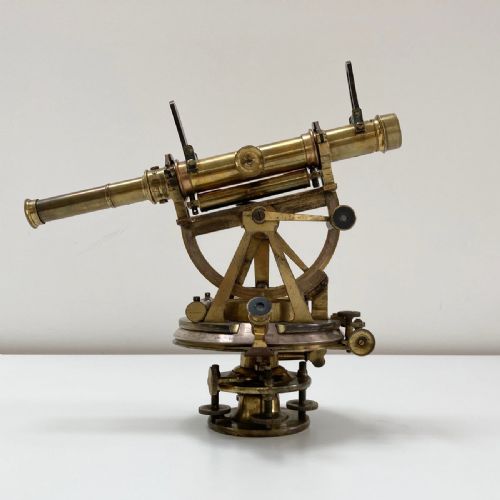
The pieces appearing on this page predominantly date from the Victorian and Georgian eras, showcasing the robust manufacturing standards of nineteenth-century workshops. Collectors will regularly meet brass theodolites, compasses, and drainage levels housed in fitted mahogany cases.
Makers from London, Leeds, and Edinburgh dominate the selection, often signing their brass circles and silvered metal dials with remarkable clarity. Whether an architect's level or a radial theodolite, each item reflects the rigorous technical demands of the period.
Materials and construction
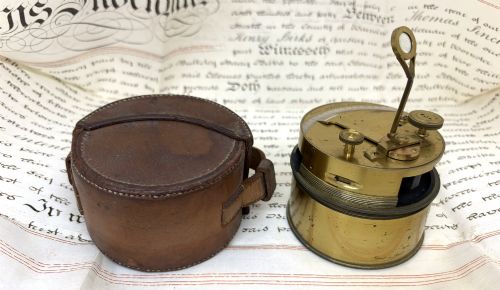
Makers built these instruments primarily from heavy cast and turned brass, paired with delicate glass lenses and silvered metal scales for precise reading. Cases utilised durable timbers such as mahogany to protect the internal optics and adjustments from damage during transport in the field.
Smaller pocket or folding variants incorporated boxwood and steel components, while specialised artificial horizon sets utilised black glass. Every joint and screw was hand-fitted, ensuring the smooth rotation required for accurate angular measurement.
Materials recorded across these surveying instruments include brass, glass, mahogany, silvered metal, leather, boxwood, bronze, and steel.
Assessing quality
The distinction between ordinary and exceptional examples rests in the crispness of the engraved divisions on the silvered metal dials and the complexity of the internal optics. Superior instruments bear the signature of renowned makers, whose workshops employed advanced division engines to achieve microscopic accuracy.
The survival of the original fitted wooden case and accompanying lenses or plumb lines elevates an object's historical integrity. Quality is further demonstrated by the fluid movement of the vernier plates and the complete retention of the original lacquer on the brass surfaces.
G. Davis of Leeds·Baker, London·W&S Jones·L Casella & Co·Elliott Bros. of London·Thomas Dunn·John Lilley & Son London·Cox of Devonport·WF Stanley
The 19th Century Surveying Instrument Glossary
- Vernier
- A secondary sliding scale that allows a user to read fractional parts of the main graduated scale on a dial. This mechanism significantly increases the precision of angular measurements.
- Altazimuth
- An instrument mounting that allows rotation about both a vertical axis and a horizontal axis. This design enables the measurement of altitude and azimuth coordinates.
- Clinometer
- A tool used for measuring angles of slope, elevation, or depression of an object with respect to gravity. Surveyors and architects rely on it for grading and topographical work.
- Artificial horizon
- A device used with a sextant or compass when the natural sea horizon is obscured. It generally employs a reflective surface, such as black glass, paired with a spirit level to establish a horizontal reference plane.
19th Century Surveying Instrument: Frequently Asked Questions
Can these instruments still be used?
While these devices remain mechanically sound, modern surveying relies on electronic and digital technology. These instruments are best appreciated as historical artefacts.
Using them in the field today is impractical due to the wear on antique optics and the absence of modern calibration standards.
Why are some instruments signed?
Prominent nineteenth-century scientific instrument makers signed their work on the silvered dials, compass faces, or outer brass plates to establish their professional reputation. Signature engraving also served as a mark of warranty for the precision of the divisions.
Unsigned pieces were often produced by smaller workshops or retailed through agents without stamping the primary manufacturer's name.
How should I display a theodolite?
Display these heavy brass objects on a sturdy desk, table, or within a glass-fronted cabinet where they are secure from accidental knocks. Positioning them away from direct sunlight protects fitted mahogany cases and delicate leather components from fading.
Allowing adequate space around the instrument highlights its complex mechanical assembly and engraved details.