



19th Century Rosewood Canterbury
A 19th century rosewood canterbury is a partition-framed stand for sheets of music, newspapers and folios, prized for its rich timber and elegant division of space.
19th Century Rosewood Canterbury
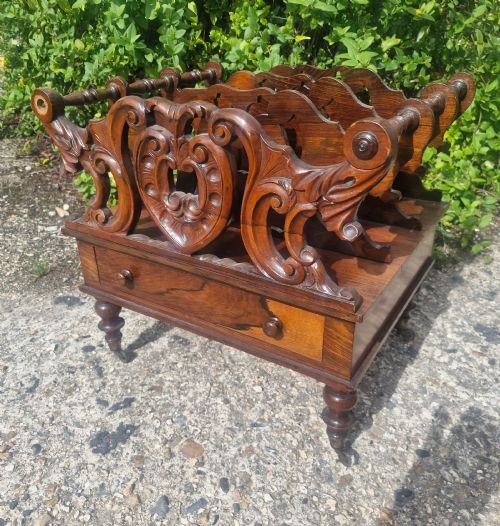
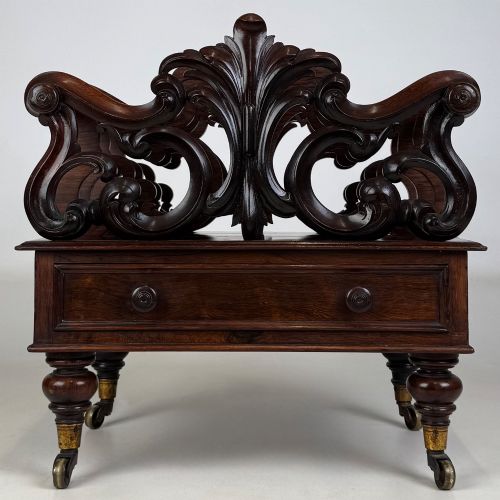
When you examine a 19th century rosewood canterbury, you see a low, compartmented stand designed to hold folios, sheet music, newspapers or periodicals. These pieces typically sit on small castors, allowing them to move easily across a parlour floor.
The versions you meet most often on this page belong to the Regency, William IV and Victorian periods, reflecting stylistic shifts from architectural clarity to rich, carved ornamentation.
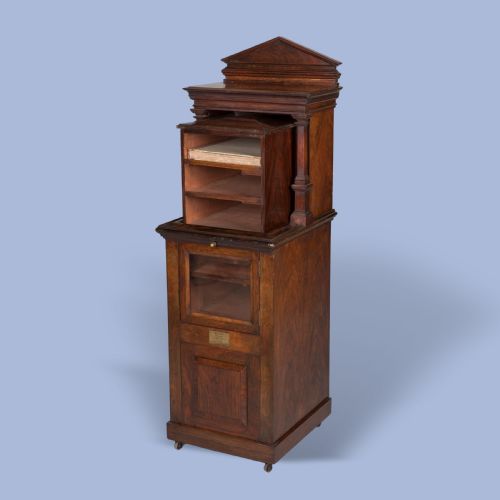
Many examples combine the slatted divisions for papers with a low drawer underneath, whilst others incorporate shelves to form a combined whatnot or music cabinet.
Materials and construction
Cabinet makers utilised dense, richly figured rosewood veneers laid over solid secondary timbers, often accentuating the deep reddish-brown grain with contrasting brass inlays or castors.
Structural elements include slender turned uprights, finely pierced slats for the divisions, and delicate joinery that supports the weight of paper without straining the frame.
Listings feature pieces spanning the Regency, William IV, Victorian and Edwardian eras, constructed primarily from rosewood, mahogany and goncalo alves.
Judging quality in rosewood canterburys
The distinction between ordinary and superior pieces rests on the crispness of the turning, the depth of the timber figuring, and the integration of secondary woods like mahogany.
Finely articulated carving, such as foliate motifs or Prince of Wales feathers, indicates a workshop operating at a high level of design, whereas simpler examples rely solely on plain uprights and minimal mouldings.
The 19th Century Rosewood Canterbury Glossary
- Canterbury
- A low stand with upright partitions designed for holding sheet music, newspapers or folios. The name derives from the Archbishop of Canterbury, who supposedly commissioned the first such piece.
- Whatnot
- A multi-tiered open shelving unit used for displaying ornaments or books. When combined with a canterbury, it forms a versatile piece of multi-function furniture.
- Goncalo Alves
- A dense, heavily figured exotic hardwood often utilised in high-end cabinet making during the period. It shows distinct dark brown and yellowish-brown markings.
- Castor
- A small swivelling wheel attached to the base of furniture legs. They permit the heavy timber stand to be repositioned easily across a carpet.
- Marquetry
- The art of applying decorative veneer pieces to a structure to form geometric or floral patterns. It appears on the panels of finer music cabinets.
19th Century Rosewood Canterbury: Frequently Asked Questions
What was a canterbury used for?
These stands held loose sheets of music, newspapers, magazines and writing folios in domestic parlours and drawing rooms.
They kept reading and musical materials tidy and close to hand near a piano or seating area.
How do I date a rosewood canterbury?
Dating relies on stylistic markers such as Regency architectural restraint, William IV robust scrolling, or Victorian carved ornament.
Secondary indicators include the presence of turned spindle work, drawer construction, and the specific cut of the rosewood veneers.
Are all canterburys made of solid rosewood?
Most examples utilise rosewood veneers applied over stable secondary timbers like mahogany or pine rather than solid rosewood blocks.
This technique prevented the heavy timber from warping while displaying the striking grain on outer surfaces.
Can I use a canterbury as a magazine rack?
The partitioned structure suits modern periodicals, broadsheet newspapers and large art books just as well as nineteenth-century sheet music.
Their sturdy timber construction and compartmented design handle contemporary reading materials without difficulty.