




19th Century Love Seat
A 19th century love seat brings intimacy to a drawing room, offering two people a shared perch designed for close conversation.
19th Century Love Seat
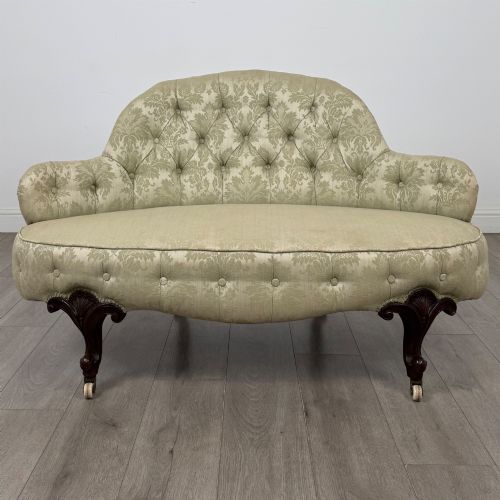
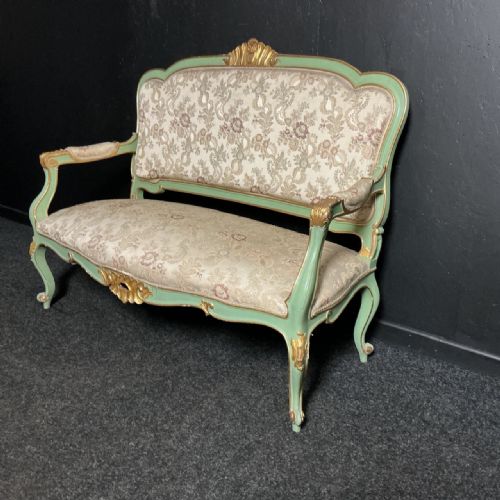
A 19th century love seat typically takes the form of a compact settee, a two-seater sofa, or a circular conversation seat designed for close dialogue. These seating pieces emerge across various nineteenth-century revivals and movements, including Victorian Rococo Revival, Louis XV Revival, and the Aesthetic Movement. Buyers will encounter both serpentine frames intended for parlour placement and buttoned designs built for comfort.
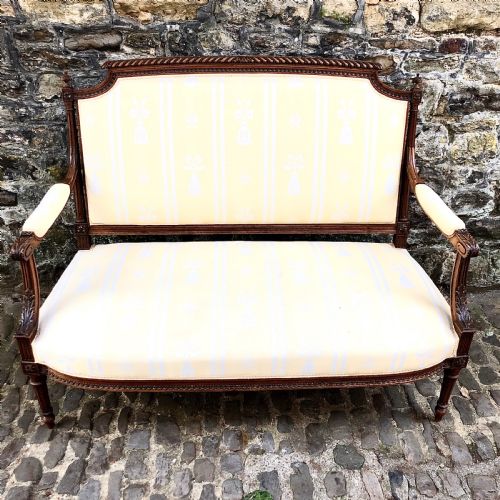
The evidence shows these seats spanning several decades, from early Victorian rosewood examples to later Irish and Swedish interpretations. Forms range from traditional settees to cloverleaf conversation seats where sitters face outward in multiple directions. Origin styles draw heavily on French Louis XVI influences, painted finishes, and British revival cabinet-making.
Materials and construction
Frames rely on dense timbers such as mahogany, rosewood, walnut, and fruitwood, often carved with show-wood details or gilded with gold leaf. Cabinet-makers shaped these hardwoods to support complex frames like the barley twist or the sweeping curves of revival styles. Painted finishes and caning appear on French and Swedish interpretations alongside structural brass elements.
Upholstery forms a vital part of the construction, utilising fabrics such as velvet, damask, and deep-buttoned textiles over internal padding. Master upholsterers secured the springs and stuffing to provide the deep comfort associated with Victorian and Second Empire seating. The integration of show-wood carvings with these soft textiles defines the primary construction method.
Some nineteenth-century conversation seats let two people whisper sweet nothings while facing entirely opposite directions.
Evaluating craftsmanship and condition
Quality rests in the crispness of the timber carving and the architectural integrity of the frame. Finer examples display deeply carved show-wood in mahogany or rosewood rather than simpler turned members, alongside balanced proportions that maintain elegance in a small footprint. Original paintwork and untouched gilding elevate a piece above later decorative interventions.
The execution of the upholstery and the retention of original textiles or period-appropriate replacement fabrics dictate the upper tier of the range. Superior pieces combine robust joinery with sophisticated stylistic details, such as the specific floral motifs of the Aesthetic Movement or the refined lines of French Directoire work.
Butlers of Dublin
The 19th Century Love Seat Glossary
- Conversation seat
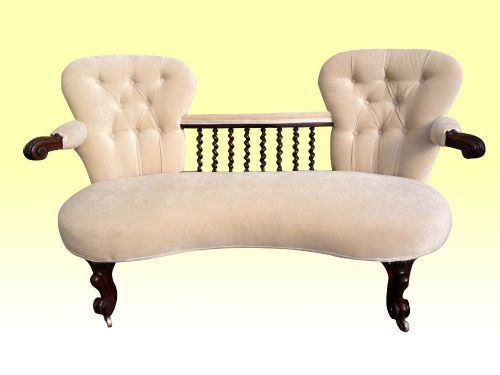
- A multi-seated piece designed so that two or more people can sit facing different directions while maintaining proximity for dialogue. These often feature an upholstered central backrest.
- Settee
- A long upholstered seat with a back and arms, designed to accommodate multiple people. In nineteenth-century contexts, this term frequently overlaps with smaller two-seater sofas.
- Show-wood
- Exposed wooden framing on an upholstered piece of furniture, carved or polished to display the grain and craftsmanship. This contrasts with fully upholstered frames where no wood is visible.
- Barley twist
- A turning technique resembling a twisted rope, commonly used on the legs and structural supports of nineteenth-century seating. It adds texture and visual movement to the timber frame.
- Giltwood
- Timber that has been coated with a thin layer of gold leaf or gold paint. This finish appears frequently on French and Swedish revival pieces to create an opulent surface.
19th Century Love Seat: Frequently Asked Questions
What is a 19th century love seat?
A 19th century love seat is a compact two-seater sofa, settee, or conversation seat built during the nineteenth century. These pieces were designed to accommodate two sitters in close proximity for conversation.
They appear in various styles from the period, including Victorian revival forms, French painted designs, and Aesthetic Movement pieces. The category encompasses both standard linear settees and circular cloverleaf arrangements.
How were conversation seats used?
Conversation seats were utilised in nineteenth-century drawing rooms and parlours to facilitate polite social intercourse. Their unique configurations allowed sitters to converse face-to-face without the awkwardness of turning chairs.
These seats occupied central positions in rooms rather than being pushed against walls, functioning as both functional furniture and social focal points.
How do I identify a Victorian love seat?
Victorian love seats are identified by their characteristic timber frames, deep buttoning, and revivalist stylistic details. Common indicators include exposed mahogany or rosewood show-wood and sprung upholstery.
They often incorporate specific Victorian design elements like barley twist turnings or elaborate floral carvings. The proportions remain intimate, reflecting the domestic scale of nineteenth-century reception rooms.
What materials are used in these seats?
These seats are constructed using a hardwood frame, traditionally mahogany, rosewood, walnut, or fruitwood. Some examples feature gilded surfaces or painted finishes over pine or secondary woods.
Upholstery materials include velvet, damask, and standard woven fabrics, frequently finished with deep buttoning. Brass components and caning also appear depending on the regional style and maker.
Where should I place a love seat?
A love seat suits placement in living rooms, bedrooms, or large hallways where its compact scale can be appreciated. Circular conversation seats work well in open spaces where people can walk around them.
Linear settees fit effectively against feature walls or at the foot of a bed, complementing existing nineteenth-century or eclectic interior schemes.