




19th Century Louis XVI Chest
A 19th century louis xvi chest brings neoclassical restraint and refined marquetry to a room, offering both practical storage and elegant proportions.
19th Century Louis XVI Chest
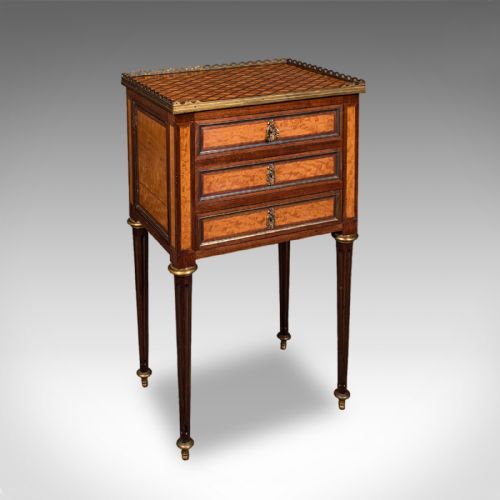
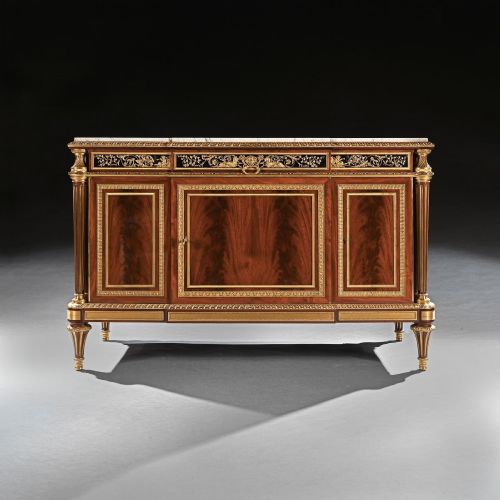
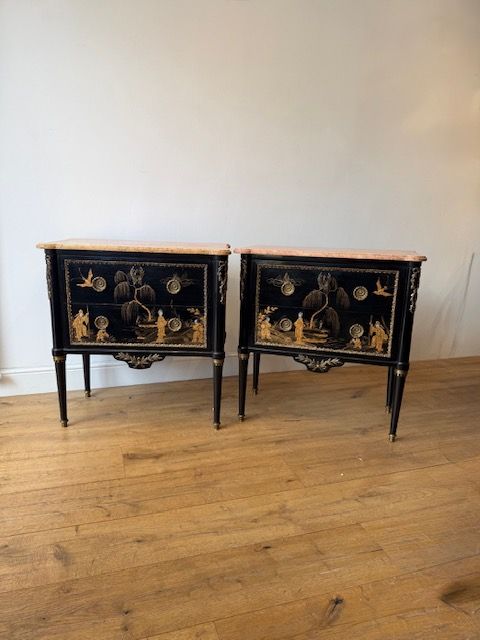
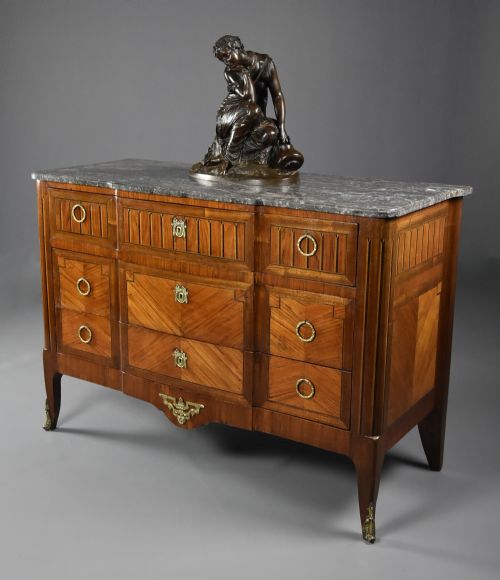
A 19th century louis xvi chest encompasses formal commodes, bedside tables, and secretaire desks created during the revival of the neoclassical French style. These pieces emerge in mahogany, walnut, and exotic veneers, often finished with distinctive marble surfaces.
The version most commonly met on this page is the four-drawer commode or bedside chest, drawing on revival aesthetics from the eighteen-eighties and eighteen-nineties. Alongside standard drawer configurations, variations include marble-topped wine coolers and compact cabinets.
Originating predominantly from French workshops, these items adapt eighteenth-century design vocabulary for nineteenth-century interiors. Makers adopt transitional forms and parquetry patterns that reflect classical symmetry and rectilinear discipline.
Materials and Construction
Construction relies upon solid carcases of mahogany, walnut, or oak, layered with decorative veneers of tulipwood, kingwood, rosewood, and satinwood. Marquetry and parquetry designs are painstakingly arranged across drawer fronts and sides to create geometric or pictorial compositions.
Ormolu and gilt metal mounts provide structural accents around corners, keyholes, and feet, echoing neoclassical hardware. Heavy grey or white marble slabs are fitted to the top surfaces, completing the assembly with functional stone.
The site archive records pieces spanning the nineteenth century up to the nineteen-twenties.
Distinctions in Quality
Quality separates along the precision of the veneer work and the crispness of the cast ormolu mounts. Finer examples display seamless timber matching and securely fitted marble tops that integrate cleanly with the wooden frame.
Workshop attribution and the complexity of the marquetry elevate specific commodes above standard production pieces. The depth of the carving and the weight of the bronze or brass hardware signal the degree of skilled labour invested in the manufacture.
Maison Krieger·Henry Dasson·Weisweiler·Riesener
The 19th Century Louis XVI Chest Glossary
- Commode
- A low chest of drawers, typically featuring multiple tiers and decorative mounts. This form serves as a central storage unit in formal bedrooms and reception spaces.
- Ormolu
- Gilt bronze applied to furniture as decorative mounts and feet. The technique involves finishing metal with gold amalgam to yield a bright metallic sheen.
- Marquetry
- The art of applying thin slices of wood veneer to a structural carcase to form decorative patterns. Craftsmen use contrasting timbers to create complex visual motifs.
- Parquetry
- Geometric patterns formed by small pieces of wood veneer fitted together. This technique appears frequently on drawer fronts and tabletops.
- Transitional design
- A stylistic phase bridging the curved lines of rococo and the straight lines of neoclassical design. Pieces display a restrained silhouette leaning towards strict symmetry.
19th Century Louis XVI Chest: Frequently Asked Questions
How do I spot a true revival piece?
Look for nineteenth-century construction methods, timber choices, and hardware styling that align with revival periods rather than original eighteenth-century production. Secondary woods and modern joinery indicators often clarify the manufacturing era.
Examine the backboards and interior drawer construction for machine-cut marks or hand-planed surfaces that verify the nineteenth-century date of origin.
Where should I place a marble top commode?
These chests function effectively in hallways, bedrooms, or living spaces where the surface resists daily wear and moisture. The stone top provides a durable area for lamps and decorative objects.
Ensure the floor is level to prevent stress on the stone slab and the underlying wooden carcase over time.
What is the difference between a commode and a nightstand?
A commode typically refers to a larger chest of drawers with multiple tiers designed for primary rooms. A nightstand or bedside chest is scaled down in width and depth to sit adjacent to a bed.
Both pieces often share similar veneer types, marble tops, and neoclassical ormolu mounts despite their distinct proportions.
How do I care for antique veneer and ormolu?
Dust surfaces regularly with a dry cloth and avoid commercial polishes containing silicone or harsh solvents. Maintain consistent indoor humidity levels to protect delicate wood veneers from splitting.
Clean ormolu mounts gently with a soft brush, taking care not to abrade the underlying gilt surface against the timber.